
Many English learners feel confused when they see phrases like “we got,” “we’ve got,” and “we have.”
At first, they look very similar. Sometimes, they even seem to mean the same thing. But in real English, especially in daily conversations, these phrases are used in slightly different ways.
The confusion usually happens because English speakers often shorten words when they speak. For example, “we have” becomes “we’ve.”
Also, “got” can act like a helping word or a main verb depending on the sentence. This makes things tricky for beginners.
Understanding these differences is very important. These phrases are used every day in spoken English, movies, social media, and even in casual writing.
If you use them correctly, your English will sound more natural and fluent.
By the end of this guide, you will clearly understand:
- What each phrase means
- When to use each one
- The grammar behind them
- Common mistakes to avoid
- Easy tricks to remember
Everything is explained in very simple English, just like a teacher would explain in a classroom.
What Does “We Got” Mean?
Simple Definition
“We got” is the past form of “we get.” It means something happened in the past.
👉 It can mean:
- We received something
- We obtained something
- We experienced something
When to Use It
Use “we got” when you are talking about something that already happened.
Grammar Rule
“We got” = Subject (we) + past verb (got)
It is past tense, so it always talks about a completed action.
Examples
- We got a new car last week.
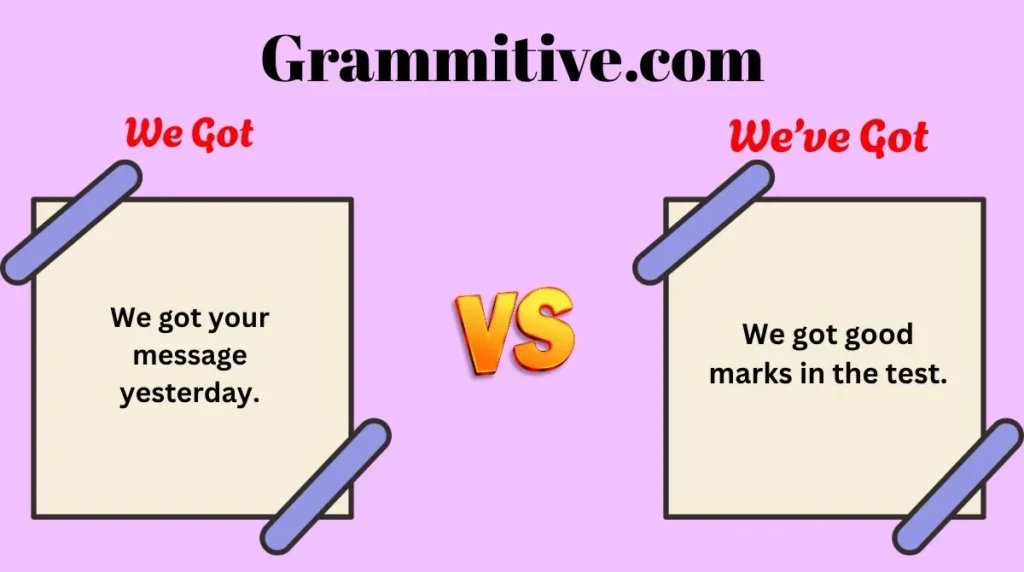
- We got your message yesterday.
- We got home very late.
- We got good marks in the test.
- We got stuck in traffic.
- We got help from our teacher.
- We got a chance to meet him.
- We got lost in the city.
Common Learner Confusion
Many learners think “we got” means “we have.”
❌ This is not always true.
Example:
- “We got a car” = We received a car (past)
- “We have a car” = We own a car now (present)
So, “we got” is about the past, not the present.
What Does “We’ve Got” Mean?
Simple Definition
“We’ve got” is a short form of “we have got.”
👉 It usually means:
- We have something
- We own something
- We need to do something
When to Use It
“We’ve got” is used in spoken English and informal writing. It is very common in daily conversation.
Grammar Rule
“We’ve got” = We have got
- “We’ve” = We have
- “got” adds emphasis or feeling
It is used in the present tense, not past.
Examples
- We’ve got a new car.
- We’ve got two brothers.
- We’ve got a problem.
- We’ve got to leave now.
- We got your message yesterday.
- We’ve got a meeting today.
- We’ve got enough time.
- We’ve got many friends here.
Important Note
“We’ve got” often means the same as “we have.”
Example:
- We’ve got a car = We have a car
Common Learner Confusion
Learners often think:
❌ “We’ve got” is past tense because of “got”
But actually:
✔ It is present tense
That’s because the main verb is “have,” not “got.”
Difference Between “We Got” and “We’ve Got” (Detailed)
Comparison Table
| Feature | We Got | We’ve Got |
|---|---|---|
| Tense | Past | Present |
| Meaning | Received / happened | Have / own |
| Structure | We + got | We have + got |
| Usage | Past events | Current situation |
| Formality | Neutral | Informal |
Usage Difference
- We got → something already happened
- We’ve got → something is true now
Example:
- We got tickets yesterday. (past)
- We’ve got tickets now. (present)
Grammar Logic
“We got” uses past simple tense.
“We’ve got” uses present perfect form (have got).
Sentence Structure Difference
- We got + object
- We’ve got + object
Example:
- We got a gift.
- We’ve got a gift.
Same object, different meaning.
Meaning Comparison
- “We got a house” → We received or bought a house before
- “We’ve got a house” → We own a house now
This small difference changes the whole meaning.
Grammar Rules You Must Remember
Rule #1: “We got” is always past
✔ We got a letter yesterday.
❌ We got a letter now.
Use it only for completed actions.
Rule #2: “We’ve got” means “we have”
✔ We’ve got a car.
✔ We have a car.
Both are correct, but “we’ve got” is more casual.
Rule #3: Use “We’ve got to” for obligation
✔ We’ve got to go now.
✔ We have to go now.
It means something is necessary.
Rule #4: Do not mix tenses
❌ We got a car now.
✔ We’ve got a car now.
Always match the time with the correct form.
Common Mistakes Students Make
Why Mistakes Happen
- “Got” looks like past tense
- Spoken English uses contractions
- “Have got” is not common in some languages
Mistake 1
❌ We got a car (meaning present)
✔ We’ve got a car
👉 Fix: Use “we’ve got” for present ownership
Mistake 2
❌ We’ve got a car yesterday
✔ We got a car yesterday
👉 Fix: Use “we got” with past time words
Mistake 3
❌ We’ve got went there
✔ We went there
👉 Fix: Don’t mix verb forms
Easy Correction Tips
- Look for time words (yesterday, now, today)
- If it’s past → use “we got”
- If it’s present → use “we’ve got”
Easy Trick to Remember the Difference
Here’s a simple trick:
👉 “Got = Past” (when alone)
👉 “Have got = Present”
Think like this:
- If you see only “got” → past
- If you see “have + got” → present
Real-Life Logic
Imagine:
- Yesterday → “We got food”
- Today → “We’ve got food”
This makes it very easy to remember.
Daily Life Examples (Very Important)
These are natural spoken English sentences:
- We got your call last night.
- We’ve got your number saved.
- We got home late yesterday.
- We’ve got dinner ready.
- We got tickets for the movie.
- We’ve got tickets for tonight.
- We got help from a friend.
- We’ve got everything we need.
- We got a chance to travel.
- We’ve got a big plan today.
These examples show how both forms are used in real conversations.
Practice Section
Choose the correct option:
- We ___ a new phone yesterday.
(a) got
(b) have got - We ___ a problem right now.
(a) got
(b) have got - We ___ your message last night.
(a) got
(b) have got - We ___ to leave early today.
(a) got
(b) have got - We ___ stuck in traffic yesterday.
(a) got
(b) have got
Answers
- (a) got
- (b) have got
- (a) got
- (b) have got
- (a) got
FAQs
1. What is the difference between “we got” and “we’ve got”?
“We got” is past tense and talks about something that already happened. “We’ve got” means “we have” and is used for present situations.
2. Can we use “we’ve got” in questions?
Yes. Example:
Have we got enough time?
It is common in spoken English.
3. Is “we’ve got” formal or informal?
“We’ve got” is informal. It is mostly used in daily conversation. In formal writing, “we have” is better.
4. Is “we got” always past tense?
Yes. “We got” always refers to a completed action in the past.
5. Can “we’ve got” mean obligation?
Yes.
Example: We’ve got to go now.
It means something is necessary.
6. Which one is better: “we have” or “we’ve got”?
Both are correct.
- “We have” = formal
- “We’ve got” = casual
Choose based on the situation.
Final Conclusion
Understanding the difference between “we got,” “we’ve got,” and “we have” becomes easy once you focus on time and structure. “We got” always talks about the past.
It describes something that already happened. On the other hand, “we’ve got” is just a shorter way of saying “we have,” and it is used for the present.
The biggest mistake learners make is mixing past and present. But if you remember one simple idea — “got alone = past” and “have got = present” — you will avoid most errors.
Try to notice these phrases in movies, conversations, and daily life. Practice using them in your own sentences. Over time, they will feel natural.
Keep learning step by step. Small grammar points like this make a big difference in how fluent and confident you sound in English.

I am Lucas Bennett, a digital content creator passionate about social media trends and online growth strategies.
I share practical insights and guides to help users better understand and navigate the digital world.