
English spelling can be tricky. Some words sound exactly the same but have totally different meanings. These words often confuse learners, especially beginners and non-native speakers.
“Ware” and “wear” are perfect examples.
Both words sound like /wair/. When you hear them in a sentence, they sound identical. But their meanings are very different. One is mostly about products or goods, and the other is about clothes, using something, or damage over time.
Because the pronunciation is the same, many students mix them up in writing. You might see sentences like:
❌ I like to ware a jacket.
❌ The shop sells kitchen wear.
These small spelling mistakes can change the meaning or make your English look less natural.
Understanding the difference helps you:
- write correctly
- speak with confidence
- avoid embarrassing mistakes
- pass exams and tests
- sound more fluent in daily life
By the end, the difference will feel simple and natural. You’ll know exactly when to use each word without stopping to think.
What Does “Ware” Mean?
Simple Definition
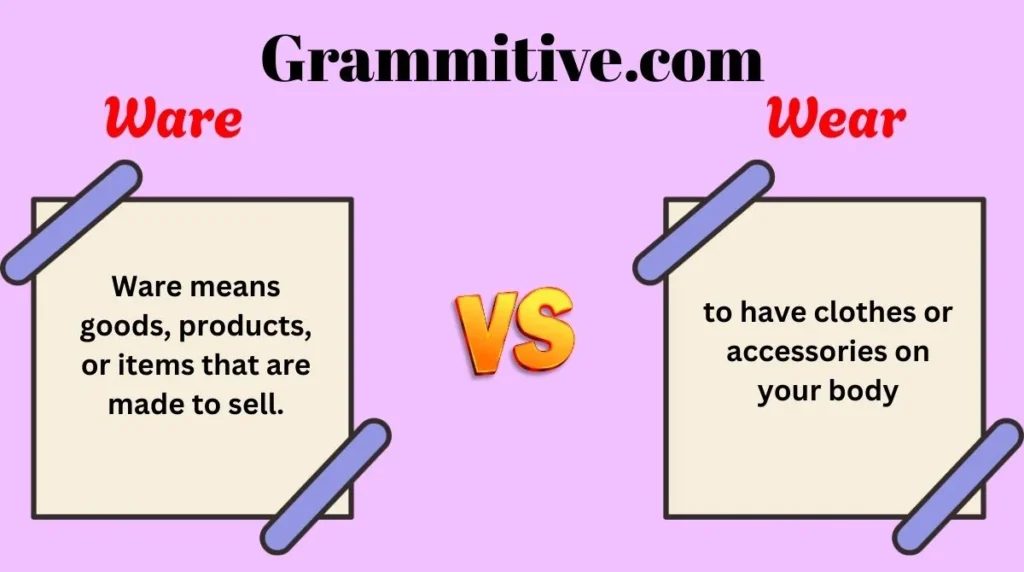
Ware means goods, products, or items that are made to sell.
It is usually used in business, shopping, or trade language.
Think of it as:
👉 things for sale
You often see it as part of bigger words like:
- software
- hardware
- kitchenware
- glassware
- tableware
When to Use It
Use ware when talking about:
- products in stores
- objects for sale
- manufactured goods
- items grouped by type
It is mostly a noun.
Grammar Rule
“Ware” is usually:
- a noun, or
- part of a compound noun (like cookware)
It is rarely used as a verb in modern everyday English.
Example Sentences
- The market sells handmade clay wares.
- This shop offers kitchenware and home tools.
- The street vendor displayed his wares on a table.
- They produce high-quality glassware.
- The company sells both hardware and software.
- Silverware is kept in the top drawer.
- Local artists sell their wares online.
- The shelves are full of beautiful pottery ware.
Common Learner Confusion
Many students confuse ware with wear because both sound the same.
They might write:
❌ I ware glasses.
❌ She bought winter wear.
But remember:
If you mean clothes or using something, you need wear, not ware.
“Ware” is about things for sale, not putting something on your body.
What Does “Wear” Mean?
Simple Definition
Wear means:
- to have clothes or accessories on your body
- to use something regularly
- or to slowly damage something through use
So it has three common meanings:
- clothing
- using
- damage over time
When to Use It
Use wear when talking about:
- clothes or fashion
- glasses, watches, shoes, etc.
- using something daily
- something becoming old or thin
It is mostly a verb, but sometimes a noun too.
Grammar Rule
“Wear” can be:
- a verb → I wear glasses.
- a noun → sportswear, casual wear
Verb forms:
- wear
- wore
- worn
- wearing
Example Sentences
- I wear a jacket in winter.
- She wears glasses at work.
- He wore a blue shirt yesterday.
- These shoes are worn out.
- Please wear your seatbelt.
- The carpet shows signs of wear.
- They sell sportswear for athletes.
- Kids wear uniforms at school.
Common Learner Confusion
Students sometimes use ware by mistake:
❌ I ware a hat.
❌ He ware new shoes.
The correct spelling is wear, because it relates to clothing or using something.
If it touches your body or you use it often → it’s wear.
Difference Between Ware and Wear (Detailed)
These words sound the same but have different meanings and uses.
Quick Comparison Table
| Feature | Ware | Wear |
|---|---|---|
| Meaning | goods/products | clothing or using |
| Part of speech | noun | verb & noun |
| Related to | selling | body/use/damage |
| Common in | shops, business | daily life |
| Example | kitchenware | wear shoes |
Usage Difference
- Ware → things you sell
- Wear → things you put on or use
Grammar Logic
“Ware” talks about objects as items.
“Wear” talks about actions or states.
So:
- shop = ware
- clothes = wear
Sentence Structure Difference
With wear (verb):
👉 Subject + wear + object
- I wear boots.
With ware (noun):
👉 adjective + ware
- kitchenware
- silverware
Meaning Comparison
- The store sells beautiful wares. (products)
- I wear beautiful clothes. (clothing)
One is about selling, the other is about using.
Grammar Rules You Must Remember
Rule #1: If it’s clothing, use “wear”
Correct: She wears a dress.
Wrong: She wares a dress.
Clothes always use wear.
Rule #2: If it’s something for sale, use “ware”
Correct: The market sells local wares.
Wrong: The market sells local wears.
Goods = ware.
Rule #3: Verb action = wear
Correct: I wear glasses.
Wrong: I ware glasses.
Actions use wear.
Rule #4: Compound product words use “ware”
Correct: cookware, hardware, glassware
Wrong: cookwear, hardwear
Product categories usually use ware.
Common Mistakes Students Make
Why mistakes happen
The main reason is pronunciation. Both words sound identical. When writing fast, learners guess the spelling.
Also, spell check may not catch the error because both words are real words.
Wrong vs Correct Examples
❌ I ware a coat.
✅ I wear a coat.
❌ The shop sells sports wear.
✅ The shop sells sportswear.
❌ She bought new wares to the party.
✅ She wore new clothes to the party.
❌ These shoes show too much ware.
✅ These shoes show too much wear.
Easy Correction Tips
- Clothes → wear
- Shop products → ware
- Verb action → wear
- Product category → ware
If unsure, ask yourself:
“Am I talking about using or selling?”
Easy Trick to Remember the Difference
Here’s a simple memory trick students love.
Think about the letters
Wear → has “ear”
You wear things on your body, near your ears, face, body.
Ware → has “are”
Products are things for sale.
Or another easy idea:
👉 You WEAR clothes. A store sells WARES.
Picture yourself:
- wearing a jacket
- selling dishes in a shop
Different situations. Different words.
This small picture in your mind makes it easier to choose the right spelling.
Daily Life Examples (Very Important)
These examples sound like normal spoken English.
- What are you going to wear today?
- I usually wear jeans to work.
- This store sells handmade kitchenware.
- Please wear comfortable shoes.
- The old bridge shows signs of wear.
- They displayed their wares at the festival.
- She loves sportswear brands.
- Don’t wear that shirt; it’s dirty.
- The potter sells beautiful clay wares.
- Kids wear uniforms at this school.
These sentences show how natural each word feels in daily life.
Practice Section
Choose the correct word: ware or wear
- I usually _____ a hat in summer.
- The shop sells handmade _____ .
- These boots show a lot of _____ .
- Please _____ your jacket.
- The artist displayed his _____ at the market.
Answers
- wear
- wares
- wear
- wear
- wares
FAQs
1. What is the difference between ware and wear?
“Ware” means goods or products for sale. “Wear” means clothing something or using it. One is about selling, the other is about using or dressing.
2. Can we use wear as a noun?
Yes. It can mean clothing types like sportswear or formal wear. It can also mean damage, like “wear and tear.”
3. Is ware commonly used alone?
Not very often. It is usually part of compound words like kitchenware or hardware. Alone, it sounds old-fashioned or business-style.
4. Which word is used for clothes?
Always use wear for clothes, shoes, glasses, or accessories.
5. Why do learners confuse ware and wear?
Because they sound exactly the same. English spelling does not always match pronunciation, so mistakes happen in writing.
6. Is wear formal or informal?
“Wear” is normal everyday English. You can use it in both formal and informal situations without any problem.
Final Conclusion
“Ware” and “wear” may sound like twins, but their meanings are completely different. One belongs to shops and products. The other belongs to clothes, daily use, and natural damage.
When you talk about dressing yourself, always choose wear.
When you talk about goods or items for sale, choose ware.
Keep practicing with real sentences. Notice these words when reading signs, websites, or store names. The more you see them, the easier they feel.
Small spelling differences matter in English, but once you understand the logic, they become simple. With a little practice, you’ll never mix these two words again.
Keep learning step by step, and your English will keep improving every day.
Meta Description:

I am Lucas Bennett, a digital content creator passionate about social media trends and online growth strategies.
I share practical insights and guides to help users better understand and navigate the digital world.