
English has many word pairs that sound the same but mean very different things. These words often confuse learners, even advanced students. One common pair is vial and vile.
They sound exactly alike. When you say them aloud, both sound like “vy-uhl.” Because of this, many students mix them up while writing. You might see sentences like:
❌ The doctor gave me a vile of medicine.
❌ He is a vial person.
Both sentences are wrong — but it’s easy to understand why someone made that mistake.
Small spelling changes in English can completely change the meaning of a word. That’s why learning these differences is important.
If you use the wrong word, your sentence can sound strange or even funny.
The good news is that this pair is actually very simple once you understand the meanings clearly.
After reading this guide, you will:
- know the exact meaning of each word
- understand when to use them
- avoid common mistakes
- remember them easily with simple tricks
- use them confidently in daily English
By the end, you won’t confuse them ever again.
What Does “Vial” Mean?
Simple definition
A vial is a small bottle or container, usually made of glass or plastic.
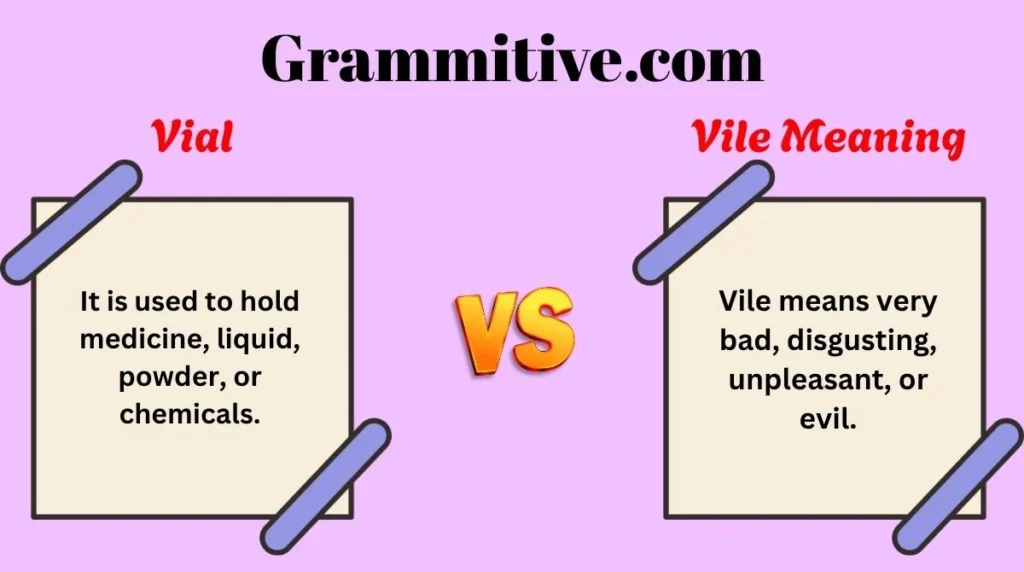
It is used to hold medicine, liquid, powder, or chemicals.
Think of it as a tiny bottle doctors or scientists use.
When to use it
Use vial when talking about:
- medicine
- vaccines
- laboratory chemicals
- perfumes
- small liquid containers
It is always a noun (a thing).
Grammar rule
Vial = countable noun
You can say:
- a vial
- one vial
- two vials
- several vials
You cannot use it as an adjective or verb.
Example sentences
- The nurse opened a vial of vaccine.
- The doctor gave me a vial of cough syrup.
- The lab technician filled the vial with blood.
- She kept perfume in a tiny vial.
- The scientist dropped the vial by accident.
- Three vials were placed in the freezer.
- Each vial contains 10 milliliters of medicine.
- He carried a small vial in his pocket.
Common learner confusion
Many students think vial means something “bad” or “evil.” That’s incorrect.
Remember:
👉 Vial is always a container. Nothing negative.
What Does “Vile” Mean?
Simple definition
Vile means very bad, disgusting, unpleasant, or evil.
It describes something that makes you feel sick, angry, or shocked.
When to use it
Use vile when describing:
- bad behavior
- dirty smells
- horrible actions
- cruel people
- disgusting things
It describes a quality, so it is an adjective.
Grammar rule
Vile = adjective (describing word)
It usually comes:
- before a noun → a vile smell
- after a verb → The food is vile.
Example sentences
- The garbage gave off a vile smell.
- He said some vile things online.
- That was a vile joke.
- The water tasted vile.
- She felt sick because of the vile odor.
- The criminal committed a vile act.
- His behavior was truly vile.
- The food looked old and vile.
Common learner confusion
Students sometimes use vile to mean “small bottle.” That’s wrong.
Remember:
👉 Vile describes something bad, not an object.
Difference Between Vial and Vile (Detailed)
Understanding the difference becomes easier when you compare them side by side.
Comparison Table
| Feature | Vial | Vile |
|---|---|---|
| Meaning | Small bottle/container | Very bad or disgusting |
| Part of speech | Noun | Adjective |
| Used for | Medicine, liquids, chemicals | Behavior, smell, actions |
| Countable | Yes | No |
| Positive or negative | Neutral | Negative |
| Example | a vial of blood | a vile smell |
Usage difference
- Vial = something you can hold
- Vile = something you feel or describe
If you can touch it → probably vial
If you are describing it → probably vile
Grammar logic
Because vial is a noun, it needs:
- a/an
- the
- numbers
Example:
✔ a vial
✔ two vials
Because vile is an adjective, it modifies nouns:
✔ vile behavior
✔ vile taste
Sentence structure difference
Vial structure
- a vial of + liquid
- several vials
Vile structure
- vile + noun
- is/was + vile
Meaning comparison
Think like this:
- Hospital → vial
- Bad smell → vile
Completely different ideas.
Grammar Rules You Must Remember
Rule #1: Vial is always a noun
✔ She opened a vial.
❌ She opened a vile.
Rule #2: Vile describes something
✔ It’s a vile smell.
❌ It’s a vial smell.
Rule #3: Use “of” with vial for liquids
✔ a vial of medicine
✔ a vial of blood
Rule #4: Vile often shows emotion
Use it when you feel disgust or anger.
✔ That comment was vile.
✔ His actions were vile.
Common Mistakes Students Make
Why mistakes happen
The main reason is pronunciation.
Both words sound the same:
👉 /vaɪl/
So when writing, students guess the spelling.
Wrong vs correct examples
❌ The nurse brought a vile of vaccine.
✔ The nurse brought a vial of vaccine.
❌ The soup tastes vial.
✔ The soup tastes vile.
❌ He is a vial man.
✔ He is a vile man.
❌ She broke the vile in the lab.
✔ She broke the vial in the lab.
Easy correction tips
- Ask: Is it a thing or a description?
- Thing → vial
- Description → vile
This question fixes 90% of mistakes.
Easy Trick to Remember the Difference
Here’s a simple memory trick students love.
Trick
Vial = has “A” like “Ampoule” and “bottle”
Both are containers.
Vile = has “E” like “Evil”
Both mean bad.
So:
- A → container
- E → evil/bad
Super easy to remember during exams.
Daily Life Examples (Very Important)
These examples sound like real conversations.
- “The doctor gave me a small vial of insulin.”
- “Wow, this milk smells vile.”
- “Please store the vials in the fridge.”
- “That movie had some vile scenes.”
- “Be careful not to drop the vial.”
- “His language was really vile.”
- “The nurse prepared three vials for the test.”
- “The trash outside smells vile today.”
- “Each vial costs ten dollars.”
- “That taste is absolutely vile.”
Notice how natural they sound in everyday speech.
Practice Section
Choose the correct word (vial or vile).
- The doctor opened a ___ of medicine.
- The smell was ___ and terrible.
- Please hand me that glass ___.
- His behavior was ___ and rude.
- The nurse carried three ___.
Answers
- vial
- vile
- vial
- vile
- vials
FAQs
What is the difference between vial and vile?
Vial is a small container for liquids or medicine.
Vile means very bad or disgusting.
One is a noun, the other is an adjective.
Can we use vial in questions?
Yes. It works like any noun.
Example: Do you have a vial of insulin?
Is vile formal or informal?
It can be both.
It appears in everyday speech and formal writing.
It simply means very unpleasant.
Why do they sound the same?
English has many homophones.
These words share the same pronunciation but different spellings and meanings.
Can vile describe a person?
Yes.
Example: He is a vile person.
It means the person behaves very badly.
Can vial be used for food or drinks?
Usually no.
It is mostly used for medicine or chemicals, not normal drinks.
Final Conclusion
Small spelling differences can create big meaning changes in English. The pair vial and vile is a perfect example.
One refers to a tiny container used for liquids or medicine. The other describes something disgusting or morally bad.
Once you connect the ideas — container versus description — everything becomes simple.
Add the memory trick about A for ampoule and E for evil, and you’ll rarely make mistakes again.
Try to notice these words in real life. When you visit a clinic, think “vial.” When you smell something awful, think “vile.”
Linking words to real experiences helps your brain remember faster.
Keep practicing with sentences and small exercises. Little by little, confusing word pairs stop being scary. English becomes clearer and more natural.
You’ve got this. Keep learning and stay curious.

I am Lucas Bennett, a digital content creator passionate about social media trends and online growth strategies.
I share practical insights and guides to help users better understand and navigate the digital world.