
Many English learners often get confused between “useful to” and “useful for.”
You might hear sentences like: “This book is useful to me” or “This tool is useful for cooking.” But which one is correct?
Or are they both correct? This confusion is common because both expressions are correct in English, but their usage depends on what comes after them.
Understanding the difference is important because these phrases appear in daily conversations, reading, and writing.
If you use them incorrectly, your sentences can sound awkward or even change meaning.
Imagine saying “This medicine is useful to cure headache” instead of “This medicine is useful for curing headache.”
Small mistakes like this can make your English sound unnatural.
By the end of this lesson, you will know exactly when to use useful to and when to use useful for.
You will also learn easy rules, common mistakes, memory tricks, and practice examples.
This means you can confidently speak, write, and understand sentences with these expressions, whether you are talking to a teacher, friend, or colleague.
Let’s break it down clearly and step by step so that the confusion disappears once and for all.
What Does “Useful to” Mean?
The phrase “useful to” is usually followed by a person or a group of people. It shows that something benefits someone.
Simple Definition:
- Useful to = helpful or beneficial for someone
Grammar Rule:
- Use “useful to” when the focus is on the person who gets the benefit.
- Structure: [something] + is + useful + to + [person/group]
Example Sentences:
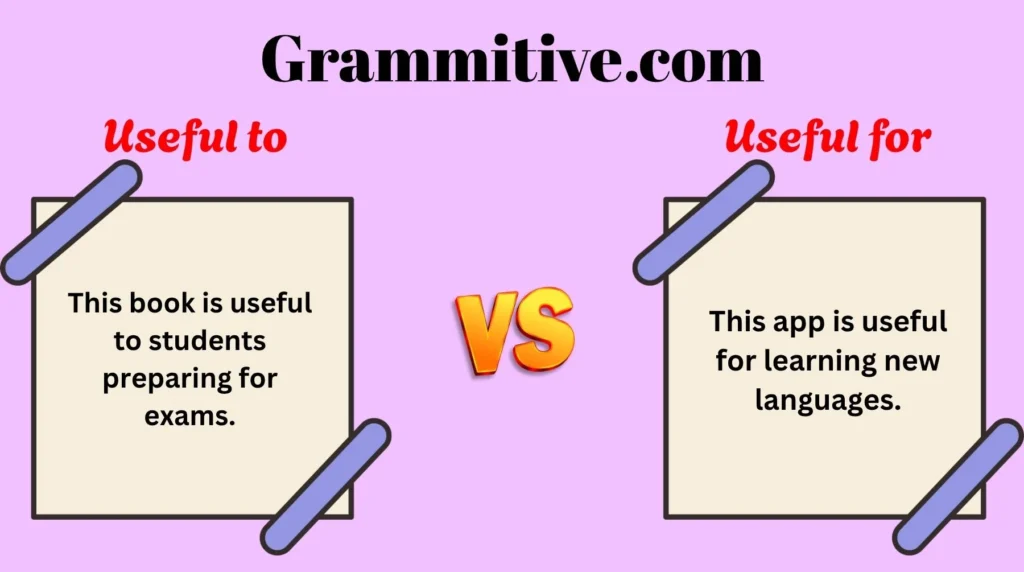
- This book is useful to students preparing for exams.
- The advice was useful to me during the interview.
- These tips are useful to anyone learning English.
- Your guidance will be useful to new employees.
- The map is useful to tourists visiting the city.
- This app is useful to people who travel frequently.
- The instructions are useful to beginners in cooking.
- The teacher’s feedback was very useful to the students.
Common Learner Confusion:
- Many learners incorrectly use “useful to” with things or activities, e.g., “This medicine is useful to cure headache” (❌).
- Correct version: “This medicine is useful for curing headache”.
- Remember: “to” focuses on a person, not an activity or task.
What Does “Useful for” Mean?
The phrase “useful for” is used when something is beneficial for an activity, task, or purpose, rather than a person.
Simple Definition:
- Useful for = helps to do something or achieve a goal
Grammar Rule:
- Use “useful for” when the focus is on what the thing helps with.
- Structure: [something] + is + useful + for + [activity/task/purpose]
Example Sentences:
- This app is useful for learning new languages.
- The knife is useful for cutting vegetables.
- Exercise is useful for improving your health.
- The guide is useful for tourists visiting Paris.
- This software is useful for editing photos.
- Drinking water is useful for staying healthy.
- This tip is useful for solving difficult math problems.
- The book is useful for understanding English grammar.
Common Learner Confusion:
- Learners sometimes mix useful to and useful for, e.g., “This book is useful to learning English” (❌).
- Correct version: “This book is useful for learning English.”
- Rule of thumb: If it explains an activity or purpose, use “for.”
Difference Between Useful to and Useful for (Detailed)
It’s easier to understand when we compare both phrases side by side.
| Feature | Useful to | Useful for |
|---|---|---|
| Focus | Person, group, or audience | Activity, task, or purpose |
| Grammar | [something] + is + useful + to + [person] | [something] + is + useful + for + [activity/task] |
| Example | The advice is useful to me. | The advice is useful for solving problems. |
| Common Mistake | Using with activities | Using with people |
| Meaning | Indicates who benefits | Indicates what the benefit is |
Usage Difference:
- Useful to emphasizes the person or group who gains something.
- Useful for emphasizes the action, task, or purpose.
Sentence Structure Difference:
- Person as object: “This tool is useful to beginners.”
- Activity as object: “This tool is useful for fixing bicycles.”
Meaning Comparison:
- “Useful to” → Who benefits?
- “Useful for” → What is it helpful for?
Examples Together:
- This book is useful to students. → Students benefit.
- This book is useful for studying grammar. → The activity of studying grammar benefits.
- The advice was useful to me. → I received the benefit.
- The advice was useful for making better decisions. → The activity or task benefits.
Grammar Rules You Must Remember
Rule #1: Person vs Activity
- Person → to
- Activity → for
- Example: “This guide is useful to travelers” ✅ / “This guide is useful for finding restaurants” ✅
Rule #2: Use -ing form after “for”
- When talking about actions, use verb + ing.
- Example: “This app is useful for learning”, not “useful for learn”.
Rule #3: Can follow “be” only
- Useful is an adjective, so always follow be verbs: is, was, are, etc.
- Example: “This tool is useful for painting”, not “This tool useful for painting”.
Rule #4: Avoid confusing “to” with direction
- To here is not about direction, it is about benefit.
- Wrong: “This book is useful to read” ❌
- Correct: “This book is useful for reading” ✅
Common Mistakes Students Make
English learners often make mistakes because the meanings of “to” and “for” overlap in translation.
Mistake 1: Using “to” with activities
- ❌ “This book is useful to learn English.”
- ✅ “This book is useful for learning English.”
Mistake 2: Using “for” with people
- ❌ “This advice is useful for me.”
- ✅ “This advice is useful to me.”
Mistake 3: Using infinitive after “for”
- ❌ “This app is useful for to track expenses.”
- ✅ “This app is useful for tracking expenses.”
Easy Correction Tips:
- Ask: Who benefits? → use “to”
- Ask: What is it helping to do? → use “for”
- Always use -ing form after for
- Read your sentence aloud – does it sound natural?
Easy Trick to Remember the Difference
Here’s a simple trick:
- To = Person → Think of giving something to someone.
- For = Action → Think of helping someone do something.
Real-life logic:
- You give advice to someone.
- You make advice useful for solving problems.
Student-friendly Explanation:
- Imagine your teacher giving you a pencil. You receive it → “useful to me.”
- You use that pencil to write → it is “useful for writing.”
Daily Life Examples
Here are some everyday sentences you can use in conversation:
- This app is really useful to beginners.
- This app is really useful for learning English vocabulary.
- The instructions were useful to the students.
- The instructions were useful for building the model airplane.
- Drinking water is useful to your body.
- Drinking water is useful for staying healthy.
- This tip is useful to me.
- This tip is useful for cooking rice perfectly.
- The advice was useful to everyone in the class.
- The advice was useful for preparing for exams.
Practice Section
Choose the correct option in the sentences below:
- This guide is useful ___ tourists.
- a) for
- b) to
- Yoga is useful ___ improving flexibility.
- a) for
- b) to
- The teacher’s advice was useful ___ me.
- a) for
- b) to
- This tool is useful ___ fixing bikes.
- a) for
- b) to
- This information is useful ___ students preparing for exams.
- a) for
- b) to
Answers:
1 → b) to
2 → a) for
3 → b) to
4 → a) for
5 → b) to
FAQs
1. What is the difference between useful to and useful for?
- “Useful to” shows who benefits, while “useful for” shows what activity or task benefits.
2. Can we use useful to in questions?
- Yes, e.g., “Is this book useful to you?” ✅
3. Can we use useful for in questions?
- Yes, e.g., “Is this tool useful for cutting wood?” ✅
4. Is useful to formal or informal?
- Both are neutral and can be used in formal or informal English.
5. Can we say “useful to learn”?
- No, it’s incorrect. Use “useful for learning.”
6. Can we use useful for people?
- Technically yes, but “useful to” is more natural for people.
Final Conclusion
Understanding the difference between useful to and useful for is simple if you remember the main idea: to = person, for = activity or purpose.
English learners often confuse these phrases, but with practice, you can easily use them correctly in writing and speaking.
Daily life examples, practice exercises, and memory tricks make it easier to remember. Start paying attention in conversations, books, and shows.
Soon, you’ll instinctively choose the right phrase without thinking.
Keep practicing by noticing whether a sentence focuses on a person benefiting or an activity benefiting.
Your English will sound natural, clear, and professional. Every time you see “useful to” or “useful for,” check:
Who or what is it helping? This simple habit will make a huge difference.

I am Lucas Bennett, a digital content creator passionate about social media trends and online growth strategies.
I share practical insights and guides to help users better understand and navigate the digital world.