
English spelling can be tricky. Some words sound the same but mean very different things. These words often confuse learners. One very common example is “to late or too late.”
Many students write sentences like:
❌ I am to late for school.
❌ It is to late to call him.
They feel something is wrong, but they are not sure why.
The problem happens because “to” and “too” sound exactly the same. When you speak, nobody hears the difference. But in writing, the meaning changes completely. One small extra “o” can change your whole sentence.
This mistake is very common in emails, messages, homework, and even exams. And yes — native speakers also mix them up sometimes!
Understanding this topic is important because we use “too late” very often in daily life:
- It’s too late to go out.
- Sorry, you’re too late.
- Don’t worry, it’s never too late to start.
By the end of this guide, you will clearly understand:
- what to means
- what too means
- when to use each one
- why “to late” is usually wrong
- easy tricks to remember forever
Everything will be explained in simple English, like a classroom lesson. No complicated grammar talk — just clear ideas and real examples.
What Does “To” Mean?
Simple meaning
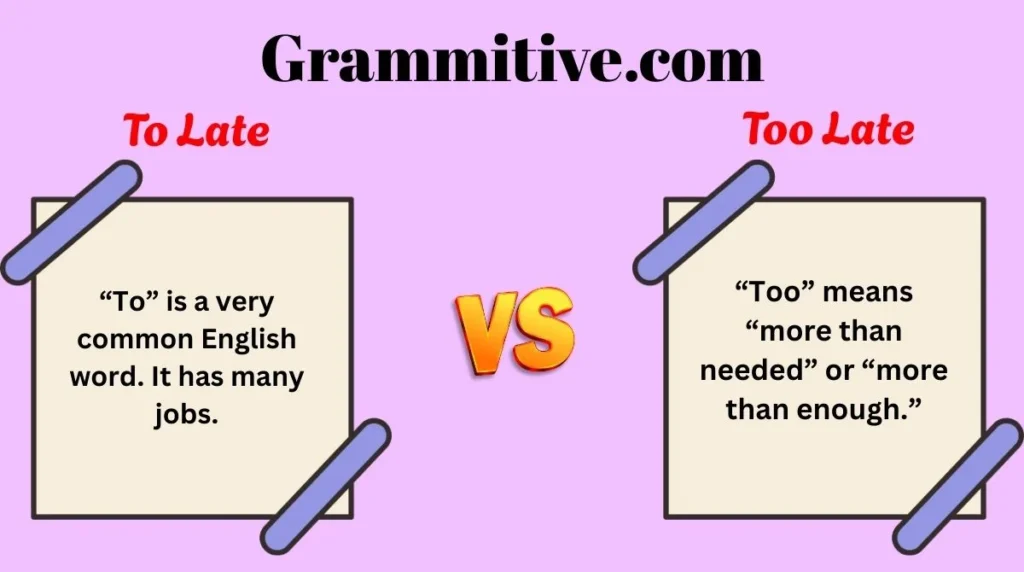
“To” is a very common English word. It has many jobs.
It can be:
- a preposition
- part of an infinitive verb
- used to show direction, time, or purpose
But “to” NEVER means “very” or “more than enough.”
When to use “to”
We use to:
- To show movement or direction
- Before a verb (to eat, to go, to study)
- To show time or limit
- To show connection between things
Grammar rule
To + base verb = infinitive
Examples:
- to go
- to sleep
- to finish
Examples with “to”
Look at these simple sentences:
- I am going to school.
- She walked to the market.
- We want to eat pizza.
- It’s five minutes to six.
- Give this gift to Anna.
- I need to study tonight.
- He came to help me.
- They traveled to Japan.
Notice something important:
None of these sentences talk about “extra” or “very much.”
That’s because “to” is not about degree or amount.
Common learner confusion
Many students write:
❌ I am to tired.
❌ It’s to expensive.
❌ She is to late.
These are wrong because “to” cannot describe adjectives like tired, expensive, or late.
When you want to show “more than normal”, you must use too, not to.
What Does “Too” Mean?
Simple meaning
“Too” means “more than needed” or “more than enough.”
It often shows:
- excess
- problems
- something negative
- something extra
It can also mean “also” (like “me too”).
When to use “too”
Use too:
- Before adjectives
- Before adverbs
- To show something is excessive
- To mean “also”
Grammar rule
Too + adjective/adverb
Examples:
- too fast
- too hot
- too late
- too tired
Examples with “too”
- It’s too hot today.
- This bag is too heavy.
- I’m too tired to walk.
- She speaks too fast.
- We arrived too late.
- The music is too loud.
- That test was too difficult.
- I want ice cream too. (means also)
In all these sentences, too shows extra or more than comfortable.
Common learner confusion
Students sometimes write:
❌ I went too school.
❌ She gave it too me.
This is wrong because too cannot show direction.
Only to shows movement or connection.
So:
✔ I went to school.
✔ She gave it to me.
Difference Between To and Too (Detailed)
Now let’s compare them clearly.
Comparison Table
| Word | Meaning | Grammar Use | Example |
|---|---|---|---|
| to | direction / purpose | preposition or infinitive | go to bed |
| too | more than enough / also | before adjective/adverb | too late |
Usage difference
To connects things.
Too describes degree or excess.
Think like this:
- To = movement or link
- Too = extra or more
Grammar logic
You cannot say:
❌ to late
❌ to hot
❌ to expensive
Because “to” cannot describe adjectives.
But:
✔ too late
✔ too hot
✔ too expensive
Because too + adjective is correct grammar.
Sentence structure difference
To structure:
- to + noun
- to + verb
Example:
- to school
- to run
Too structure:
- too + adjective
- too + adverb
Example:
- too slow
- too early
Meaning comparison
Look at these:
- I went to bed. (movement)
- It’s too late. (excess time)
Completely different meanings.
Even though they sound the same, their jobs in a sentence are very different.
Grammar Rules You Must Remember
Rule #1 – Too + adjective
If an adjective comes after the word, use too.
✔ too late
✔ too big
Example:
It’s too late to call him.
Rule #2 – To + verb
Before a base verb, use to.
✔ to eat
✔ to sleep
Example:
I want to sleep.
Rule #3 – Too means extra or more
If you mean “very” or “more than enough,” use too.
Example:
This coffee is too hot.
Rule #4 – To shows direction or connection
If you show movement or giving something, use to.
Example:
Send the email to your teacher.
Common Mistakes Students Make
Why mistakes happen
The problem happens because:
- both words sound the same
- typing quickly causes errors
- learners guess the spelling
- autocorrect sometimes changes it
Wrong vs correct examples
❌ I am to late
✔ I am too late
❌ It’s to cold
✔ It’s too cold
❌ Give it too me
✔ Give it to me
❌ She went too school
✔ She went to school
Easy correction tips
Ask yourself:
👉 “Am I describing something as extra?” → use too
👉 “Am I showing movement or purpose?” → use to
This small question fixes most mistakes.
Easy Trick to Remember the Difference
Here’s a simple memory trick students love.
The “extra O” trick
Look at too.
It has two O’s.
Think:
Two O’s = TOO MUCH
So whenever something is extra or more than enough, choose too.
Examples:
- too heavy
- too late
- too expensive
Now look at to.
Only one O.
Simple direction word. Nothing extra.
This trick works fast, even during exams.
Daily Life Examples (Very Important)
These are real spoken sentences you may hear every day.
- Sorry, I’m too late for the meeting.
- It’s too late to change the plan now.
- Don’t drive too fast.
- This box is too heavy to carry.
- I have to go home.
- She walked to the bus stop.
- It’s never too late to learn English.
- Come to my house tonight.
- The movie started too early for me.
- Give the keys to your brother.
Try saying these aloud. You will hear how natural they sound.
Practice Section
Choose to or too.
- I am ___ tired to work.
- She went ___ the store.
- It’s ___ late to call.
- This tea is ___ hot.
- I need ___ finish my homework.
Answers
- too
- to
- too
- too
- to
FAQs (SEO Focused)
What is the difference between to and too?
“To” shows direction, purpose, or connection. “Too” means extra, very, or more than enough. They sound the same but have different grammar roles.
Is “to late” ever correct?
Almost never. “To late” is usually a spelling mistake. The correct form is “too late,” because late is an adjective and needs “too.”
Can we use too in questions?
Yes. Example: “Is it too late to apply?” It still means more than the right time.
Does too only mean very?
Not exactly. It means more than necessary, often negative. “Very” is neutral, but “too” often shows a problem.
Is too formal or informal?
It is used in both. You can use “too” in daily speech, emails, and formal writing.
How can I remember the spelling quickly?
Remember: too has two O’s = too much. Extra O means extra amount. This trick helps you choose the correct word fast.
Final Conclusion
Small spelling differences can create big grammar problems. “To” and “too” are perfect examples. They sound identical, but their meanings are completely different.
“To” connects ideas. It shows direction or purpose.
“Too” describes excess or something more than needed.
Once you remember that too has an extra O for extra meaning, everything becomes easier.
Keep practicing with real sentences. Notice how people use these words in conversations, messages, and movies. The more you see them, the more natural they feel.
Mistakes are normal when learning English. Don’t worry if you mix them up sometimes. Just slow down, check the sentence, and ask yourself what you really mean.
With practice, choosing between to late or too late will never confuse you again.

I am Lucas Bennett, a digital content creator passionate about social media trends and online growth strategies.
I share practical insights and guides to help users better understand and navigate the digital world.