
Many English learners feel confused when they hear phrases like thus far and so far. They look similar. They talk about time. And in many sentences, both seem possible.
So students often ask, “Are they the same?” or “Which one should I use in daily English?”
That confusion is completely normal.
Both expressions talk about something that has happened until now. But they are not used in the same situations.
One sounds more formal. The other sounds more natural in everyday speech. One fits better in writing. The other fits better in conversation.
If you choose the wrong one, your sentence may sound strange, too formal, or unnatural.
Good news — the difference is actually simple once someone explains it clearly.
After reading this guide, you will understand:
- the exact meaning of each phrase
- when to use each one
- grammar rules
- real-life examples
- common mistakes
- an easy trick to remember
By the end, you’ll feel confident using both naturally — like a fluent speaker.
What Does “Thus Far” Mean?
Simple definition
Thus far = until this point in time (formal)
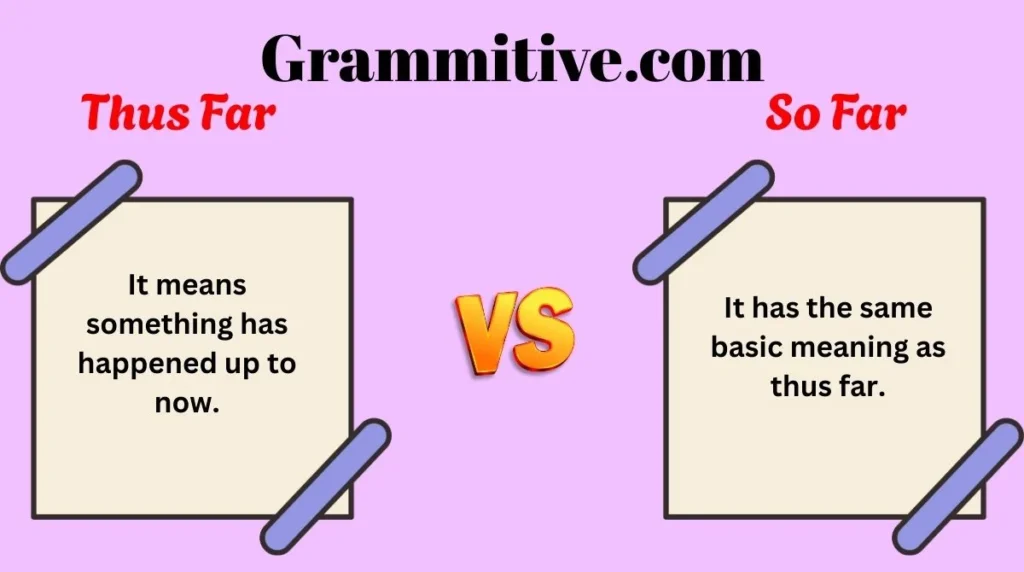
It means something has happened up to now.
But it sounds formal, serious, or professional.
You will hear it more in:
- reports
- news
- speeches
- academic writing
- business English
Not usually in casual conversation.
When to use it
Use thus far when:
- writing formally
- giving official information
- talking about progress in reports
- speaking in presentations
- writing essays or articles
It sounds polite and professional.
Grammar rule
Thus far usually comes:
- at the beginning, or
- at the end of a sentence
It often works with:
- present perfect tense
- present perfect continuous
Structure examples:
- Thus far + present perfect
- Present perfect + thus far
Example sentences
- Thus far, the project has been successful.
- We have raised $5,000 thus far.
- Thus far, no problems have appeared.
- The team has completed three tasks thus far.
- Thus far, the weather has been pleasant.
- Our research has shown positive results thus far.
- Thus far, everything is going according to plan.
- The company has hired 20 employees thus far.
Common learner confusion
Many students try to use thus far in daily speech:
❌ “Thus far, I didn’t eat lunch.”
❌ “Thus far, I like the movie.”
These sound too serious or unnatural in casual talk.
Native speakers usually say so far instead.
What Does “So Far” Mean?
Simple definition
So far = until now / up to this moment
It has the same basic meaning as thus far.
But it sounds:
- natural
- friendly
- everyday
- conversational
This is the phrase people use most often.
When to use it
Use so far in:
- conversations
- texting
- daily speech
- informal writing
- storytelling
It fits almost everywhere.
If you are unsure, so far is usually the safer choice.
Grammar rule
So far commonly appears with:
- present perfect tense
- present perfect continuous
It usually goes:
- at the end of the sentence
- sometimes at the beginning
Structure examples:
- Subject + have/has + verb + so far
- So far, + clause
Example sentences
- I like the movie so far.
- So far, everything is good.
- We have finished two chapters so far.
- She hasn’t called me so far.
- So far, the trip has been amazing.
- I’ve learned ten new words so far.
- The test is easy so far.
- So far, nobody has complained.
Common learner confusion
Students sometimes think so far is informal and “wrong” for writing.
That’s not true.
It’s fine in most writing — emails, blogs, messages, even many articles.
Only very formal or academic writing prefers thus far.
Difference Between Thus Far and So Far (Detailed)
Both phrases mean “until now.”
But the feeling and situation are different.
Here’s the clear comparison:
| Feature | Thus Far | So Far |
|---|---|---|
| Meaning | Until now | Until now |
| Formality | Formal | Neutral/Informal |
| Common in speech | Rare | Very common |
| Common in writing | Yes (formal) | Yes (general) |
| Tone | Professional | Natural |
| Difficulty | Advanced | Beginner-friendly |
Usage difference
Thus far
→ reports, presentations, official tone
So far
→ everyday conversations, normal English
Grammar logic
Both describe unfinished time (time that continues until now).
So we usually use:
- present perfect
- present perfect continuous
Examples:
✔ I have worked hard so far.
✔ We have completed three tasks thus far.
Sentence structure difference
Thus far:
- Thus far, we have made progress.
- We have made progress thus far.
So far:
- So far, we have made progress.
- We have made progress so far.
Both structures work the same grammatically.
The difference is style, not grammar.
Meaning comparison
Meaning = almost identical
Feeling = different
Think of it like:
- thus far → business meeting
- so far → talking to a friend
Grammar Rules You Must Remember
Rule #1 — Use present perfect tense
✔ I have learned a lot so far.
❌ I learn a lot so far.
Rule #2 — Use for unfinished time
Use these phrases only when time is still continuing.
✔ The day has been great so far.
❌ Yesterday was great so far.
(Yesterday is finished — cannot use)
Rule #3 — Don’t use with future time
❌ I will finish three tasks so far.
✔ I will finish three tasks by tomorrow.
Rule #4 — Thus far sounds formal
✔ Thus far, sales have increased. (report)
✔ So far, sales are good. (casual talk)
Choose based on tone.
Common Mistakes Students Make
Why mistakes happen
Students:
- translate from their language
- overuse formal phrases
- think “formal = better English”
- forget about tense rules
But English doesn’t work that way.
Natural English is usually simple.
Mistake 1 — Using simple past
❌ I finished two lessons so far.
✔ I have finished two lessons so far.
Tip: If you see so far, think have/has.
Mistake 2 — Using thus far in casual talk
❌ Thus far, I like your shoes.
✔ So far, I like your shoes.
Tip: If talking to a friend → use so far.
Mistake 3 — Using with finished time
❌ Last week was busy so far.
✔ Last week was busy.
Tip: Only use for time connected to NOW.
Easy correction tip
Ask yourself:
“Is the time still continuing right now?”
If yes → you can use so far / thus far.
Easy Trick to Remember the Difference
Here’s a simple memory trick.
Think about the first letter:
T = Thus far = Thesis or Textbook (formal writing)
S = So far = Speech (speaking)
T → serious
S → simple
When talking → choose so far
When writing formally → choose thus far
Easy.
Daily Life Examples (Very Important)
These sound natural in real conversations:
- So far, the food tastes great.
- I’m enjoying the class so far.
- So far, no traffic today.
- The movie is boring so far.
- So far, everything is going smoothly.
- We haven’t had any problems so far.
- So far, this book is interesting.
- I’ve saved $200 so far.
- The baby hasn’t slept so far.
- So far, so good!
Now some formal ones:
- Thus far, the company has grown steadily.
- Thus far, no errors have been reported.
Notice the serious tone.
Practice Section
Choose the correct option.
Questions
- I have read five pages (so far / thus far).
- ______, the results have been positive. (formal report)
- We haven’t received any emails (so far / thus far).
- The trip has been fun ______.
- ______, no damage has been found. (official statement)
Answers
- so far
- Thus far
- so far
- so far
- Thus far
FAQs
What is the difference between thus far and so far?
Both mean “until now.” The difference is tone. Thus far is formal and professional. So far is casual and everyday.
Can we use so far in questions?
Yes. It’s very common.
Example: How do you like the class so far?
Is thus far formal or informal?
It is formal. You’ll see it in reports, news, and academic writing, not daily speech.
Which one should beginners use more?
Use so far. It sounds natural and works in most situations. Thus far is only needed in formal writing.
Can both be used with present perfect?
Yes. They usually appear with present perfect or present perfect continuous tense.
Example: I have studied a lot so far.
Do native speakers use thus far often?
Not really. It’s less common in everyday speech. Most people say so far instead.
Final Conclusion
Small phrases like these can feel confusing at first. They look almost the same, and both talk about time up to now. But once you notice the difference in tone, everything becomes simple.
Thus far is formal and professional. It fits reports, speeches, and serious writing. So far is friendly, natural, and perfect for everyday English. That’s why you hear it much more often.
When unsure, choose so far. You’ll almost always sound correct.
Try using both in your own sentences today. Talk about your day, your studies, or your progress. Practice makes these phrases feel automatic.
Soon you won’t even think about the rule — you’ll just use them naturally.
And that’s the goal of good English.

I am Lucas Bennett, a digital content creator passionate about social media trends and online growth strategies.
I share practical insights and guides to help users better understand and navigate the digital world.