

Many English learners feel confused when they see the words through and throughout. At first, they look almost the same.
Both talk about time or place. Both appear in daily conversations. Both can describe movement or duration. Because they look and sound similar, students often mix them up.
You might hear sentences like:
- I studied through the night.
- I studied throughout the night.
These two sentences feel close in meaning, but they are not exactly the same. That small difference can change what you want to say.
And this is why the topic matters.
These words are very common in everyday English. You see them in books, movies, news, emails, and exams. If you use the wrong one, your sentence can sound strange or unclear.
The good news? The difference is not difficult when explained in simple steps.
By the end, you will clearly understand:
- what each word means
- when to use each one
- grammar rules
- common mistakes
- easy tricks to remember
- real-life examples
After that, choosing the right word will feel natural, not stressful.
What Does “Through” Mean?
Simple definition
Through means:
👉 from one side to another
👉 from beginning to end
👉 by using something
👉 during a period of time (sometimes)
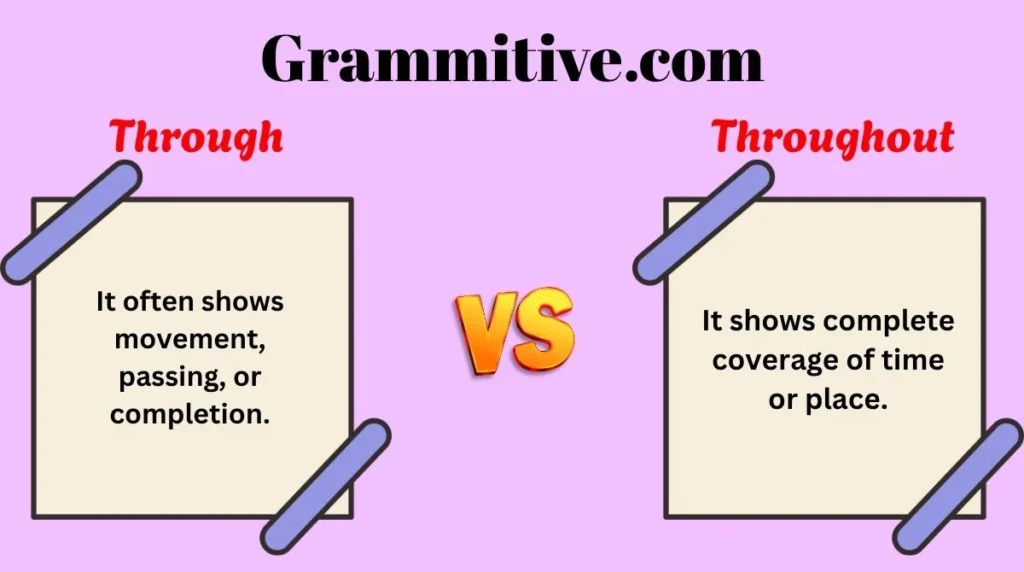
It often shows movement, passing, or completion.
When to use it
Use through when:
- something moves inside or across something
- something continues until the end
- something happens by means of something
Grammar rule
Through is usually a preposition.
Structure:
- through + noun
- through + time period
- through + object
Examples:
- through the door
- through the tunnel
- through the night
- through hard work
Example sentences (6–8)
- She walked through the park after school.
- The train went through the tunnel.
- We drove through the city at night.
- He worked through the weekend.
- Light came through the window.
- I learned English through practice.
- The river flows through the village.
- She read through the entire book in one day.
Common learner confusion
Students often think through = during all the time.
But that is not always correct.
For time, through often means:
👉 until the end of something
Example:
- I stayed awake through the movie.
(Not every second — just until it finished.)
So it does not always mean “every moment.”
What Does “Throughout” Mean?
Simple definition
Throughout means:
👉 in every part of something
👉 during the whole time
👉 everywhere inside
It shows complete coverage of time or place.
Think:
all parts, all time, everywhere
When to use it
Use throughout when:
- something happens in every area
- something continues for the whole time
- something spreads everywhere
Grammar rule
Throughout is also a preposition.
Structure:
- throughout + noun (time or place)
Examples:
- throughout the day
- throughout the house
- throughout the year
Example sentences (6–8)
- Music played throughout the house.
- It rained throughout the day.
- She felt nervous throughout the exam.
- Trees grow throughout the country.
- The smell spread throughout the room.
- He practiced English throughout the year.
- There were lights throughout the street.
- The teacher smiled throughout the class.
Common learner confusion
Some students use throughout for movement.
❌ He walked throughout the tunnel.
This sounds strange.
Because throughout is about coverage, not movement from one side to another.
For movement, use through.
Difference Between Through and Throughout (Detailed)
This is where things become clearer.
Both words talk about time and place, but their focus is different.
- Through → path or end point
- Throughout → every part
Comparison table
| Feature | Through | Throughout |
|---|---|---|
| Basic idea | passing or crossing | everywhere or whole time |
| Movement | yes | no |
| Coverage | partial or to the end | complete |
| Time meaning | until the end | during all the time |
| Place meaning | from one side to another | in every part |
| Length | shorter | longer (more emphasis) |
Usage difference
Through → travel or pass
- through the forest
- through the door
Throughout → spread everywhere
- throughout the forest
- throughout the house
Grammar logic
Think like this:
- through = a line → start → end
- throughout = area → all parts filled
One is like walking across a road.
The other is like paint covering the whole wall.
Sentence structure difference
Movement:
✔ He ran through the crowd.
Coverage:
✔ Police were standing throughout the crowd.
Different meanings, right?
Meaning comparison
Time example:
- I slept through the movie → I didn’t wake up until it finished
- I slept throughout the movie → I slept the entire time
Small change, big difference.
Grammar Rules You Must Remember
Rule #1 – Use “through” for movement
✔ The cat ran through the garden.
Movement from one side to another.
Rule #2 – Use “throughout” for complete time
✔ It snowed throughout the night.
Snow did not stop.
Rule #3 – Do not use “throughout” for crossing
❌ She walked throughout the bridge.
✔ She walked through the bridge.
Rule #4 – Use “through” for method or means
✔ I got the job through a friend.
This means “by using help.”
“Throughout” cannot be used here.
Common Mistakes Students Make
Why mistakes happen
- words look similar
- both talk about time
- both are prepositions
- meanings overlap slightly
So confusion is normal.
Wrong vs correct examples
❌ It rained through the day.
✔ It rained throughout the day.
(We mean whole time.)
❌ The car drove throughout the tunnel.
✔ The car drove through the tunnel.
(Movement, not coverage.)
❌ I learned English throughout YouTube.
✔ I learned English through YouTube.
(Method or means.)
Easy correction tips
Ask yourself:
- Am I moving across something? → through
- Do I mean every part or whole time? → throughout
- Am I talking about a method? → through
Simple questions save you every time.
Easy Trick to Remember the Difference
Here’s a fun memory trick.
Look at the words:
throughout = through + out
“Out” makes it bigger and wider.
So:
- through → one path
- throughout → everywhere
Picture this:
If you throw water through a pipe → straight line
If you throw water throughout a room → splashes everywhere
Big spread = throughout.
Most students remember it quickly with this image.

Daily Life Examples (Very Important)
These are the kinds of sentences you hear every day.
- I stayed awake through the flight.
- We laughed throughout the movie.
- The dog ran through the house.
- There were cameras throughout the building.
- She worked through lunch.
- He felt happy throughout the trip.
- Sunlight came through the window.
- Decorations were placed throughout the hall.
- I met many people through social media.
- Music played throughout the party.
Try reading them aloud. They sound very natural.
Practice Section
Choose through or throughout.
- It snowed ______ the night.
- We walked ______ the forest path.
- Lights were placed ______ the stadium.
- I learned cooking ______ my grandmother.
- She stayed calm ______ the exam.
Answers
- throughout
- through
- throughout
- through
- throughout
FAQs
What is the difference between through and throughout?
Through usually shows movement or reaching the end.
Throughout means every part or the whole time.
Think line vs area.
Can we use through for time?
Yes. It means until the end.
Example: He slept through the class.
But it does not always mean every second.
Can we use throughout for place?
Yes. It means everywhere inside.
Example: Shops are located throughout the city.
It shows full coverage.
Which word is more formal?
Both are normal and neutral.
You can use them in daily speech and writing.
No strong difference in formality.
Can throughout show movement?
No. It does not show crossing or travel.
Use through for movement.
Throughout only shows coverage.
Why do learners confuse them so much?
Because they look similar and both relate to time and place.
Also, dictionaries explain them in complex ways.
Simple ideas like “path vs everywhere” make it easier.
Final Conclusion
Through and throughout may look like twins, but they behave differently in sentences. One talks about movement, direction, or reaching the end.
The other talks about complete coverage in time or place. Once you see this difference, everything becomes simple.
When you speak or write, pause for a second and ask yourself what you really mean. Are you crossing something?
Use through. Are you talking about every part or the whole time? Use throughout.
Practice with daily examples. Read books. Listen to conversations. Notice how native speakers use these words naturally.
After a few days, you won’t even need to think about the rule. It will feel automatic.
Grammar becomes easier when you connect it to real life. Keep practicing, and your English will grow stronger every day.

I am Lucas Bennett, a digital content creator passionate about social media trends and online growth strategies.
I share practical insights and guides to help users better understand and navigate the digital world.