
Many English learners stop for a second when they want to say something like, “this information is helpful” or “these information are helpful.”
Both sound possible. Both seem logical. But only one is correct.
That small moment of doubt happens because English has some tricky nouns. are uncountable.
The word information belongs to a special group that does not behave the way most learners expect.
In many languages, the word for “information” can be plural. So students naturally say these informations or these information. It feels right in their head. But English grammar follows a different rule.
This topic is important because we use the word information every single day. At school. At work. In emails. In conversations. In exams. Using the wrong form can make your sentence sound unnatural or incorrect.
After reading this guide, you will clearly understand:
- why “these information” is wrong
- when to use this information
- what to say instead of “these information”
- simple grammar rules
- real-life examples you can copy
By the end, you won’t hesitate anymore. You’ll speak and write with confidence.
What Does “This” Mean?
Simple definition
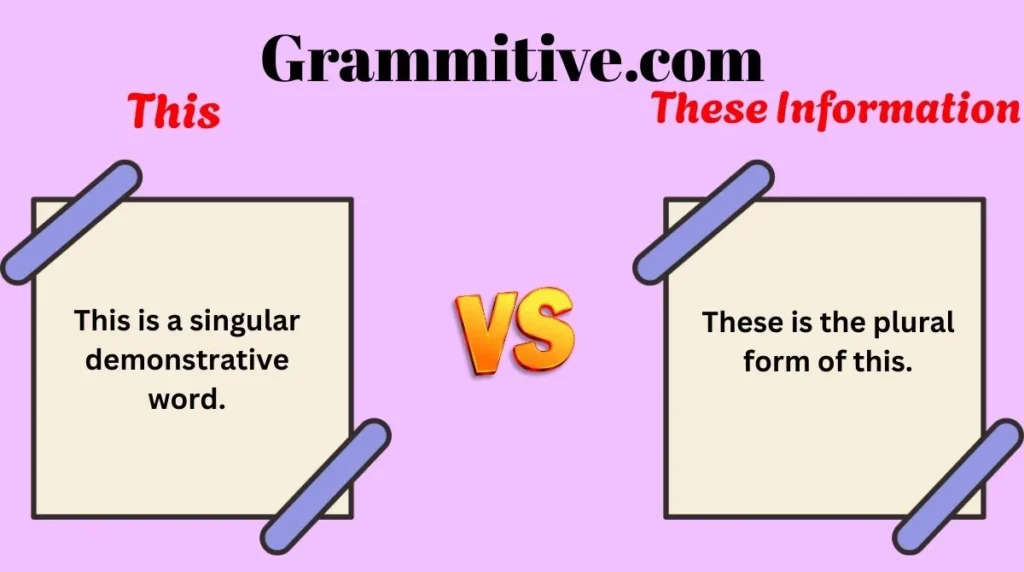
This is a singular demonstrative word.
We use this to talk about:
- one thing
- something close to us
- something happening now
- one idea or situation
Think of this = one.
When to use it
Use this with:
- singular countable nouns → this book, this phone
- uncountable nouns → this water, this money, this information
Yes, uncountable nouns also use this.
Grammar rule
This + singular or uncountable noun
Structure:
👉 this + noun
Examples:
- this car
- this problem
- this advice
- this information
Example sentences
- This book is very interesting.
- This coffee tastes strong.
- This idea might work.
- This information is helpful.
- This news sounds serious.
- This homework is easy.
- This water is cold.
- This message is important.
Common learner confusion
Students often think:
“Information sounds plural, so I should use these.”
But information is not plural in English.
It is an uncountable noun, so we treat it like water, rice, or money.
We never say:
❌ this informations
❌ these information
Only:
✅ this information
What Does “These” Mean?
Simple definition
These is the plural form of this.
We use these to talk about:
- more than one thing
- things close to us
Think of these = many.
When to use it
Use these only with plural countable nouns.
Structure:
👉 these + plural noun
Examples:
- these books
- these apples
- these questions
- these students
Grammar rule
These + plural countable noun
Never use these with singular or uncountable nouns.
Example sentences
- These cookies are fresh.
- These shoes are expensive.
- These people are my friends.
- These problems are difficult.
- These emails arrived today.
- These photos look great.
- These chairs are broken.
- These ideas are creative.
Common learner confusion
Many learners try to say:
❌ these information
❌ these advice
❌ these furniture
But these words are uncountable. They do not have plural forms.
So we must avoid these with them.
Difference Between This and These (Detailed)
Understanding the difference becomes easy when you remember one key idea:
👉 Countable = these possible
👉 Uncountable = only this
Comparison table
| Feature | This | These |
|---|---|---|
| Number | Singular | Plural |
| Used with | One thing / uncountable | Many countable things |
| Distance | Near | Near |
| Example | this information | these books |
| Verb form | is/was | are/were |
Usage difference
- This → one item or uncountable
- These → many separate items
Information is not separate pieces. It feels like one mass.
Just like:
- water
- sand
- sugar
We don’t count them individually.
Grammar logic
English divides nouns into two groups:
Countable nouns
You can count them:
- one book, two books
- one chair, three chairs
So you can say:
- this book
- these books
Uncountable nouns
You cannot count them directly:
- information
- advice
- furniture
- water
So you can only say:
- this information
- this advice
Never “these.”
Sentence structure difference
Singular/uncountable:
👉 This information is useful.
Plural:
👉 These books are useful.
Notice:
- this → is
- these → are
Meaning comparison
- This information → one body of facts
- These pieces of information → many separate facts
If you want plural meaning, you must change the structure.
Grammar Rules You Must Remember
Rule #1: Information is uncountable
You cannot add -s.
❌ informations
✅ information
Example:
✔ This information is correct.
Rule #2: Use “this” with uncountable nouns
Never use “these”.
Example:
✔ This advice helps me.
✔ This information is clear.
Rule #3: Use “these” only for plural countable nouns
Example:
✔ These questions are easy.
✔ These documents are ready.
Rule #4: Use “pieces of” for plural meaning
If you want to count information, use:
👉 piece(s) of information
Examples:
✔ two pieces of information
✔ several pieces of information
Sentence:
✔ These pieces of information are important.
Common Mistakes Students Make
Why mistakes happen
Most mistakes come from:
- direct translation from native language
- thinking information is plural
- hearing people speak fast
- not knowing uncountable nouns
Let’s fix them.
Wrong vs Correct
❌ These information are useful.
✅ This information is useful.
❌ Many informations
✅ Much information
❌ Three informations
✅ Three pieces of information
❌ These advice
✅ This advice
❌ These furniture
✅ This furniture
Easy correction tips
When you see “information,” ask:
👉 Can I count it?
If no → use this
If yes → use these
Simple.
Easy Trick to Remember the Difference
Here’s a memory trick my students love.
Think about water.
You would never say:
❌ these waters (when talking about drinking water)
You say:
✔ this water
Information works the same way.
Information = water for the brain.
Both are:
- not countable
- used as a mass
- take “this”
So just remember:
👉 Information flows like water → use THIS
Daily Life Examples (Very Important)
These are sentences people really say in daily English.
- This information helps me understand the problem.
- This information came from my teacher.
- Can you send me this information by email?
- This information is confidential.
- Thanks for this information.
- This information looks correct.
- I saved this information on my phone.
- This information is enough for now.
- Where did you get this information?
- This information makes me worried.
Notice something?
Every sentence uses this information.
Never “these information.”
Practice Section
Choose the correct answer.
Questions
- ___ information is important. (This / These)
- ___ books are mine. (This / These)
- I need two ___ of information. (pieces / piece)
- ___ advice helps me a lot. (This / These)
- ___ emails arrived today. (This / These)
Answers
- This
- These
- pieces
- This
- These
FAQs
What is the difference between this information and these information?
“This information” is correct because information is uncountable.
“These information” is grammatically wrong.
Use “these” only with plural countable nouns like books or files.
Can we ever say “these information”?
No. It is always incorrect in standard English.
If you want plural meaning, say “these pieces of information” instead.
Is information singular or plural?
Information is grammatically singular and uncountable.
It takes singular verbs like “is” and “was.”
Example: The information is correct.
How do I make information plural?
Use counting words.
Say “pieces of information,” “bits of information,” or “items of information.”
Never add -s to information.
Can we use this information in formal writing?
Yes. It is perfectly correct and common in both formal and informal English.
You will see it in emails, reports, and academic writing.
What other nouns behave like information?
Many nouns follow the same rule, such as advice, furniture, luggage, news, and equipment.
All of them use “this,” not “these.”
Final Conclusion
Small grammar points can feel frustrating at first, especially when they go against logic or your native language. “This or these information” is one of those tricky spots that confuses many learners.
But once you understand that information is uncountable, everything becomes simple. No plural form. No “these.” Just this information every time.
When you need to count, add helpful words like “pieces” or “items.” That small change makes your English sound natural and correct.
Try using the sentences from this guide in your daily speaking or writing. Practice helps your brain remember faster than memorizing rules alone.
Soon, you won’t even think about it. The correct form will come out naturally.
And that’s exactly how good grammar should feel — easy and automatic.

I am Lucas Bennett, a digital content creator passionate about social media trends and online growth strategies.
I share practical insights and guides to help users better understand and navigate the digital world.