
English learners often face small phrases that seem simple but cause a lot of confusion. One such phrase is choosing between “thanks everybody” and “thanks everyone.”
At first glance, they look almost identical. Both are polite ways to express gratitude, and both are widely used in English conversations, emails, or social media posts.
But there is a subtle difference that can change how natural your English sounds.
This topic is especially important because saying thanks correctly is not only about grammar—it also affects how polite and fluent you appear.
Using the wrong phrase might make your English sound slightly awkward or informal in ways you did not intend.
Many students mix them up because they both refer to “all the people,” but the choice depends on style, context, and even rhythm of speech.
After understanding this article, you will know exactly when to use “thanks everybody” and when to use “thanks everyone.”
You will also be able to spot common mistakes, remember simple rules, and confidently use these phrases in real-life conversations.
By the end, you’ll feel more natural and polite when thanking groups of people. You won’t just memorize rules—you will understand why one works better than the other.
What Does “Thanks Everybody” Mean?
Simple Definition
“Thanks everybody” is an informal way of saying thank you to all the people in a group. Here, “everybody” refers to all the members of a group individually.
When to Use It
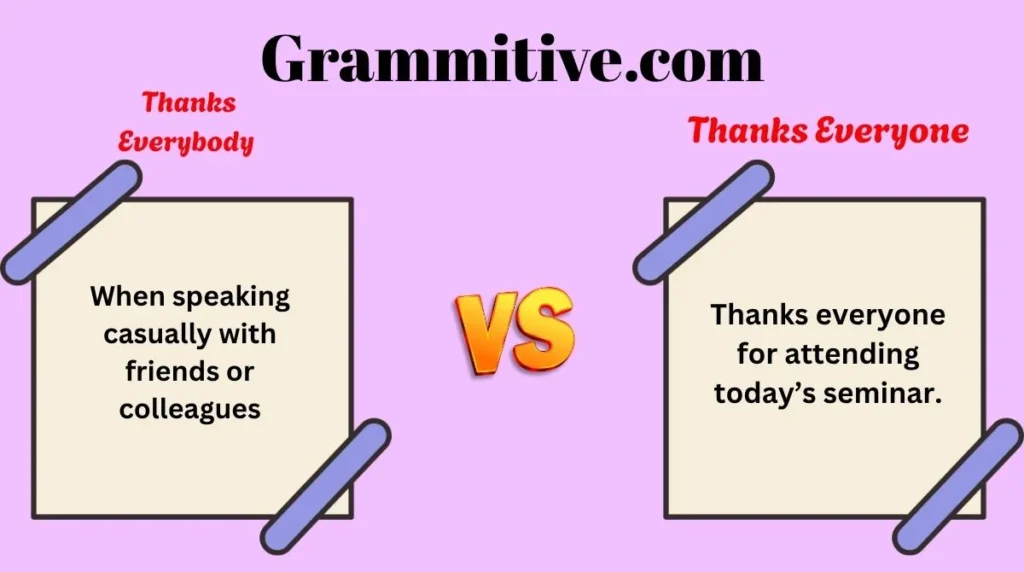
- When speaking casually with friends or colleagues
- When sending quick messages or chatting online
- In small groups where you know everyone personally
Grammar Rule
- Everybody is singular in grammar but refers to all people.
- You pair it with a singular verb if you need one in a sentence.
- In the phrase “thanks everybody,” the word “thanks” acts as an interjection, so verb agreement is not an issue here.
Example Sentences
- Thanks everybody for coming to my birthday party.
- Thanks everybody who helped me with my homework.
- Thanks everybody for your kind messages.
- Thanks everybody for joining the meeting today.
- Thanks everybody for your patience while we fixed the problem.
- Thanks everybody for supporting me in this project.
- Thanks everybody for the wonderful gifts.
- Thanks everybody—your help means a lot to me.
Common Learner Confusion
Many learners ask, “Can I use everybody in formal writing?” While it is grammatically correct, it is slightly informal. In professional emails, thanks everyone is often preferred. Some students also confuse everybody with everyone, thinking they are exactly the same, but subtle style differences matter.
What Does “Thanks Everyone” Mean?
Simple Definition
“Thanks everyone” is a slightly more formal or neutral way to thank all people. Here, “everyone” also refers to all people in a group, but it feels smoother and more polite in broader situations.
When to Use It
- In professional emails or messages
- In speeches or presentations
- In social media captions when addressing followers
- When you want a neutral, polite tone
Grammar Rule
- Everyone is singular in grammar, just like everybody.
- It always refers to all members of a group collectively.
- Use thanks everyone as an interjection or start of a sentence for smooth politeness.
Example Sentences
- Thanks everyone for attending today’s seminar.
- Thanks everyone for your hard work this week.
- Thanks everyone for your feedback on the report.
- Thanks everyone who participated in the contest.
- Thanks everyone for the warm welcome.
- Thanks everyone for being so understanding.
- Thanks everyone for your valuable suggestions.
- Thanks everyone for making this event a success.
Common Learner Confusion
Some learners wonder if everyone is more formal than everybody. Yes, in many cases, everyone is slightly more neutral or professional. Another confusion is pronunciation and rhythm—everyone sounds smoother in sentences with longer phrases.
Difference Between “Thanks Everybody” and “Thanks Everyone”
Understanding the subtle differences is key to speaking English naturally. Both words mean “all people,” but they have different tones, contexts, and frequencies in spoken versus written English.
| Feature | Thanks Everybody | Thanks Everyone |
|---|---|---|
| Formality | Informal / casual | Neutral / slightly formal |
| Best context | Friends, family, casual chats | Emails, speeches, public announcements |
| Tone | Friendly, personal | Polite, neutral |
| Usage frequency in speech | Common | Very common, even in formal settings |
| Interchangeable? | Sometimes, depends on context | Sometimes, depends on context |
| Common error | Overused in formal situations | Rarely sounds awkward |
| Example sentence | Thanks everybody for helping me today. | Thanks everyone for helping me today. |
Grammar Logic:
Both everybody and everyone are singular grammatically but refer to a group. The verb doesn’t change when using these phrases as interjections.
Sentence Structure:
- Thanks everybody → friendly opening or casual message.
- Thanks everyone → professional or neutral opening.
Meaning Comparison:
- Everybody feels more personal and intimate.
- Everyone is smoother and slightly more formal.
Grammar Rules You Must Remember
Rule #1: Singular Verb with “Everybody” and “Everyone”
Even though both refer to many people, they are grammatically singular.
- Example: Everybody is invited to the party.
- Example: Everyone has completed the assignment.
Rule #2: Use as Interjection
“Thanks everybody” or “Thanks everyone” can start a sentence without a verb.
- Example: Thanks everybody for your help!
- Example: Thanks everyone for attending.
Rule #3: Informal vs Neutral Context
- Use everybody in casual conversations.
- Use everyone in formal or neutral situations.
- Example informal: Thanks everybody for the gift.
- Example formal: Thanks everyone for your cooperation.
Rule #4: Adding Modifiers
You can add extra phrases to make it specific:
- Example: Thanks everybody who participated in the survey.
- Example: Thanks everyone for making this event possible.
Common Mistakes Students Make
Mistake #1: Using “everybody” in formal writing
- Wrong: Thanks everybody for reviewing the annual report.
- Correct: Thanks everyone for reviewing the annual report.
Mistake #2: Mixing singular and plural verbs incorrectly
- Wrong: Everyone are welcome to join.
- Correct: Everyone is welcome to join.
Mistake #3: Forgetting the polite tone
- Wrong: Thanks everybody, you did good.
- Correct: Thanks everybody, you did well.
Mistake #4: Using both together unnecessarily
- Wrong: Thanks everybody and everyone for coming.
- Correct: Thanks everyone for coming.
Correction Tips:
- Think about the tone first: casual → everybody, polite → everyone
- Remember: singular verb with both words
- Keep it simple, don’t combine them
Easy Trick to Remember the Difference
Think of everybody as friends and familiar people. Imagine saying “thanks” to your classmates, neighbors, or close colleagues—friendly and warm.
Think of everyone as a group you respect or don’t know closely. Imagine sending a thank-you email to a conference audience or posting on social media for followers—it’s polite and neutral.
Memory Trick:
- B in everybody → Buddy / casual
- E in everyone → Everyone / etiquette / formal

Daily Life Examples
Here are practical examples for real-life English:
- In class: “Thanks everybody for answering my question!”
- In a meeting: “Thanks everyone for attending today’s discussion.”
- Birthday party: “Thanks everybody for the lovely presents!”
- Online chat: “Thanks everyone for joining the live stream.”
- Work email: “Thanks everyone for submitting your reports on time.”
- Family gathering: “Thanks everybody for helping with the dinner.”
- Presentation: “Thanks everyone for listening so carefully.”
- Volunteer event: “Thanks everybody for your hard work today.”
- Social media: “Thanks everyone for the birthday wishes!”
- Class project: “Thanks everybody for your cooperation and effort.”
These examples show how natural the phrases sound in spoken English and written communication.
Practice Section
Choose the correct option for each sentence:
- ___ for coming to my party!
a) Thanks everybody
b) Thanks everyone - ___ who helped with the project!
a) Thanks everybody
b) Thanks everyone - ___ for your support during the seminar.
a) Thanks everybody
b) Thanks everyone - ___ for all the gifts!
a) Thanks everybody
b) Thanks everyone - ___ who joined the team meeting.
a) Thanks everybody
b) Thanks everyone
Answers: 1-a, 2-a, 3-b, 4-a, 5-b
FAQs
Q1: What is the difference between everybody and everyone?
- Both mean all people, but everybody is casual, and everyone is neutral or slightly formal.
Q2: Can we use “thanks everyone” in questions?
- Yes, for example: “Can I say thanks everyone for joining?” It is polite and acceptable.
Q3: Is “thanks everybody” formal or informal?
- It is informal and works best in friendly situations or casual messages.
Q4: Can I use both together?
- It is unnecessary to say both; choose one based on tone and context.
Q5: Does grammar change if the group is big?
- No, both everybody and everyone remain singular grammatically, no matter the size of the group.
Q6: Are these phrases correct in emails?
- Thanks everyone is preferred in emails, while thanks everybody is fine in informal chats or team messages.
Final Conclusion
Using thanks everybody and thanks everyone correctly may seem small, but it makes your English sound natural, polite, and confident.
Remember: everybody = casual, everyone = neutral/polite. Both words are singular in grammar, even though they refer to a group.
The best way to master them is to notice how native speakers use these phrases in conversations, emails, and social media.
Try practicing in real-life situations, like thanking classmates, colleagues, or friends.
Over time, choosing the right phrase will become instinctive, and your English will sound more natural and fluent.
Keep practicing, notice context, and soon saying thanks will feel effortless, friendly, and perfectly polite.

I am Lucas Bennett, a digital content creator passionate about social media trends and online growth strategies.
I share practical insights and guides to help users better understand and navigate the digital world.