

English can feel tricky sometimes, especially when verbs change form in strange ways. You learn a simple word like walk and it becomes walked.
Easy, right? Then you see a word like sweep, and suddenly you wonder… is it sweeped or swept?
Many learners get stuck here.
Both words look possible. Both sound like they could be correct. And since most regular verbs add -ed, your brain naturally wants to say sweeped. It feels logical.
But English doesn’t always follow logic.
Mistakes with past tense verbs are very common in daily speaking and writing. If you say the wrong form, native speakers may still understand you, but it can sound unnatural or incorrect.
This matters in school, exams, job emails, and conversations.
The good news? Once you understand this one rule, it becomes very easy.
By the end of this lesson, you will clearly know:
- Which word is correct
- Why the other form is wrong
- How to use the correct form in sentences
- A simple trick to remember forever
- Real-life examples you can copy
Think of this like a friendly classroom chat. Step by step, everything will make sense.
What Does “Sweeped” Mean?
Simple definition
Here is the honest answer first:
“Sweeped” is NOT a correct English word.
Yes, really.
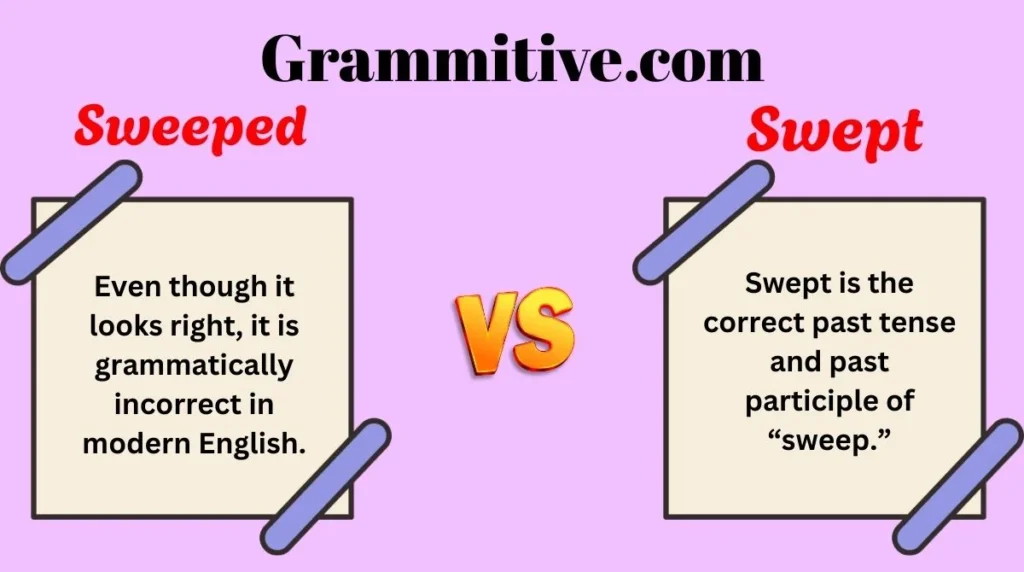
Even though it looks right, it is grammatically incorrect in modern English.
When to use it
You should not use “sweeped” at all in normal English.
You might sometimes see it:
- In very old books (hundreds of years ago)
- In poems for style
- In beginner mistakes
But in modern English, it is wrong.
Grammar rule
English verbs have two main types:
- Regular verbs → add -ed (walk → walked)
- Irregular verbs → change form (go → went)
Sweep is an irregular verb.
So it does NOT follow the “add -ed” rule.
That means:
❌ sweeped
✅ swept
Example sentences (showing mistakes learners make)
Here are sentences students often say incorrectly:
❌ I sweeped the floor yesterday.
❌ She sweeped the room quickly.
❌ He sweeped the kitchen after dinner.
❌ They sweeped the street in the morning.
❌ Mom sweeped the house before guests came.
❌ The wind sweeped the leaves away.
All of these are wrong because “sweeped” is not correct English.
Common learner confusion
Why do students say sweeped?
Because:
- 90% of verbs add -ed
- It feels natural
- It follows a pattern like “clean → cleaned”
Your brain wants patterns. English sometimes breaks those patterns.
So if you ever thought sweeped sounded right, don’t worry. Many learners think the same.
Now let’s look at the correct word.
What Does “Swept” Mean?
Simple definition
Swept is the correct past tense and past participle of “sweep.”
It means:
👉 cleaned something using a broom
👉 or moved quickly across something
👉 or carried away strongly (wind, water, emotions)
When to use it
Use swept when:
- Talking about yesterday or the past
- Using present perfect (have/has/had)
- Describing something already cleaned or moved
Grammar rule
Verb forms:
| Form | Word |
|---|---|
| Base | sweep |
| Past | swept |
| Past participle | swept |
| -ing | sweeping |
So:
- I sweep every day.
- I swept yesterday.
- I have swept the floor.
Example sentences
Here are correct examples:
- I swept the floor this morning.
- She swept the kitchen after cooking.
- He swept the leaves from the garden.
- The wind swept the dust away.
- They swept the classroom before the exam.
- The rain swept across the city.
- Mom swept under the bed.
- The cleaner has already swept the hall.
Notice how natural these sound.
This is how native speakers talk.
Common learner confusion
Students sometimes think:
- swept sounds strange
- sweeped sounds more logical
But English history changed many verbs over time. Words like:
- keep → kept
- sleep → slept
- sweep → swept
They follow a similar pattern.
So swept actually fits a group of verbs.
Difference Between Sweeped and Swept (Detailed)
Here is a clear comparison.
Comparison table
| Feature | Sweeped | Swept |
|---|---|---|
| Correct English | ❌ No | ✅ Yes |
| Verb type | Regular form (wrong) | Irregular form (correct) |
| Used by natives | Never | Always |
| Grammar books | Incorrect | Correct |
| Exams | Wrong answer | Right answer |
Usage difference
There is really only one difference:
- Sweeped → mistake
- Swept → correct
So anytime you want the past of sweep, choose swept.
Grammar logic
Why?
Because sweep belongs to a special group where:
ee → e + pt
Examples:
- sleep → slept
- keep → kept
- weep → wept
- sweep → swept
Seeing the pattern helps a lot.
Sentence structure difference
Incorrect:
❌ I sweeped the floor.
Correct:
✅ I swept the floor.
Only one word changes, but the sentence becomes correct.
Meaning comparison
Both words try to express the same meaning.
But only swept is grammatically accepted.
So meaning is not the issue — correctness is.
Grammar Rules You Must Remember
Rule #1: Sweep is irregular
Not all verbs take -ed.
Example:
✅ She swept the house.
❌ She sweeped the house.
Rule #2: Past tense and past participle are the same
Both forms use “swept”.
Examples:
Past: I swept yesterday.
Perfect: I have swept already.
Rule #3: Follow the “kept/slept/wept” family
If you remember:
- keep → kept
- sleep → slept
Then:
- sweep → swept
Rule #4: Never guess by sound
Sometimes words that “sound right” are wrong.
Always check irregular verbs.
Example:
felt (not feeled)
left (not leaved)
swept (not sweeped)
Common Mistakes Students Make
Why mistakes happen
- Too many regular verbs
- Guessing rules
- Speaking fast
- Translating from native language
Wrong vs correct examples
❌ I sweeped my room.
✅ I swept my room.
❌ She has sweeped the floor.
✅ She has swept the floor.
❌ We sweeped after the party.
✅ We swept after the party.
Easy correction tips
- Say “kept, slept, swept” together
- Memorize as a group
- Practice daily
- Read aloud
Repetition helps your brain remember faster.
Easy Trick to Remember the Difference
Here’s a simple memory trick.
Think:
👉 “I slept, I kept, I swept.”
All three rhyme.
They sound similar.
Your brain loves rhymes.
So when you want to say the past of sweep, your mind will remember:
slept → kept → swept
Never sweeped.
It works like magic for many students.

Daily Life Examples (Very Important)
These sound like real conversations.
- “I swept the kitchen before breakfast.”
- “Can you sweep the floor? I already swept the balcony.”
- “Dad swept the garage yesterday.”
- “The wind swept the papers off the table!”
- “She swept under the sofa.”
- “We swept after the party.”
- “The cleaner has swept everything.”
- “He quickly swept the dirt outside.”
- “I just swept, so please don’t make it dirty.”
- “They swept the classroom together.”
You might hear sentences like these every day.
Practice Section
Choose the correct word:
Questions
- I ___ the floor this morning. (sweeped / swept)
- She has ___ the room already. (sweeped / swept)
- We ___ the leaves yesterday. (sweeped / swept)
- Dad ___ the garage after work. (sweeped / swept)
- The wind ___ the sand away. (sweeped / swept)
Answers
- swept
- swept
- swept
- swept
- swept
All answers use “swept”.
FAQs
1. What is the difference between sweeped and swept?
“Sweeped” is incorrect and not used in modern English. “Swept” is the correct past tense and past participle of sweep.
2. Can we ever use sweeped?
No. In modern grammar, you should never use it. It is considered a mistake.
3. Is swept formal or informal?
Both. It works in all situations — speaking, writing, exams, emails, and books.
4. Why doesn’t sweep follow the -ed rule?
Because it is an irregular verb. English has many verbs that change form instead of adding -ed.
5. Is swept used in perfect tenses?
Yes.
Examples:
I have swept.
She has swept.
They had swept.
6. How can I remember swept easily?
Group it with similar words: kept, slept, wept, swept. Saying them together helps memory.
Final Conclusion
Small grammar points like this can feel confusing at first. One letter changes, and suddenly the whole sentence feels uncertain. But once you know the rule, everything becomes simple.
Just remember one key idea: sweep is irregular.
So the correct past form is always swept.
Never use sweeped.
Practice a few sentences every day. Say them aloud. Write them in a notebook. Soon, “swept” will sound completely natural, and you won’t even think twice.
English improves step by step. Tiny lessons like this build strong foundations. Keep going, keep practicing, and these tricky verbs will stop feeling scary.
You’ve got this.

I am Lucas Bennett, a digital content creator passionate about social media trends and online growth strategies.
I share practical insights and guides to help users better understand and navigate the digital world.