
Many English learners get confused between “sunset” and “sunrise.”
These two words sound similar and are both about the sun, but they happen at completely different times of the day.
Understanding the difference is important because these words are used in daily conversations, storytelling, and even in writing about feelings or nature.
For example, someone might say, “I love watching the sunset” or “I wake up early to see the sunrise.” If you mix them up, it can change the meaning of your sentence.
Beginners often struggle because both words describe beautiful sun moments, and people sometimes use them interchangeably by mistake.
Learning the correct meaning can make your English sound natural and confident.
Once you understand the difference, you will also know when to use each word in sentences, questions, or conversations.
After reading this guide, you will clearly know:
- What “sunset” and “sunrise” mean
- How to use them correctly in English
- Common mistakes to avoid
- Easy tricks to remember the difference
- How to talk about them in everyday conversations
By the end, talking about morning and evening sun moments will feel simple, natural, and fun!
What Does “Sunset” Mean?
Simple Definition
“Sunset” is the time in the evening when the sun goes down below the horizon. It marks the end of the day and the beginning of the night.
When to Use It
Use “sunset” when you are talking about the evening sun, the changing colors in the sky, or the end of the day. It can also be used figuratively to describe endings in life or events.
Grammar Rule
- “Sunset” is a noun.
- You can use it as a subject, object, or in phrases like: “at sunset,” “during sunset,” “after sunset.”
Example Sentences
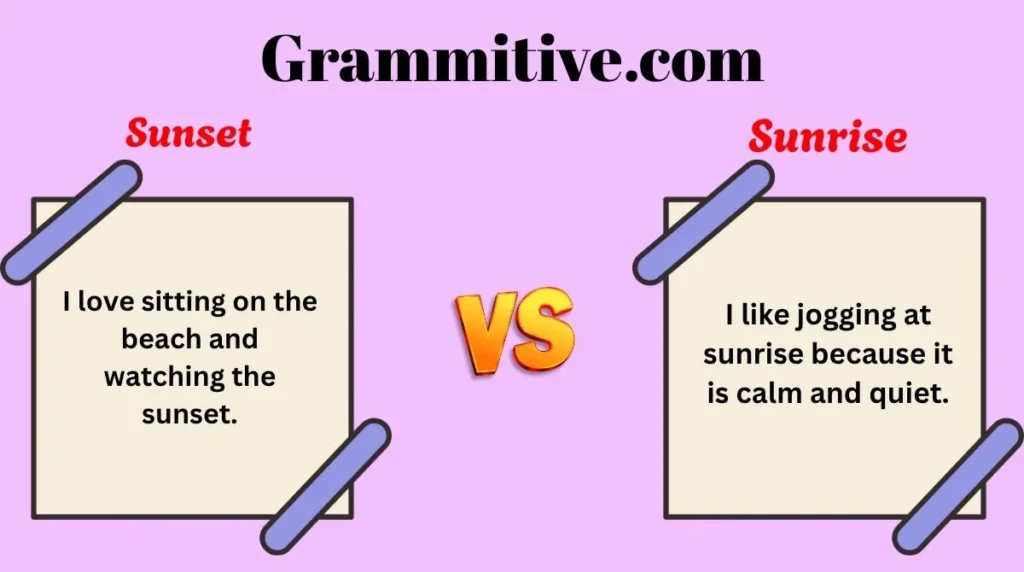
- I love sitting on the beach and watching the sunset.
- The sky turns orange and pink at sunset.
- We walked home just after sunset.
- The birds return to their nests at sunset.
- She took beautiful photos of the sunset over the mountains.
- Sunset is my favorite time of the day.
- They planned a picnic at sunset.
- The city looks magical during sunset.
Common Learner Confusion
Some learners confuse “sunset” with “sunrise” because both involve the sun. A typical mistake is:
- Wrong: I woke up early to see the sunset.
- Correct: I woke up early to see the sunrise.
Remember: sunset = evening, sun going down.
What Does “Sunrise” Mean?
Simple Definition
“Sunrise” is the time in the morning when the sun first appears above the horizon. It marks the start of a new day.
When to Use It
Use “sunrise” when talking about early morning, fresh starts, or new beginnings. People often use it to describe nature, exercise routines, or peaceful moments before the day begins.
Grammar Rule
- “Sunrise” is a noun.
- Common phrases: “at sunrise,” “during sunrise,” “before sunrise.”
Example Sentences
- I like jogging at sunrise because it is calm and quiet.
- The sunrise paints the sky with pink and gold.
- We woke up early to watch the sunrise.
- Sunrise is a symbol of hope and new beginnings.
- Birds sing loudly at sunrise.
- The mountains look stunning at sunrise.
- I took a photo of the sunrise from my balcony.
- Sunrise can be even more beautiful than sunset.
Common Learner Confusion
Learners often mistake sunrise for sunset because they both involve a colorful sky. Example:
- Wrong: The sunset is so peaceful in the morning.
- Correct: The sunrise is so peaceful in the morning.
Remember: sunrise = morning, sun coming up.
Difference Between Sunset and Sunrise
Understanding the difference is easier when we look at them side by side.
| Feature | Sunset | Sunrise |
|---|---|---|
| Time of Day | Evening | Morning |
| Sun’s Position | Going down | Coming up |
| Colors in Sky | Often red, orange, pink | Often pink, gold, light blue |
| Feelings | Calm, peaceful, ending | Fresh, hopeful, new beginnings |
| Common Phrases | at sunset, during sunset | at sunrise, before sunrise |
| Example | I watched the sunset at the beach. | I woke up early to see the sunrise. |
| Figurative Use | Ending, closing chapter | Beginning, new start |
Usage Difference
- Sunset is often used to describe endings, evenings, or reflections.
- Sunrise is used to describe beginnings, mornings, and fresh starts.
Grammar Logic
Both are nouns and used in similar sentence structures:
- Subject: Sunset is beautiful. / Sunrise is peaceful.
- Object: We watched the sunset. / We watched the sunrise.
- Prepositional: At sunset, the sky turned red. / At sunrise, the birds started singing.
Sentence Structure Difference
- Sunset sentences often include evening time expressions.
- Sunrise sentences often include morning time expressions.
Grammar Rules You Must Remember
Rule #1: Always Treat as Nouns
- Correct: I love sunsets.
- Incorrect: I love sunsetting.
Rule #2: Use Prepositions Correctly
- Correct: At sunrise, the birds sing.
- Correct: We walked home after sunset.
- Tip: At = specific moment; after/during = period of time.
Rule #3: Plural Forms for Multiple Days or Events
- Correct: We watched three sunrises on our trip.
- Correct: The beach looks amazing during all the sunsets.
Rule #4: Figurative Use
- Sunset can symbolize endings: The company faced its sunset.
- Sunrise can symbolize beginnings: This project is my sunrise.
Common Mistakes Students Make
Mistake #1: Confusing Time of Day
- Wrong: I like watching sunrise in the evening.
- Correct: I like watching sunset in the evening.
Mistake #2: Wrong Preposition
- Wrong: I woke up in sunset.
- Correct: I woke up at sunrise.
Mistake #3: Mixing Figurative Meaning
- Wrong: The sunrise of the old king was sad.
- Correct: The sunset of the old king was sad.
Easy Correction Tips
- Remember: sunrise = morning, sunset = evening.
- Use time clues in the sentence.
- Visualize the sun rising or setting.
Easy Trick to Remember the Difference
Think of the first letters:
- Sunrise = Start of the day
- Sunset = Sun goes down
Another trick: Imagine your day:
- Wake up → sunrise → start your day
- Evening → sunset → day ends, night begins
This helps your brain automatically link the word with the right time.
Daily Life Examples
- I love jogging at sunrise because the air is fresh.
- The sunset made the mountains look golden.
- She drinks tea while watching the sunrise.
- We took photos of the sunset on our vacation.
- Sunrise in the desert is absolutely stunning.
- The couple held hands and watched the sunset.
- Sunrise signals the start of a new adventure.
- He paints beautiful landscapes of sunsets.
- I set my alarm early to catch the sunrise.
- The sky turns pink and purple during sunset.
These sentences show natural ways people talk about sunrise and sunset. They are perfect for conversations, travel stories, and English writing.
Practice Section
Choose the correct word:
- I woke up early to see the _______. (sunset / sunrise)
- We went to the beach to enjoy the _______. (sunset / sunrise)
- The sky looked amazing at _______. (sunset / sunrise)
- Birds start singing at _______. (sunset / sunrise)
- I love walking after _______ to feel calm. (sunset / sunrise)
Answers:
- sunrise
- sunset
- sunrise
- sunrise
- sunset
FAQs
2. Can we use sunset and sunrise in questions?
Yes, for example: Did you see the sunrise today? or What time is sunset today?
3. Is sunset formal or informal?
Both words are neutral. You can use them in daily conversation, writing, or poetry.
4. Can sunrise describe feelings?
Yes. Sunrise often symbolizes hope, new beginnings, or positivity.
5. Can sunset describe endings?
Yes. Sunset can symbolize endings, reflection, or calmness after activity.
6. Are sunset and sunrise pluralizable?
Yes. You can say sunsets or sunrises when talking about multiple days or events.
Final Conclusion
Understanding the difference between sunset and sunrise makes your English sound natural and clear.
These two simple words tell us about time, nature, and even feelings. Remember: sunrise = morning, start of the day, sunset = evening, end of the day.
By practicing sentences, using time clues, and visualizing the sun, you will never mix them up again.
Try watching the sky every day and saying sentences aloud. Small daily practice builds confidence fast.
Soon, talking about mornings and evenings in English will feel easy and enjoyable.

I am Lucas Bennett, a digital content creator passionate about social media trends and online growth strategies.
I share practical insights and guides to help users better understand and navigate the digital world.