

English has many word pairs that look almost the same but mean completely different things. These small differences can cause big confusion. One such pair is stint and stent.
At first glance, they seem like twins. Only one letter changes. When you hear them spoken, they sound very close too. Because of this, many learners mix them up while writing or speaking.
But here’s the surprising part: these two words have completely unrelated meanings.
One word is common in everyday English. You may hear it at work, in school, or in daily conversations.
The other word belongs mostly to medical English.
So if you use the wrong one, your sentence can sound very strange… or even funny.
Imagine saying, “I worked a stent at the company.” That sounds like a hospital problem, not a job!
After reading this full guide, you will clearly understand:
- What stint means
- What stent means
- When to use each one
- Easy grammar rules
- Common mistakes
- Memory tricks
- Real-life examples
By the end, you’ll never confuse them again.
What Does “Stint” Mean?
Simple definition
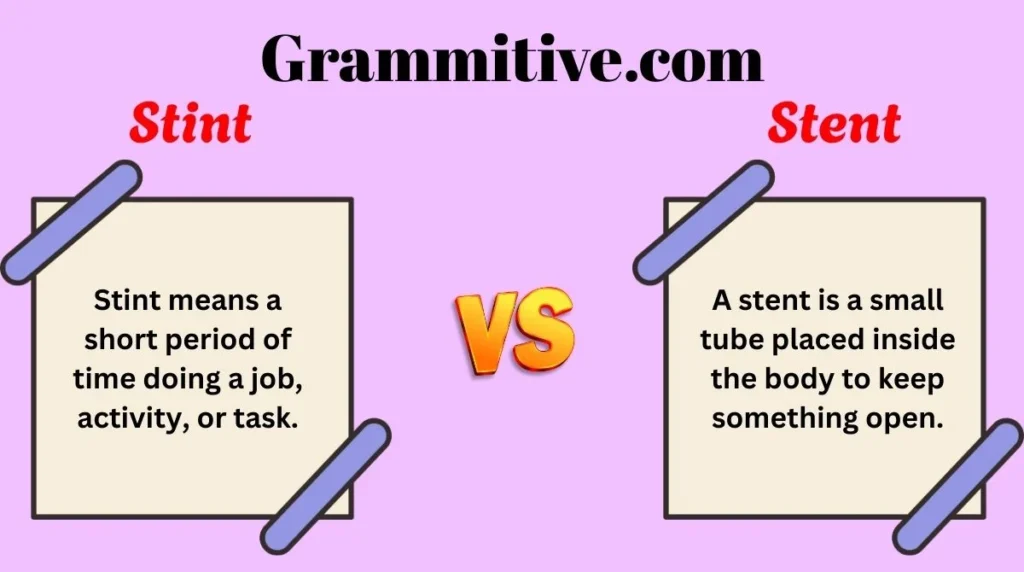
Stint means a short period of time doing a job, activity, or task.
It often talks about temporary work or service.
Think of it like:
👉 a short stay
👉 a short time working somewhere
When to use it
Use stint when talking about:
- A short job
- A temporary position
- Time spent doing something
- Limiting or not giving enough (another meaning, explained below)
Grammar rule
Stint can be:
- a noun → “a stint at a company”
- a verb → “to stint on something” (meaning to limit or not give enough)
Most learners use it as a noun.
Example sentences (noun)
- She did a stint at a local café during college.
- My brother completed a six-month stint in the army.
- He had a short stint as a teacher.
- After her stint in London, she moved back home.
- I worked a summer stint at the library.
- His stint at the company helped him gain experience.
- They finished their stint and left early.
- She enjoyed her stint abroad.
Example sentences (verb – “stint on”)
This is less common but still useful.
- Don’t stint on quality.
- They stinted on food to save money.
- He stinted on training and failed the test.
Here, stint means to give less than needed.
Common learner confusion
Students sometimes:
- spell it as stent
- use it for medical meaning
- think it means “long time”
Remember:
stint = short time
Never medical.
What Does “Stent” Mean?
Simple definition
A stent is a small tube placed inside the body to keep something open.
Doctors use it mostly in:
- heart arteries
- blood vessels
- sometimes other body parts
It helps blood or fluids flow properly.
When to use it
Use stent only in medical or hospital situations.
If you are not talking about health or surgery, you probably don’t need this word.
Grammar rule
Stent is almost always a noun.
Rarely used as a verb in technical medicine, but everyday English uses it only as a noun.
Example sentences
- The doctor inserted a stent into his artery.
- My grandfather needed a heart stent.
- The surgery placed two stents.
- The stent improved blood flow.
- She recovered quickly after the stent procedure.
- The hospital specializes in stent operations.
- The surgeon checked the stent position.
- Without the stent, the artery would close again.
Common learner confusion
Because the spelling is close to stint, students accidentally write:
❌ I did a stent at a bank.
❌ He had a stent working there.
But stent is never about work or time.
It’s only medical.
If it’s not a hospital topic, don’t use this word.
Difference Between Stint and Stent (Detailed)
Quick comparison table
| Feature | Stint | Stent |
|---|---|---|
| Meaning | Short period of work/time | Medical tube |
| Field | Daily life, jobs | Medicine |
| Part of speech | Noun & verb | Noun |
| Common with | job, work, service | heart, artery, surgery |
| Frequency | Common | Rare (medical only) |
Usage difference
Stint → time/activity
Stent → health/medical device
That’s the biggest difference.
If you talk about:
- job → stint
- internship → stint
- army service → stint
- surgery → stent
- heart problem → stent
Grammar logic
Stint behaves like other time words:
- a week
- a period
- a stay
- a stint
So you can say:
✔ a two-month stint
✔ a short stint
✔ her stint at school
But you cannot describe time with stent.
Sentence structure difference
Stint usually follows:
a stint + at/in/with + place
- a stint at Google
- a stint in the army
Stent usually follows:
a stent + in/inside + body part
- a stent in his heart
- a stent inside the artery
Meaning comparison
Think this way:
- stint → time spent working
- stent → tube inside body
Totally unrelated ideas.
Grammar Rules You Must Remember
Rule #1 – Use “stint” for short work or service
✔ She did a stint at the hospital.
❌ She did a stent at the hospital.
Rule #2 – Use “stent” only for medical devices
✔ The patient received a stent.
❌ The patient received a stint.
Rule #3 – “Stint” can be a verb (stint on)
✔ Don’t stint on effort.
❌ Don’t stent on effort.
Rule #4 – If it talks about time, never use stent
Time = stint
Body = stent
Easy rule to remember.
Common Mistakes Students Make
Why mistakes happen
- Similar spelling
- Similar pronunciation
- Typing fast
- Not knowing medical meaning
Wrong vs correct examples
❌ I worked a stent at the company.
✔ I worked a stint at the company.
❌ He finished his stent in the army.
✔ He finished his stint in the army.
❌ The doctor put a stint in his heart.
✔ The doctor put a stent in his heart.
Easy correction tips
When writing, ask yourself:
👉 “Am I talking about work or health?”
Work → stint
Health → stent
That one question fixes 99% of mistakes.
Easy Trick to Remember the Difference
Here’s a simple memory trick students love.
Stint → Time → T
STINT has T for Time
Both start with T.
So if it talks about time, choose stint.
Stent → Hospital → E
STENT has E like Emergency
Hospitals have emergency rooms.
So medical = stent.
Real-life logic
If you say:
“I did a stent at my job.”
Does that sound like a hospital?
Yes → wrong word.
Your brain will quickly notice the mistake.

Daily Life Examples (Very Important)
Here are real spoken sentences you might hear every day.
- I did a short stint at a call center last year.
- She had a stint as a babysitter.
- My dad completed a stint in the navy.
- After his stint abroad, he came home.
- I’m doing a weekend stint at the store.
- He never stints on effort.
- My uncle needed a heart stent last month.
- The doctor said the stent saved his life.
- She stayed in the hospital after the stent surgery.
- That internship was just a short stint.
Notice how naturally they fit different situations.
Practice Section
Choose the correct word: stint or stent
- She completed a three-month ___ at the company.
- The doctor inserted a ___ into his artery.
- He did a short ___ as a waiter.
- They placed two ___ during surgery.
- Don’t ___ on quality.
Answers
- stint
- stent
- stint
- stents
- stint
FAQs (SEO Focused)
1. What is the difference between stint and stent?
Stint means a short time doing a job or activity.
Stent is a medical tube placed inside the body.
One is everyday English, the other is medical.
2. Can we use stint in questions?
Yes. It works like a normal noun or verb.
Example: Did you do a stint there?
It’s common in both speaking and writing.
3. Is stent used outside hospitals?
Almost never.
It belongs to medical language.
In normal daily talk, you rarely use it unless discussing health.
4. Is stint formal or informal?
It’s neutral.
You can use it in casual talk or formal writing.
It fits both professional and everyday English.
5. Why do people confuse stint and stent?
They look and sound similar.
Only one letter changes.
Without context, learners easily mix them up.
6. Which word is more common in daily English?
Stint is much more common.
You hear it in jobs, internships, and experiences.
Stent appears mainly in medical news or hospitals.
Final Conclusion
Small spelling differences can create big meaning changes in English. Stint and stent are a perfect example. They look alike, but they live in completely different worlds.
One talks about time and work. The other belongs to medicine and surgery.
When you remember that stint = time and stent = hospital, the confusion disappears quickly. After a little practice, your brain will choose the right word automatically.
Try using “stint” in daily conversations. Write sentences about your past jobs or experiences.
The more you use it, the more natural it feels. And whenever you see “stent,” you’ll instantly know it’s medical.
Language learning becomes easier when you break things into simple ideas.
Keep practicing, keep noticing small differences, and you’ll grow more confident every day.
You’ve got this.

I am Lucas Bennett, a digital content creator passionate about social media trends and online growth strategies.
I share practical insights and guides to help users better understand and navigate the digital world.