
English has many words that look almost the same but mean very different things. These words can confuse even good students. One small spelling change can completely change the meaning.
A common example is stigmatism and astigmatism.
At first glance, both words look nearly identical. They sound similar too. Many learners think they are just two spellings of the same word.
Some even use them interchangeably. But here’s the surprise — one is a real medical term, and the other is usually a mistake or a very rare form.
This confusion happens a lot in daily life. People type the wrong word in Google. Students write it wrong in essays. Some even say it wrong when talking about eye problems.
Knowing the correct word matters. It helps you sound natural, educated, and clear. If you use the wrong word, people may not understand you.
After reading this guide, you will clearly understand:
- what each word means
- which one is correct in normal English
- when to use it
- common grammar rules
- real-life examples
- easy memory tricks
By the end, you won’t mix them up again.
What Does “Stigmatism” Mean?
Simple definition
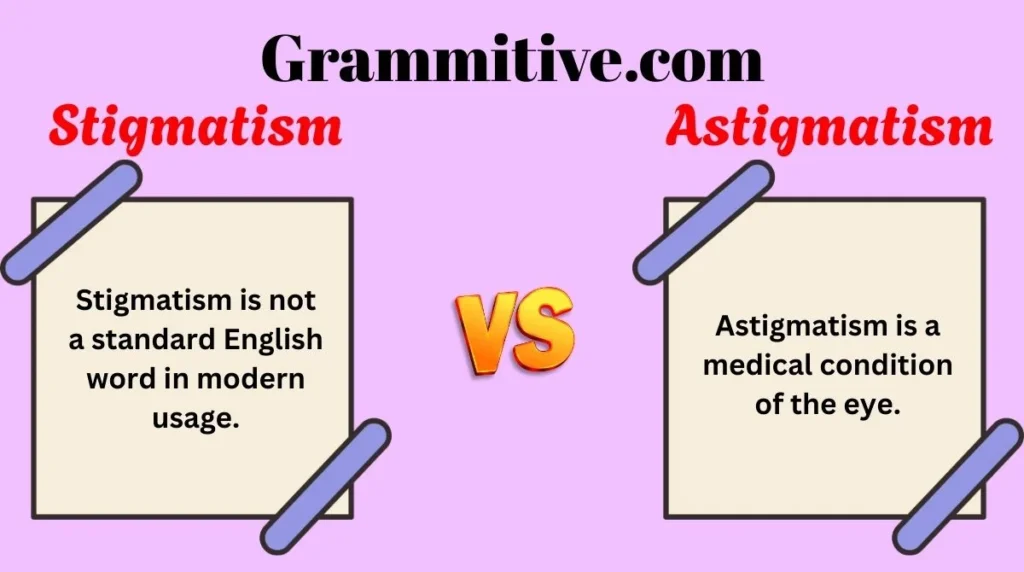
Stigmatism is not a standard English word in modern usage.
Most dictionaries do not list it as a normal word. When people use it, they usually mean astigmatism, but they spell it wrong.
In rare historical or scientific contexts, “stigmatism” might relate to the word stigma (a mark or spot). But in everyday English, it is almost always an error.
When to use it
In normal conversation or writing, you should not use stigmatism.
Instead, use:
- astigmatism (for eye problems)
- stigma (for social shame or mark)
Grammar rule
Because it is not standard, it has no proper grammar role. Treat it as a misspelling.
Example sentences (showing wrong usage)
These sentences show common mistakes learners make:
- ❌ I have stigmatism in my left eye.
- ❌ My doctor said my stigmatism is getting worse.
- ❌ She wears glasses because of stigmatism.
- ❌ Stigmatism makes things blurry.
- ❌ The teacher wrote about stigmatism on the board.
- ❌ I need surgery for stigmatism.
- ❌ Do you have stigmatism too?
All of these are incorrect.
Corrected versions
Replace with astigmatism:
- ✅ I have astigmatism in my left eye.
Common learner confusion
Why does this mistake happen?
Because:
- both words look similar
- “a” at the beginning is easy to forget
- pronunciation sounds close
- autocorrect sometimes fails
So students simply drop the “a”.
But that small letter changes everything.
What Does “Astigmatism” Mean?
Simple definition
Astigmatism is a medical condition of the eye.
It happens when the eye is not perfectly round. Because of this, light doesn’t focus correctly. Vision becomes blurry or distorted.
It is very common. Many people wear glasses or contact lenses because of it.
When to use it
Use astigmatism when talking about:
- eye health
- vision problems
- glasses or lenses
- doctor visits
- medical discussions
Grammar rule
Astigmatism is:
- a noun
- usually uncountable
We say:
- I have astigmatism
NOT - I have an astigmatism (usually)
Example sentences
- I have mild astigmatism.
- The doctor checked my eyes for astigmatism.
- Astigmatism can make driving at night difficult.
- My glasses correct my astigmatism.
- She was born with astigmatism.
- Contact lenses can fix astigmatism.
- Astigmatism causes blurry vision.
- Many children have astigmatism without knowing it.
Common learner confusion
Students often:
- spell it wrong
- say “stigmatism”
- forget the “a” sound
- think it’s related to “stigma”
But remember: this word is only about eyes, not social issues.
Difference Between Stigmatism and Astigmatism (Detailed)
This is where things become very clear.
One word is real and useful. The other is mostly a mistake.
Quick comparison table
| Feature | Stigmatism | Astigmatism |
|---|---|---|
| Is it standard English? | No | Yes |
| Word type | Not proper | Noun |
| Meaning | Usually error | Eye condition |
| Used in medicine? | No | Yes |
| Found in dictionaries? | Rarely | Yes |
| Should learners use it? | No | Yes |
Usage difference
- Stigmatism → spelling mistake
- Astigmatism → correct medical term
Grammar logic
Astigmatism functions like:
- blindness
- sickness
- happiness
It names a condition, so it behaves like an uncountable noun.
Sentence structure difference
Correct:
- I have astigmatism.
Incorrect:
- I have stigmatism.
Meaning comparison
Stigmatism → no clear meaning
Astigmatism → blurry or distorted vision
So the difference is not small. It’s huge.
Grammar Rules You Must Remember
Rule #1: Use only “astigmatism” for eye problems
✅ I have astigmatism.
❌ I have stigmatism.
Rule #2: Treat it as uncountable
✅ She has astigmatism.
❌ She has an astigmatism.
Rule #3: Use with “have,” not “am”
✅ I have astigmatism.
❌ I am astigmatism.
Rule #4: Use in medical or vision contexts only
✅ The glasses correct my astigmatism.
❌ My friend has social astigmatism. (wrong meaning)
Common Mistakes Students Make
Why mistakes happen
- Spelling similarity
- Fast typing
- Hearing the word wrong
- Mixing it with “stigma”
Wrong vs Correct
❌ I suffer from stigmatism.
✅ I suffer from astigmatism.
❌ My stigmatism is strong.
✅ My astigmatism is strong.
❌ He bought lenses for stigmatism.
✅ He bought lenses for astigmatism.
Easy correction tips
- Always check spelling
- Remember the starting “A”
- Think: “A for eye”
- Use a dictionary when unsure
Small habits stop big mistakes.
Easy Trick to Remember the Difference
Here’s a simple memory trick students love.
Think like this:
A + stigmatism
The A stands for:
👉 Eye
So:
A = Eye problem
No A = wrong word
Another trick:
Say:
“A for eye, astigmatism for my eye.”
It sounds funny, but it sticks in your brain.
Daily Life Examples (Spoken English Style)
These are natural sentences you may hear every day.
- I need new glasses. My astigmatism got worse.
- The doctor said my astigmatism is mild.
- Do you have astigmatism too?
- I can’t read small text because of my astigmatism.
- These lenses help my astigmatism a lot.
- My sister has astigmatism and wears contacts.
- Night driving is hard with astigmatism.
- The eye test showed slight astigmatism.
- I didn’t know I had astigmatism until last year.
- Glasses fixed my astigmatism immediately.
These sound natural and clear.
Practice Section
Choose the correct word.
- I have ______ in my right eye.
- My doctor diagnosed ______.
- She bought glasses for her ______.
- ______ can cause blurry vision.
- He typed the word ______ by mistake.
Answers
- astigmatism
- astigmatism
- astigmatism
- astigmatism
- stigmatism
FAQs
What is the difference between stigmatism and astigmatism?
Astigmatism is a real medical term for an eye condition. Stigmatism is usually just a spelling mistake or non-standard form.
Can we use stigmatism in English?
No. It is not accepted in modern English. Always use astigmatism instead.
Is astigmatism formal or informal?
It is neutral and medical. You can use it in both daily conversation and professional settings.
Is astigmatism countable?
Usually no. It is treated as an uncountable noun. We say “have astigmatism,” not “an astigmatism.”
Why do people say stigmatism?
Because they forget the first “a” or mishear the pronunciation. It’s a common spelling error.
How do I remember the correct spelling?
Think “A for eye.” If you remember the A, you’ll spell it correctly every time.
Final Conclusion
Small spelling differences can cause big confusion in English. Stigmatism and astigmatism look similar, but only one is correct.
Stigmatism is usually just a mistake. Astigmatism is the real word used for an eye condition that causes blurry vision.
Once you understand this, the problem disappears. Just remember the little “A” at the beginning. That letter protects you from errors.
Practice saying and writing the correct word. Use it in sentences. Read it aloud. The more you see it, the more natural it becomes.
Language learning is often about small details like this. Fixing them makes your English clearer and more confident.
And next time someone types “stigmatism,” you’ll quietly know the truth.

I am Lucas Bennett, a digital content creator passionate about social media trends and online growth strategies.
I share practical insights and guides to help users better understand and navigate the digital world.