

English learners often stumble over words that sound similar but have completely different meanings. One of the most common examples is “stear clear” vs “steer clear.”
These two phrases sound almost the same, but only one of them is correct in everyday English. Getting it wrong can confuse your listeners or make your writing look careless.
If you’ve ever wondered why some English speakers say “steer clear of trouble” while others write “stear clear,” you are not alone.
Non-native speakers often rely on how words sound, which is why spelling mistakes happen easily.
Understanding the difference between stear clear and steer clear is not just a matter of spelling—it’s about using the right expression in the right situation.
Using the correct form makes your English sound natural, confident, and fluent. This knowledge is especially important in daily conversations, emails, and even formal writing.
By the end of this guide, you will clearly understand:
- What stear clear means (and why it’s usually wrong)
- What steer clear means and how to use it properly
- How to remember the difference easily
- Common mistakes learners make and how to fix them
- Practical daily-life examples you can use immediately
Once you master this, you’ll never confuse these two phrases again. Your spoken and written English will sound more polished, and you’ll avoid embarrassing errors.
What Does “Stear Clear” Mean?
You might have seen “stear clear” in writing or online. Many learners mistakenly write this thinking it is correct.
Simple Definition
- “Stear clear” is not a correct English phrase. It is a misspelling or mishearing of “steer clear.”
Some learners think “stear” looks like “stir” or “gear,” so they write it by mistake. But in real English, “stear” does not exist as a verb or phrase in this context.
When You Might See It
- In informal writing online
- In social media posts
- When non-native speakers guess the spelling
Common Confusion
- People confuse stear with steer, because both sound almost identical in speech.
- Some dictionaries or grammar guides might mention stear as a “common error,” but it is never correct in proper English.
Example Sentences (Incorrect – Do Not Use)
- I always try to stear clear of drama. ❌
- She told him to stear clear from the dangerous area. ❌
- We should stear clear of that argument. ❌
- He advised me to stear clear of unhealthy habits. ❌
- I’m going to stear clear from the gossip. ❌
Tip: If you see stear clear in a text or social media post, think of it as a spelling mistake.
What Does “Steer Clear” Mean?
Now let’s look at the correct phrase: “steer clear.”
Simple Definition
- “Steer clear” is an idiom in English.
- It means “to avoid someone or something” deliberately.
Think of it as guiding yourself away from trouble, danger, or any unwanted situation.
When to Use It
- To warn someone to stay away from danger
- To suggest avoiding bad habits
- In informal and semi-formal conversation
- In emails, advice, and everyday speech
Grammar Rule
- Steer is a verb.
- Clear acts as an adjective in this idiom.
- The structure is: steer clear of + noun
Correct Example Sentences
- I try to steer clear of traffic during rush hour. ✅
- You should steer clear of arguments at work. ✅
- She advised me to steer clear of junk food. ✅
- They always steer clear of trouble at school. ✅
- It’s better to steer clear of that neighborhood at night. ✅
- He promised to steer clear of risky investments. ✅
- We should steer clear of unnecessary expenses. ✅
- Parents often tell children to steer clear of strangers. ✅
Common Learner Confusion
- Learners sometimes write “stear clear” because it sounds correct.
- They also confuse steer as in driving a car vs steer clear as avoiding something.
Tip: Remember, “steer” here is figurative—you are “guiding” yourself away, not literally driving a vehicle.
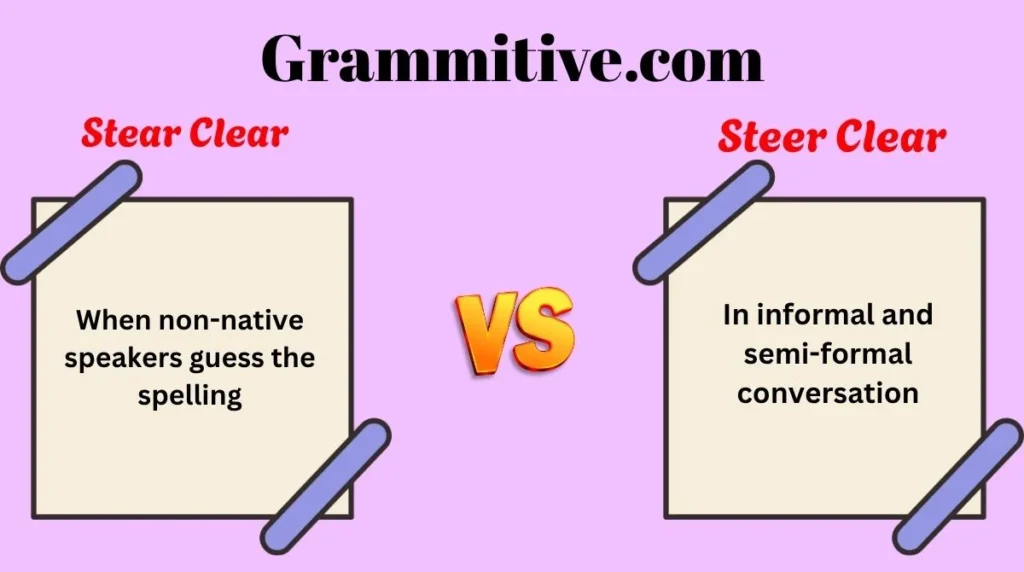
Difference Between Stear Clear and Steer Clear
Now let’s compare both expressions side by side.
| Feature | Stear Clear | Steer Clear |
|---|---|---|
| Correct English? | ❌ Not correct | ✅ Correct and widely used |
| Meaning | None (common spelling mistake) | To deliberately avoid something |
| Grammar | Incorrect usage | Verb + adjective idiom |
| Common Confusion | Spelling error | Misheard as “stear clear” |
| Example Sentence | I try to stear clear of gossip ❌ | I try to steer clear of gossip ✅ |
| Usage in Conversation | Rarely used, only in mistakes | Everyday spoken and written English |
| Formal/Informal | Not applicable | Informal to semi-formal |
Usage Difference Explained
- Steer clear is idiomatic and flexible. You can use it for people, habits, situations, or places.
- Stear clear should never be used in professional writing, exams, or formal communication.
Sentence Structure Difference
- Steer clear is always followed by “of + noun”:
- ✅ Steer clear of trouble
- ✅ Steer clear of fast food
- Stear clear has no grammatical correctness, so any following noun is technically wrong.
Grammar Rules You Must Remember
Rule #1: Use “steer clear of” with nouns
- Correct: I try to steer clear of gossip.
- Incorrect: I try to steer clear gossip.
Rule #2: Do not replace “steer” with “stear”
- Correct: She advised me to steer clear of that area.
- Incorrect: She advised me to stear clear of that area.
Rule #3: Keep it simple
- Avoid adding unnecessary words:
- ✅ Steer clear of conflict
- ❌ Steer clear away from conflict
Rule #4: Use in spoken and written English
- It works in conversations, emails, and informal writing:
- ✅ I usually steer clear of online arguments.
- ✅ Teachers tell students to steer clear of plagiarism.
Common Mistakes Students Make
Mistake #1: Writing “stear clear”
- Why it happens: Learners spell it as it sounds.
- Wrong: I always stear clear of unhealthy food.
- Correct: I always steer clear of unhealthy food.
Mistake #2: Forgetting “of”
- Wrong: She tries to steer clear junk food.
- Correct: She tries to steer clear of junk food.
Mistake #3: Overcomplicating the idiom
- Wrong: He is steering clear away from the situation.
- Correct: He is steering clear of the situation.
Easy Correction Tip: Remember the phrase is fixed: steer clear of + noun. Nothing else is needed.
Easy Trick to Remember the Difference
- Think of “steer” like driving a car. When you steer a car, you guide it away from obstacles.
- Similarly, “steer clear” means to guide yourself away from trouble or danger.
- Stear is a fake word—ignore it.
Memory Sentence:
“If you steer your car clear of a puddle, you steer yourself clear of trouble. Don’t stear!”
This logic works well for students. Whenever you hear stear, correct it in your mind to steer.

Daily Life Examples
Here are practical examples you can use in conversations:
- I steer clear of traffic jams every morning by leaving early.
- She always steers clear of drama at work.
- He wants to steer clear of fast food to stay healthy.
- We should steer clear of negative people.
- Teachers tell students to steer clear of cheating.
- I try to steer clear of online arguments.
- They steered clear of that dangerous street at night.
- Parents advise children to steer clear of strangers.
- She steers clear of gossip whenever possible.
- We should steer clear of overspending to save money.
Notice how natural these sentences sound. You can use them daily without thinking twice.
Practice Section
Choose the correct option in each sentence:
- I always ___ clear of arguments at work.
- a) stear
- b) steer ✅
- He advised me to ___ clear of unhealthy snacks.
- a) stear
- b) steer ✅
- We should ___ clear of that dangerous road.
- a) stear
- b) steer ✅
- She tries to ___ clear of drama at school.
- a) stear
- b) steer ✅
- It’s smart to ___ clear of online scams.
- a) stear
- b) steer ✅
Answers: 1-b, 2-b, 3-b, 4-b, 5-b
FAQs
Q1: What is the difference between stear clear and steer clear?
A1: “Stear clear” is incorrect. “Steer clear” is correct and means to avoid something.
Q2: Can we use steer clear in questions?
A2: Yes. Example: “Do you steer clear of junk food?”
Q3: Is steer clear formal or informal?
A3: It is mostly informal but can be used in semi-formal contexts.
Q4: Why do learners write stear clear?
A4: Because it sounds similar to steer. It’s a spelling mistake.
Q5: Can steer clear be used for people?
A5: Yes. Example: “I try to steer clear of negative people.”
Q6: Can I use steer clear in emails?
A6: Yes, especially in casual or friendly professional emails. Example: “Please steer clear of errors in your report.”
Final Conclusion
Confusing stear clear vs steer clear is a common problem, but now it’s easy to fix. Remember:
steer clear is correct and means avoiding someone or something. Stear clear is just a spelling mistake.
Using the idiom properly will make your English sound natural and fluent. Practice using it in your daily life, like avoiding traffic, unhealthy food, or gossip.
With repetition, it becomes automatic, and you’ll never make the mistake again.
English is full of tricky phrases, but once you understand one clearly, your confidence grows.
Keep practicing, and soon your speaking and writing will feel smooth, natural, and error-free.

I am Lucas Bennett, a digital content creator passionate about social media trends and online growth strategies.
I share practical insights and guides to help users better understand and navigate the digital world.