
English learners often get confused between state and status. Both words are similar and sometimes seem to mean the same thing, but they are used in very different ways.
If you use the wrong word, it can make your sentence sound odd or unnatural. Imagine saying, “I am in a happy status” instead of “I am in a happy state.”
Native speakers would notice it immediately.
Understanding the difference between these two words is important because they appear in daily conversations, emails, official forms, and even social media.
Knowing how to use them correctly can make your English clearer and more professional.
For beginners, non-native speakers, and students, this confusion is common because both words deal with conditions or situations, but the rules for using them are not the same.
After reading this guide, you will clearly understand what state means, what status means, and how to use them correctly.
You will also learn easy tricks to remember the difference, common mistakes to avoid, and real-life examples to practice your English naturally.
By the end, you will feel confident using these words in conversations, writing, and exams.
What Does “State” Mean?
Definition:
The word state usually refers to the condition or situation of someone or something at a specific time. It describes how something is rather than its position or rank.
When to use it:
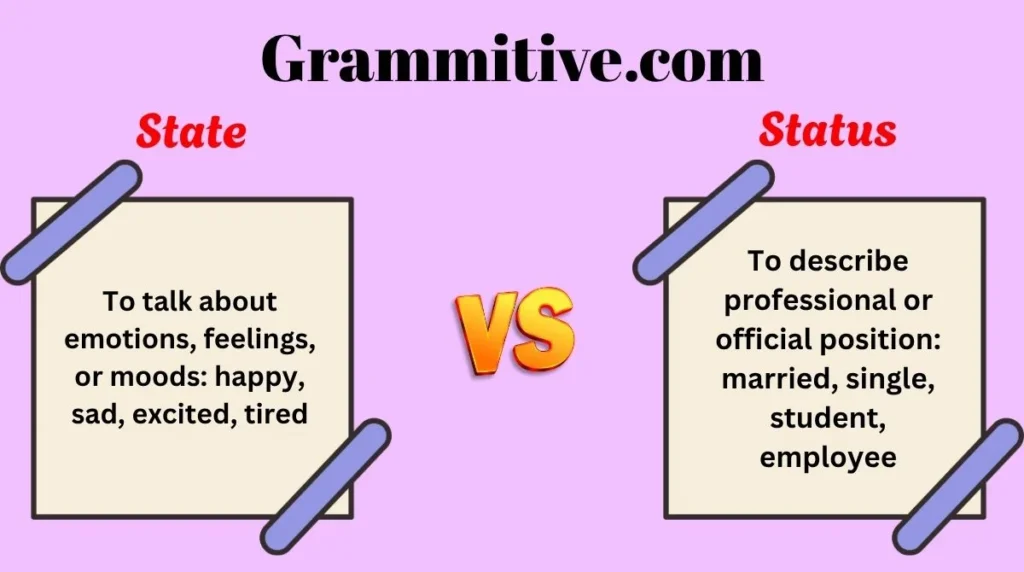
- To talk about emotions, feelings, or moods: happy, sad, excited, tired
- To describe physical conditions: clean, dirty, broken
- To explain temporary situations: under repair, in chaos, in order
Grammar Rule:
- State is a noun when talking about conditions.
- It can also be a verb when you “state” something formally, but we focus here on the noun form.
- Usually used with prepositions like in, of, or from.
Example Sentences:
- I am in a calm state today.
- The car is in a poor state after the accident.
- She was in a state of shock after hearing the news.
- The room is in a messy state; please clean it.
- He left the project in a terrible state.
- The patient is in a critical state in the hospital.
- I can’t concentrate because my mind is in a distracted state.
- The economy is in a stable state this year.
Common Learner Confusion:
Many students confuse state with status because both seem to describe “how things are.” The trick is to remember that state is about condition or situation, not rank or position. Saying “My state is married” is incorrect; instead, you say “My status is married.”
What Does “Status” Mean?
Definition:
The word status refers to the position, rank, or social condition of a person or thing. It often relates to formal, social, or official situations rather than feelings or conditions.
When to use it:
- To show social rank: high status, low status
- To describe professional or official position: married, single, student, employee
- To refer to online presence or updates: WhatsApp status, social media status
Grammar Rule:
- Status is always a noun.
- It is often used with prepositions like of, in, or as.
- Usually refers to long-term condition rather than temporary feelings.
Example Sentences:
- Her status as a doctor is respected in the community.
- He updated his status on social media.
- Marital status is required on this form.
- The company’s status in the market is improving.
- The application is pending, and its status is under review.
- High social status often comes with responsibility.
- What is your status at work? Are you full-time or part-time?
- The patient’s status has stabilized after treatment.
Common Learner Confusion:
Students often use status to describe temporary conditions, like mood or feelings. Saying “I am in a happy status” is incorrect. Remember: status is about rank, official position, or social situation, not feelings.
Difference Between State and Status (Detailed)
Understanding the difference is easier when we compare them side by side:
| Feature | State | Status |
|---|---|---|
| Meaning | Condition or situation | Position, rank, or official condition |
| Duration | Temporary, can change quickly | Longer-term, more formal |
| Context | Personal feelings, physical, temporary | Social, professional, official, formal |
| Examples | “She is in a happy state.” | “Her marital status is single.” |
| Prepositions | in, of, from | of, in, as |
| Common Mistake | Using for rank or position | Using for mood or feelings |
Usage Difference:
- State focuses on what something is like right now.
- Status focuses on what position, rank, or social label someone has.
Grammar Logic:
- “State” can describe emotional, physical, or mental conditions.
- “Status” usually describes legal, social, or official conditions.
Sentence Structure Difference:
- State: Subject + be + in a + state + of + condition
Example: I am in a state of confusion. - Status: Subject + be + status + of + official/social position
Example: My marital status is married.
Meaning Comparison:
Think of state as “how things are” and status as “what position or role things have.”
Grammar Rules You Must Remember
Rule #1: Use “state” for temporary conditions.
- Example: I am in a nervous state before exams.
Rule #2: Use “status” for social, official, or long-term positions.
- Example: Please fill out your marital status on the form.
Rule #3: “State” often comes with “of” to describe conditions.
- Example: She was in a state of panic.
Rule #4: “Status” often comes with “of” or “as” to describe roles or labels.
- Example: His status as a teacher is well-known.
Common Mistakes Students Make
Why mistakes happen:
- Both words seem similar.
- Learners translate directly from their native language.
- Social media encourages misuse (e.g., “I am in a happy status”).
Wrong vs Correct Examples:
- Wrong: I am in a tired status.
Correct: I am in a tired state. - Wrong: What is your current state at work?
Correct: What is your current status at work? - Wrong: She updated her state on WhatsApp.
Correct: She updated her status on WhatsApp.
Easy Correction Tips:
- Ask yourself: Am I talking about condition or feelings → use state.
- Am I talking about position, rank, or role → use status.
Easy Trick to Remember the Difference
Memory Trick:
- State = Situation now (temporary, feelings, conditions)
- Status = Social/official standing (long-term, role, rank)
Real-life Logic:
- You are in a state of excitement before a trip.
- Your status is “married” on official documents.
Student-friendly Explanation:
Think: State = how you feel or what condition something is in. Status = what label, rank, or title something has.
Daily Life Examples
Here are some sentences you can use in real life:
- I am in a worried state about my exam results.
- Please check the patient’s status in the hospital records.
- The car was in a dirty state after the trip.
- His status as a manager requires him to make big decisions.
- I updated my WhatsApp status yesterday.
- She is in a confused state after hearing the instructions.
- Your marital status must be listed on the application.
- The room was left in a messy state by the children.
- The company’s status in the market is very strong.
- He was in a joyful state after winning the competition.
Practice Section
Choose the correct word: state or status
- My current ___ is single.
- I am in a nervous ___ before the interview.
- The patient’s ___ is stable after surgery.
- The kitchen is in a messy ___ after cooking.
- His ___ as a teacher is respected by everyone.
Answers:
- status
- state
- status
- state
- status
FAQs
Q1: What is the difference between state and status?
A: State is about condition or feelings, temporary. Status is about position, rank, or official labels.
Q2: Can we use status in questions?
A: Yes. For example: “What is your marital status?”
Q3: Is state formal or informal?
A: State is neutral. It can be used in formal and informal contexts.
Q4: Is status only for formal writing?
A: Mostly yes, but it’s also used in social media and official documents.
Q5: Can state describe permanent situations?
A: Usually no. Use status for permanent roles or conditions.
Q6: Are state and status interchangeable?
A: No. Using them interchangeably can make your English incorrect.
Final Conclusion
Understanding the difference between state and status is simple once you focus on condition vs position.
State talks about how things are now — your feelings, moods, or physical situations. Status talks about official, social, or professional positions.
By practicing real-life examples and remembering the easy trick, you can use these words naturally in conversations, forms, and writing.
Mistakes happen, but careful observation and daily practice make a big difference.
Keep reading, listening, and using these words correctly, and your English will sound more confident and fluent.
Remember: think state = now, status = official. Soon, you won’t even have to think twice!

I am Lucas Bennett, a digital content creator passionate about social media trends and online growth strategies.
I share practical insights and guides to help users better understand and navigate the digital world.