
Many English learners stop for a moment when they see standalone and stand alone.
They look almost the same. Same words. Same spelling. Only a small space changes everything.
So people start asking:
Is there a difference?
Are both correct?
Which one should I write in exams?
Why does one look like one word and the other like two words?
This tiny space causes big confusion.
You might see sentences like:
- This is a standalone app.
- The house stands alone.
- This device works stand alone. (Is this right?)
It feels tricky because sometimes English joins words together and sometimes it doesn’t. And nobody explains clearly why.
But don’t worry. The rule is actually simple once you understand how grammar works.
After reading this guide, you will clearly know:
- What standalone means
- What stand alone means
- When to use each one
- How grammar changes the form
- Common mistakes students make
- Easy tricks to remember forever
By the end, you won’t hesitate again. You’ll choose the correct form naturally, just like native speakers do.
What Does “Standalone” Mean?
Simple meaning
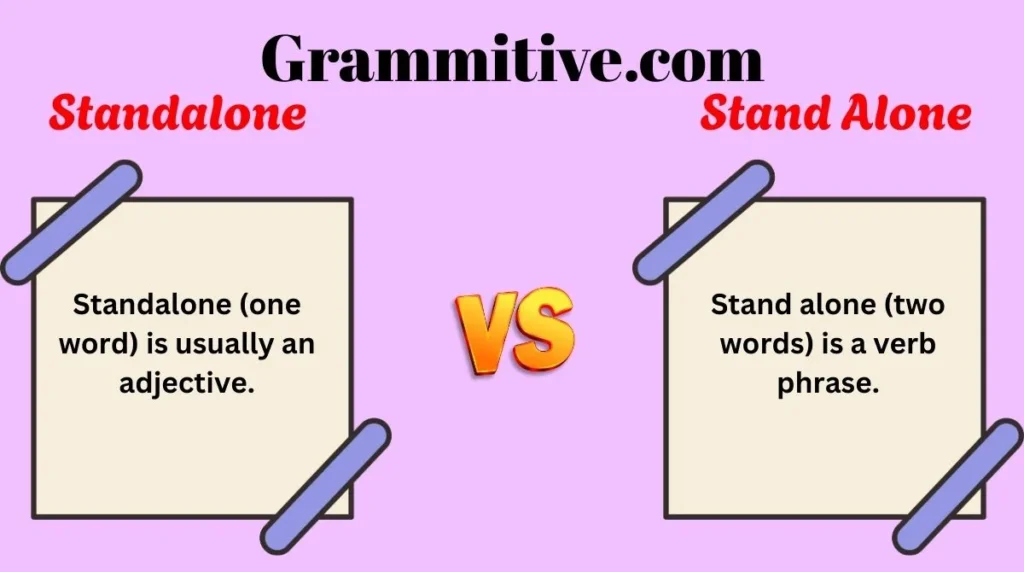
Standalone (one word) is usually an adjective.
It describes something that works by itself, independent, or not connected to anything else.
Think of it as meaning:
👉 independent
👉 separate
👉 self-contained
When to use it
Use standalone when you are describing a noun.
It comes before a noun most of the time.
Structure:
standalone + noun
Grammar rule
Because it acts like an adjective, it gives extra information about something.
Just like:
- big house
- fast car
- standalone device
Examples
- This is a standalone computer.
- We built a standalone website.
- The software has a standalone version.
- She bought a standalone camera.
- The system works as a standalone unit.
- They offer a standalone course for beginners.
- The printer is a standalone machine.
- It’s a standalone tool, not part of a set.
Common learner confusion
Many students write:
❌ This software works standalone.
But this sentence needs a verb, not an adjective.
So it sounds incomplete.
Better:
✅ This software works alone.
or
✅ This is a standalone software program.
Remember: standalone describes, it does not show an action.
What Does “Stand Alone” Mean?
Simple meaning
Stand alone (two words) is a verb phrase.
It means:
👉 to be alone
👉 to be separate
👉 to not depend on others
Here, stand is the verb and alone tells us how.
When to use it
Use stand alone when talking about an action.
Someone or something stands alone.
Structure:
subject + stand/stands/stood + alone
Grammar rule
Because it is a verb phrase, it changes with tense:
- stand alone
- stands alone
- stood alone
- standing alone
Examples
- The tree stands alone in the field.
- She stood alone at the bus stop.
- This idea stands alone without support.
- The building stands alone on the hill.
- He doesn’t want to stand alone.
- The statue stood alone for years.
- Their product stands alone in quality.
- I don’t like standing alone in crowds.
Common learner confusion
Students sometimes join the words:
❌ The house standalone on the hill.
But that’s wrong because we need a verb.
Correct:
✅ The house stands alone on the hill.
If you can change the tense, it’s a verb phrase.
Difference Between Standalone and Stand Alone (Detailed)
Understanding the difference becomes easy when you compare them side by side.
Quick comparison table
| Feature | Standalone | Stand Alone |
|---|---|---|
| Type | Adjective | Verb phrase |
| Words | One word | Two words |
| Function | Describes a noun | Shows action/state |
| Position | Before noun | After subject |
| Tense change | No | Yes (stand, stands, stood) |
| Example | standalone device | device stands alone |
Usage difference
Standalone → describes something
Stand alone → tells what something does
Compare:
- This is a standalone printer. (description)
- The printer stands alone. (action/state)
Same idea. Different grammar.
Grammar logic
English often creates compound adjectives by joining words.
For example:
- full-time job
- high-speed train
- standalone app
These describe something as a single idea.
But when words act separately with a verb, we keep them apart.
- stand alone
- sit down
- wake up
Sentence structure difference
Standalone (adjective)
👉 before noun
- a standalone system
- a standalone lesson
Stand alone (verb)
👉 after subject
- The system stands alone.
- The lesson stands alone.
Meaning comparison
Both express independence.
But:
- standalone = description
- stand alone = action or state
Small difference in grammar, same basic idea.
Grammar Rules You Must Remember
These rules will save you in exams and writing.
Rule #1 – Use standalone before a noun
✅ We built a standalone app.
❌ We built a stand alone app.
One word because it describes “app.”
Rule #2 – Use stand alone as a verb phrase
✅ The app stands alone.
❌ The app standalone.
Needs a verb, not adjective.
Rule #3 – If you can change tense, use two words
Try:
- stood alone
- standing alone
If this works, it’s definitely stand alone.
Example:
✅ The tower stood alone.
Rule #4 – Don’t use standalone after linking verbs
After verbs like is/are/was/seems, usually use:
- independent
- separate
- alone
Example:
❌ The system is standalone.
Better:
✅ The system is independent.
or
✅ It’s a standalone system.
Common Mistakes Students Make
Why mistakes happen
There are three main reasons:
- The words look similar
- Spell check doesn’t always help
- Learners don’t know adjective vs verb difference
Let’s fix the most common ones.
Mistake 1
❌ This software works standalone.
Problem: standalone cannot act as an adverb.
✅ This software works alone.
Mistake 2
❌ This device stand alone mode.
Wrong structure.
✅ This device has a standalone mode.
Mistake 3
❌ The building standalone.
Missing verb.
✅ The building stands alone.
Easy correction tip
Ask yourself:
👉 Am I describing something? → standalone
👉 Am I showing an action? → stand alone
Simple question. Instant answer.
Easy Trick to Remember the Difference
Here’s a trick my students love.
The “Space Test”
Look at the space.
If there is NO SPACE, think:
👉 “It sticks to the noun.”
So it stays close to the noun:
- standalone phone
- standalone course
If there IS SPACE, think:
👉 “It moves like a verb.”
Because verbs move and change.
- stands alone
- stood alone
Space = action
No space = description
Easy, right?
Daily Life Examples (Very Important)
These sound natural in real conversations.
- I need a standalone charger for my phone.
- This printer stands alone in the corner.
- They sell a standalone version of the game.
- That house stands alone near the lake.
- I prefer a standalone desk, not a built-in one.
- His opinion stands alone. Nobody agrees.
- We bought a standalone microwave.
- The old tree stands alone after the storm.
- The company offers a standalone service.
- She didn’t want to stand alone during the meeting.
These are everyday sentences you might hear at home or work.
Practice Section
Choose the correct option.
1
This is a ______ laptop.
(a) standalone
(b) stand alone
2
The cabin ______ in the woods.
(a) standalone
(b) stands alone
3
They created a ______ app.
(a) standalone
(b) stand alone
4
The statue ______ for 100 years.
(a) stood alone
(b) standalone
5
We need a ______ solution.
(a) standalone
(b) stands alone
Answers
1 → standalone
2 → stands alone
3 → standalone
4 → stood alone
5 → standalone
FAQs
1. What is the difference between standalone and stand alone?
Standalone is an adjective that describes a noun, like “standalone device.” Stand alone is a verb phrase that shows action, like “the device stands alone.”
2. Can we use standalone after a verb?
Usually no. It doesn’t work well after verbs. Instead, rewrite the sentence or use “alone” or “independent.”
3. Is standalone formal or informal?
It’s neutral. It’s common in technology, business, and everyday English. Perfectly fine for writing and speaking.
4. Can stand alone change tense?
Yes. Because it’s a verb phrase, it can change. For example: stands alone, stood alone, standing alone.
5. Do both forms mean the same thing?
Almost. Both show independence. The difference is grammar, not meaning.
6. Which one is more common in tech writing?
Standalone is very common in tech writing because many products are described as standalone apps, systems, or devices.
Final Conclusion
English sometimes feels confusing because small things like spaces can change grammar. But once you understand the pattern, everything becomes clear.
Standalone is simply an adjective. It describes something that works independently. Use it before a noun.
Stand alone is a verb phrase. It shows action or state. Use it after the subject.
That’s the whole story.
When writing, pause for one second and ask yourself: “Am I describing something or showing an action?” Your answer will guide you every time.
Practice with real sentences. Say them out loud. Notice how native speakers use them in conversations. Soon, choosing the correct form will feel natural and easy.
Keep learning, keep noticing small details, and your English will grow stronger day by day.

I am Lucas Bennett, a digital content creator passionate about social media trends and online growth strategies.
I share practical insights and guides to help users better understand and navigate the digital world.