
English has many words that look almost the same but mean different things. Sometimes, just one extra letter can change everything.
That is exactly what happens with snugly and snuggly.
Many English learners see both words online and feel confused. One spelling appears in books and dictionaries.
The other shows up in ads, baby clothes, or social media posts. So which one is correct? Which one should you use in school writing or exams?
This small spelling difference can make you sound either fluent or unsure. That is why it matters.
Imagine writing, “The baby slept snuggly.” Your teacher might mark it wrong. But then you see a store selling “snuggly blankets.”
Now you wonder what is right. It feels confusing, doesn’t it?
English is full of these tricky word pairs. But once you understand the meaning and grammar behind them, everything becomes clear and easy.
By the time you finish reading, you will clearly understand:
- the real meaning of snugly
- whether snuggly is correct or not
- which one to use in formal English
- simple grammar rules
- memory tricks
- everyday examples
After that, you will never mix them up again.
What Does “Snugly” Mean?
Simple meaning
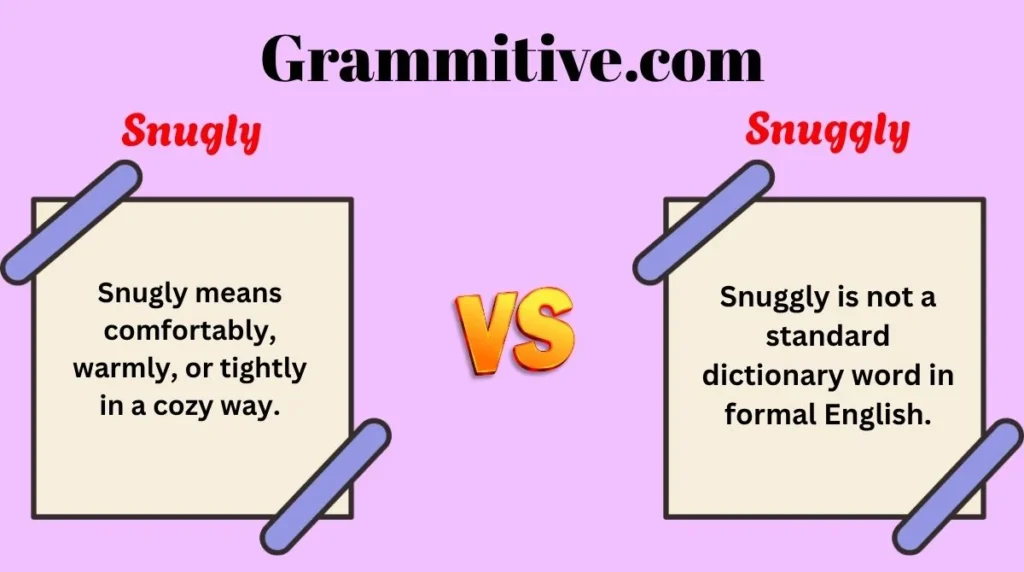
Snugly means comfortably, warmly, or tightly in a cozy way.
It describes something that fits well or feels warm and safe.
Grammar rule
Snugly = adverb
It comes from:
snug (adjective) + -ly = snugly
Adverbs usually describe verbs (actions).
So snugly tells us how something happens.
When to use it
Use snugly when you want to describe:
- how someone sleeps
- how clothes fit
- how something is wrapped
- how something stays warm or tight
Examples
- The baby slept snugly in her crib.
- He wrapped the scarf snugly around his neck.
- The cat curled up snugly on the sofa.
- The gloves fit snugly on my hands.
- She tucked the blanket snugly under the mattress.
- The coat sat snugly on his shoulders.
- The puppy hid snugly inside the box.
- The child snuggled snugly next to his mother.
Common learner confusion
Many students think “snugly” looks strange or too short. They feel it should have two g’s because of the word “snuggle.” But grammatically, snugly is correct because it comes from snug, not snuggle.
That one idea clears up most confusion.
What Does “Snuggly” Mean?
Simple meaning
Snuggly is not a standard dictionary word in formal English.
It is usually:
- an informal spelling
- a marketing word
- or a cute version of “snuggly/snuggable”
Some brands use it to sound sweet or cozy.
Grammar rule
There is no proper grammar rule for “snuggly” in standard English.
It does not come from normal word formation.
Correct forms are:
- snuggle (verb)
- snuggly/snuggly (rare or informal)
- snugly (correct adverb)
When people use it
You might see “snuggly” in:
- baby products
- blankets
- stuffed toys
- cute social media captions
- advertising
It is often used to create a soft, cuddly feeling, not correct grammar.
Examples (informal usage)
These are common but not grammatically correct in formal writing:
- This is a snuggly teddy bear.
- I bought a snuggly blanket.
- The pajamas are soft and snuggly.
- She looks snuggly in that sweater.
- My dog is so snuggly.
- These socks feel warm and snuggly.
- A snuggly winter coat.
- The baby looks extra snuggly today.
Common learner confusion
Students think:
“If snug is correct, and snuggle is correct, then snuggly must also be correct.”
But English does not always work that way.
Snuggly sounds cute, but it is not standard.
Teachers, exams, and formal writing prefer snugly.
Difference Between Snugly and Snuggly (Detailed)
Understanding the difference is easier when you compare them side by side.
Comparison Table
| Feature | Snugly | Snuggly |
|---|---|---|
| Part of speech | Adverb | Informal adjective |
| Dictionary word | Yes | Usually no |
| Correct spelling | Yes | Mostly no |
| Formal writing | Acceptable | Avoid |
| Usage | Describes actions | Describes feeling/cuteness |
| Example | Fit snugly | A snuggly toy (informal) |
Usage difference
- Snugly = describes HOW something happens
- Snuggly = describes a CUTE or COZY feeling (informal)
Grammar logic
Snug → snugly
Adjective → adverb
This follows normal English grammar.
But:
Snuggle → snuggly ❌ (not a standard pattern)
English does not usually add -ly like this.
Sentence structure difference
Correct:
- The baby slept snugly. (describes sleep)
Informal:
- The baby is snuggly. (sounds cute but not standard)
Meaning comparison
- snugly → warm and tight fit
- snuggly → cuddly feeling (baby talk or marketing)
Think: grammar vs cuteness
Grammar Rules You Must Remember
Rule #1 – Use snugly as an adverb
It describes actions.
Example:
She wrapped the baby snugly in a blanket.
Rule #2 – Adverbs usually end in -ly
If you describe HOW something happens, use an adverb.
Example:
The jacket fits snugly.
Rule #3 – Avoid made-up spellings in formal writing
Teachers and exams prefer standard words only.
Wrong:
The dog slept snuggly.
Correct:
The dog slept snugly.
Rule #4 – Use adjectives before nouns, adverbs after verbs
Correct:
The blanket is cozy.
He slept snugly.
Not:
He slept cozy.
Common Mistakes Students Make
Why mistakes happen
- both words look similar
- “snuggle” influences spelling
- social media uses “snuggly” often
- learners guess the spelling
Wrong vs Correct
❌ The coat fits snuggly.
✅ The coat fits snugly.
❌ She wrapped him snuggly.
✅ She wrapped him snugly.
❌ A snuggly sleeping baby (formal writing)
✅ A snug sleeping baby
or
✅ The baby slept snugly
Easy correction tips
- If describing action → snugly
- If writing an exam → never use snuggly
- Replace snuggly with cozy or cuddly
Easy Trick to Remember the Difference
Here is a simple memory trick.
Think about the word “hug”
When you hug someone, you hold them snug.
Snug → snugly → correct
But:
snuggle → cute sound only
Quick memory line
“Snug is real, so snugly is real.”
If you remember that, you will never be confused.
Daily Life Examples (Very Important)
These sound like real conversations.
- The baby slept snugly all night.
- Wrap the scarf snugly. It’s cold outside.
- These shoes fit snugly.
- The cat is sleeping snugly by the heater.
- Pull the blanket snugly over your shoulders.
- The jacket sits snugly around my waist.
- The child hid snugly under the covers.
- The hat fits snugly on his head.
- She held the pillow snugly while sleeping.
- The puppy curled up snugly next to me.
Notice how each one describes how something happens.
Practice Section
Choose the correct word: snugly or snuggly.
- The baby slept ______ in the crib.
- The coat fits ______.
- She wrapped the gift ______.
- This teddy bear looks ______. (informal)
- He tucked himself ______ under the blanket.
Answers
- snugly
- snugly
- snugly
- snuggly (informal only)
- snugly
FAQs
What is the difference between snugly and snuggly?
Snugly is a correct adverb that means comfortably or tightly. Snuggly is informal and mostly used in cute or marketing language.
Can we use snugly in questions?
Yes. It works like any adverb.
Example: Did the coat fit snugly?
Is snuggly wrong?
In formal English, yes. It is not standard. Avoid it in school or professional writing.
Is snugly formal or informal?
It is neutral and correct for both formal and casual writing.
Why do stores use snuggly?
Because it sounds soft and cute. It helps sell baby or cozy products. It is more about feeling than grammar.
Can I replace snuggly with another word?
Yes. Use cozy, cuddly, soft, or warm instead.
Final Conclusion
Small spelling differences can cause big confusion in English. Snugly and snuggly look almost the same, but only one follows proper grammar rules.
Snugly is the correct and standard word. It works as an adverb and describes how something fits, feels, or happens.
You can safely use it in school, exams, emails, and professional writing.
Snuggly, on the other hand, is mostly informal and playful. It appears in ads or cute captions.
It may sound sweet, but it is not grammatically strong. So it is better to avoid it in serious writing.
The good news is that the rule is simple. Remember “snug is real, so snugly is real.” Practice with daily sentences.
Notice how native speakers use it. After some time, the correct word will come naturally.
Language learning becomes easier when you focus on small details like this. Keep practicing, and your English will feel snugly comfortable too.

I am Lucas Bennett, a digital content creator passionate about social media trends and online growth strategies.
I share practical insights and guides to help users better understand and navigate the digital world.