
English has many word pairs that look almost the same but mean very different things. These pairs often confuse learners.
A small spelling change can create a completely new meaning.
One such confusing pair is slack and slake.
At first glance, they look nearly identical. Both start with sla- and sound similar when spoken quickly.
Because of this, many students mix them up while writing or speaking. Some even think they are just different spellings of the same word. But that is not true at all.
These two words belong to different situations. One is common in daily English. The other is rare and used in specific contexts like thirst or chemistry.
If you use the wrong one, your sentence may sound strange or completely wrong.
Understanding the difference helps you:
- speak more naturally
- write correct sentences
- avoid embarrassing mistakes
- improve your vocabulary
By the end, you will clearly know what each word means, when to use it, how grammar works with them, and how to remember them easily.
You’ll also see many real-life examples that feel natural and simple.
What Does “Slack” Mean?
Simple Definition
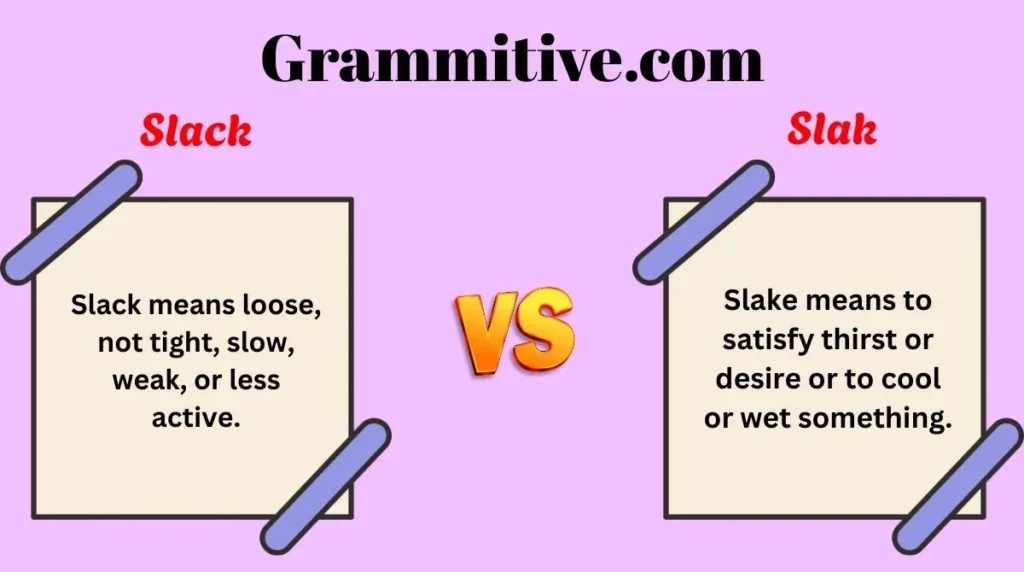
Slack means loose, not tight, slow, weak, or less active.
It can describe:
- ropes or clothes (not tight)
- work or business (slow)
- effort (lazy or not strong)
It is a very common everyday English word.
When to Use It
Use slack when something:
- loses tension
- becomes loose
- slows down
- becomes lazy or careless
It can be used as:
- adjective (slack rope)
- noun (cut me some slack)
- verb (to slack off)
Grammar Rule
Slack works in three ways:
| Form | Example |
|---|---|
| Adjective | The rope is slack |
| Noun | There is some slack |
| Verb | Don’t slack off |
Example Sentences
- The rope became slack after the wind stopped.
- Business is slack during winter.
- Please pull the wire tight. It looks slack.
- He started to slack off at work.
- The team’s energy went slack in the second half.
- Don’t give me slack excuses.
- There is too much slack in this schedule.
- She felt slack and tired after lunch.
Common Learner Confusion
Students often confuse slack with:
- lazy
- slow
- loose
But remember: slack usually describes a lack of tightness or activity, not always laziness.
For example:
❌ He is slack (sounds odd)
✅ He is lazy
Slack fits better with objects or situations, not personality alone.
What Does “Slake” Mean?
Simple Definition
Slake means to satisfy thirst or desire or to cool or wet something.
It is much less common than slack.
You usually see it in:
- books
- formal writing
- poetry
- science (like slaked lime)
When to Use It
Use slake when:
- thirst is satisfied
- hunger is satisfied
- desire is satisfied
- lime is mixed with water (chemistry)
It often appears with words like:
- thirst
- hunger
- desire
Grammar Rule
Slake is mainly a verb.
Structure:
- slake + thirst/desire/hunger
Example:
She slaked her thirst with cold water.
Example Sentences
- He drank water to slake his thirst.
- Nothing could slake her curiosity.
- The rain slaked the dry soil.
- They stopped to slake their thirst.
- The cool juice slaked my hunger.
- Reading helps slake my desire for knowledge.
- The workers slaked the lime with water.
- She needed tea to slake her tiredness.
Common Learner Confusion
Students rarely use slake because:
- it sounds old-fashioned
- it is not common in daily speech
- they mix it with slack
Most native speakers say:
✅ drink water
instead of
❌ slake thirst
So use slake carefully. It sounds more formal or literary.
Difference Between Slack and Slake (Detailed)
Both words look similar but behave very differently.
Here is a clear comparison.
Comparison Table
| Feature | Slack | Slake |
|---|---|---|
| Meaning | loose or slow | satisfy thirst/desire |
| Type | noun/verb/adjective | verb only |
| Common? | very common | rare |
| Tone | casual | formal/literary |
| Use with objects? | yes | yes |
| Daily speech? | yes | rarely |
Usage Difference
Slack → loosen or reduce activity
Slake → satisfy or quench
Examples:
- The rope is slack.
- He slaked his thirst.
Different ideas completely.
Grammar Logic
Slack:
- many forms
- flexible
Slake:
- mainly verb
- fixed structure
So if you need an adjective, slake cannot work.
❌ slake rope
✅ slack rope
Sentence Structure Difference
Slack:
- be + slack
- make something slack
- slack off
Slake:
- slake + thirst/desire
Different patterns mean different grammar.
Meaning Comparison
Slack → less energy
Slake → more satisfaction
One means reduce tension, the other means fulfill a need.
Opposite ideas in many ways.
Grammar Rules You Must Remember
Rule #1: Slack describes looseness
The rope is slack.
If it talks about tightness, use slack.
Rule #2: Slake needs an object like thirst
She slaked her thirst.
You must add what is satisfied.
Rule #3: Slack can be adjective
Business is slack today.
Slake cannot be used this way.
Rule #4: Slake sounds formal
He slaked his thirst at the river.
In daily speech, “drank water” sounds more natural.
Common Mistakes Students Make
Why Mistakes Happen
- Similar spelling
- Similar sound
- Rare use of slake
- Guessing meaning
Wrong vs Correct
❌ I slaked off today
✅ I slacked off today
❌ The rope is slake
✅ The rope is slack
❌ I slack my thirst
✅ I slake my thirst
❌ She slacked her thirst
✅ She slaked her thirst
Easy Correction Tips
Ask yourself:
- Is something loose or slow? → slack
- Is someone thirsty or hungry? → slake
Simple.
Easy Trick to Remember the Difference
Here is a fun memory trick.
Think about letters:
Slack → “lack” inside
Lack = less
So slack means less tight or less active.
Slake → “lake” inside
Lake = water
Water removes thirst
So slake = satisfy thirst
Lack → loose
Lake → drink
This trick works very well for students.
Daily Life Examples (Very Important)
These are natural spoken English examples.
- The rope is slack. Pull it tighter.
- Work has been slack this week.
- Don’t slack off before exams.
- Business gets slack after holidays.
- I drank cold juice to slake my thirst.
- The rain finally slaked the dry ground.
- He slacked off and missed the deadline.
- Nothing can slake her love for books.
- The shirt looks slack on you.
- They stopped walking to slake their thirst.
Notice how slack sounds casual, but slake sounds more book-like.
Practice Section
Choose the correct word: slack or slake
- The rope became ______.
- She drank water to ______ her thirst.
- Don’t ______ off at work.
- Business is ______ today.
- The rain helped ______ the dry land.
Answers
- slack
- slake
- slack
- slack
- slake
FAQs
What is the difference between slack and slake?
Slack means loose or slow. Slake means satisfy thirst or desire. They have totally different meanings and grammar uses.
Can we use slake in daily conversation?
Yes, but it sounds formal or old-fashioned. Most people simply say “drink water” instead of “slake thirst.”
Is slack formal or informal?
Slack is neutral and very common. It works in everyday speech and writing.
Can slack be a verb?
Yes. You can say “slack off,” which means to become lazy or slow down.
Can slake be an adjective?
No. Slake is mainly a verb. You cannot say “slake rope” or “slake day.”
Why do students mix them up?
Because they look and sound similar. But their meanings are very different, so memorizing examples helps.
Final Conclusion
Slack and slake may look like twins, but they behave like strangers.
Slack is common, simple, and used every day. It talks about looseness, slow activity, or reduced effort. You hear it at work, at school, and in normal conversations.
Slake is rare and more formal. It usually appears with thirst, hunger, or desire. You see it more in books than in daily speech.
Once you remember “lack” for slack and “lake” for slake, the difference becomes easy. Practice using them in short sentences. Read them out loud. Notice how they sound in context.
Small word differences can change meaning a lot. Paying attention to these details makes your English stronger and more natural.
Keep practicing, and these tricky word pairs will soon feel simple.

I am Lucas Bennett, a digital content creator passionate about social media trends and online growth strategies.
I share practical insights and guides to help users better understand and navigate the digital world.