
Many English learners feel confused when they hear words like situation and circumstance. At first, they look almost the same.
Both talk about problems, events, or things happening around us. Both appear in daily conversations. Both show up in books, news, and exams.
So learners often ask, “Aren’t they the same word?”
Not exactly.
Sometimes you can use either one. But many times, choosing the wrong word sounds strange or unnatural. Native speakers notice the difference quickly. For learners, this can be frustrating.
Imagine saying:
❌ I am in a difficult circumstance at work.
It sounds odd.
But:
✅ I am in a difficult situation at work.
Now it sounds natural.
Small difference. Big impact.
Understanding these two words helps you speak more clearly, write better essays, and sound more fluent. It also helps in tests like IELTS, TOEFL, or school exams.
By the end, you will clearly know:
- what each word really means
- when to use each one
- how grammar changes
- common mistakes to avoid
- easy tricks to remember forever
Think of this lesson like a friendly classroom talk. Simple, clear, and practical.
What Does “Situation” Mean?
Simple definition
Situation = the condition or state you are in at a specific time.
It describes:
- what is happening
- where you are
- what problem or condition exists
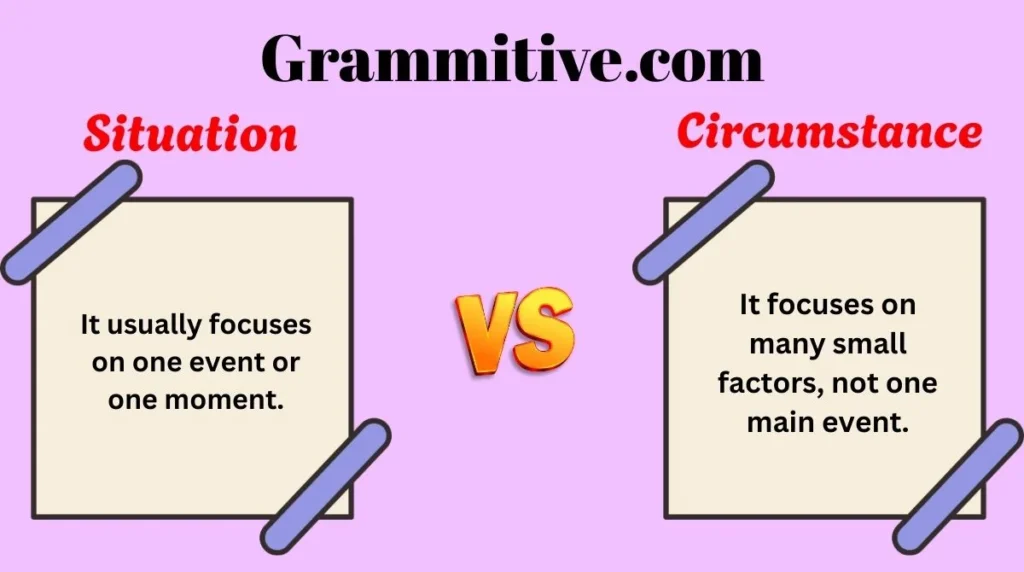
It usually focuses on one event or one moment.
When to use it
Use situation when you talk about:
- problems
- positions
- events happening now
- personal or social conditions
It is very common in daily English.
Grammar rule
Most common patterns:
- in a situation
- difficult situation
- current situation
- situation at work/home/school
- handle/deal with a situation
It is a countable noun, so we say:
- a situation
- many situations
Example sentences
- I am in a difficult situation right now.
- The money situation is getting worse.
- She handled the situation calmly.
- What would you do in my situation?
- The teacher explained the situation to the parents.
- It was an embarrassing situation.
- The traffic situation is terrible today.
- We need to improve our financial situation.
Common learner confusion
Many students think situation means only “problem.” But that’s not true.
It can also mean:
- good condition
- normal condition
- neutral condition
For example:
- The job situation is improving.
Not a problem — just a condition.
So remember: situation is neutral. It can be good or bad.
What Does “Circumstance” Mean?
Simple definition
Circumstance = the facts, details, or conditions around an event.
It describes:
- background details
- surrounding factors
- reasons something happened
It focuses on many small factors, not one main event.
When to use it
Use circumstance(s) when talking about:
- reasons behind something
- outside forces
- life conditions
- things we cannot control
It often appears in more formal English.
Grammar rule
Very important:
It is usually used in plural form → circumstances
Common patterns:
- under the circumstances
- due to circumstances
- special circumstances
- personal/financial circumstances
Singular form exists, but is less common.
Example sentences
- Under the circumstances, we had to cancel the trip.
- He lost his job due to family circumstances.
- They helped her because of her difficult circumstances.
- The police investigated the circumstances of the accident.
- In normal circumstances, this wouldn’t happen.
- Her financial circumstances improved.
- We cannot control our circumstances sometimes.
- The circumstances were beyond our control.
Common learner confusion
Students often say:
❌ I am in a bad circumstance.
This sounds unnatural.
Instead say:
✅ I am in a bad situation.
or
✅ I have difficult circumstances.
Notice:
- situation → specific problem
- circumstances → life conditions or background factors
Difference Between Situation and Circumstance (Detailed)
Now let’s look closely.
These two words overlap a little, but their focus is different.
Quick comparison table
| Feature | Situation | Circumstance(s) |
|---|---|---|
| Meaning | condition or state | surrounding factors |
| Focus | one event or problem | many background details |
| Tone | everyday, common | slightly formal |
| Countability | countable | often plural |
| Example | bad situation | difficult circumstances |
Usage difference
Situation
Talks about what is happening right now.
Example:
I am in a stressful situation at work.
Circumstances
Talks about the reasons or conditions behind something.
Example:
Because of financial circumstances, I quit my job.
Grammar logic
- situation → singular or plural
- circumstance → mostly plural
You rarely hear:
❌ a circumstance
But you often hear:
✅ circumstances
Sentence structure difference
Situation:
- in a situation
- deal with a situation
- improve the situation
Circumstances:
- under the circumstances
- because of circumstances
- due to circumstances
Notice the prepositions change.
Meaning comparison
Think like this:
- Situation = the problem itself
- Circumstances = everything around the problem
Example:
He lost his job.
- Situation → He is unemployed now.
- Circumstances → company closed, no money, family issues, bad economy.
See the difference? One is the main event. The other is background details.
Grammar Rules You Must Remember
Rule #1 — Use “situation” for specific events
✅ She is in a tough situation.
❌ She is in tough circumstances. (unnatural)
If you talk about one problem, choose situation.
Rule #2 — Use “circumstances” for background conditions
✅ Due to personal circumstances, he moved home.
❌ Due to personal situation (sounds odd)
If you explain reasons or life conditions, choose circumstances.
Rule #3 — “Circumstances” is usually plural
✅ difficult circumstances
❌ difficult circumstance
Almost always use the “s”.
Rule #4 — Common fixed phrases matter
Some phrases are fixed and cannot change.
Examples:
- under the circumstances
- in this situation
- special circumstances
- handle the situation
Memorize these chunks.
Common Mistakes Students Make
Why mistakes happen
The meanings overlap. Dictionaries sometimes explain both as “condition.” So learners think they are equal.
But natural English depends on usage patterns, not only dictionary meanings.
Mistake 1
❌ I am in a bad circumstance.
✅ I am in a bad situation.
Tip: single problem → situation.
Mistake 2
❌ Because of my situation, I couldn’t attend the wedding.
✅ Because of my circumstances, I couldn’t attend the wedding.
Tip: life reasons → circumstances.
Mistake 3
❌ Under the situation
✅ Under the circumstances
Tip: memorize this fixed phrase.
Easy correction tips
Ask yourself:
- One event? → situation
- Many reasons around it? → circumstances
Simple.
Easy Trick to Remember the Difference
Here’s a small memory trick my students love.
Think of letters
Situation → “site” inside → one place, one event
Circumstances → “circle” feeling → many things around
So:
- situation = center
- circumstances = around the center
Picture a circle:
Problem in the middle → situation
Everything around → circumstances
This visual idea makes it stick fast.
Daily Life Examples (Very Important)
These sound natural in real conversations.
- “I’m in a weird situation at work.”
- “Under the circumstances, we should stay home.”
- “It’s a complicated situation.”
- “She left because of family circumstances.”
- “How did you handle that situation?”
- “Given the circumstances, you did well.”
- “The housing situation is expensive these days.”
- “His financial circumstances are improving.”
- “That put me in an awkward situation.”
- “We couldn’t help it. The circumstances were out of our control.”
Try saying these out loud. They sound natural and smooth.
Practice Section
Choose the correct word: situation or circumstances
Questions
- I am in a difficult ______ at school.
- Due to personal ______, she canceled the trip.
- The traffic ______ is terrible today.
- Under the ______, we must wait.
- He handled the ______ very calmly.
Answers
- situation
- circumstances
- situation
- circumstances
- situation
FAQs (SEO Focused)
What is the difference between situation and circumstance?
A situation is a specific condition or event happening now. Circumstances are the background factors or reasons around that event. One is the main problem; the other is everything around it.
Can we use circumstance in singular form?
Yes, but it is rare. Native speakers usually say “circumstances.” Using the plural sounds more natural in daily English.
Which word is more formal?
Circumstances sounds slightly more formal and is common in official or written English. Situation is used more often in everyday speech.
Can situation be positive?
Yes. It can describe good or bad conditions. For example, “The job situation is improving.” It is neutral.
Is “under the situation” correct?
No. The correct phrase is “under the circumstances.” This is a fixed expression and cannot change.
How can I remember when to use each word?
Think: one problem → situation. Many reasons → circumstances. This simple idea works almost every time.
Final Conclusion
These two words may look like twins, but they play different roles in English. One points to the problem or condition you face. The other explains the background details around it. Once you see this difference, everything becomes easier.
Whenever you speak or write, pause for a second and ask yourself: “Am I talking about one event, or many surrounding reasons?” That small question guides you to the right choice.
Try using both words in your daily sentences. Notice how native speakers use them in movies, news, or conversations. Practice a little each day. Soon, you won’t even think about it — the correct word will come naturally.
Language learning is full of small steps like this. Master one pair of confusing words, and your confidence grows. Keep going. You’re improving more than you think.

I am Lucas Bennett, a digital content creator passionate about social media trends and online growth strategies.
I share practical insights and guides to help users better understand and navigate the digital world.