
English has many word pairs that sound almost the same but mean very different things. These pairs can confuse learners a lot. One small spelling change can completely change the meaning of a sentence.
A good example is shudder and shutter.
They look similar.
They sound similar.
But they are not related at all.
One word talks about a physical reaction in your body, like fear or cold.
The other talks about closing windows or cameras.
Because the pronunciation is close, many students mix them up while speaking and writing. Some learners even use the wrong word in exams or emails without noticing.
That can change the whole meaning of the sentence — and sometimes it sounds funny or strange.
Understanding the difference between these two words helps you:
- speak more clearly
- write correctly
- avoid embarrassing mistakes
- sound more natural in English
By the end of this guide, you will clearly know what each word means, when to use it, how to remember it, and how native speakers use them in daily life.
You’ll also see many simple examples so everything feels easy and natural.
Let’s start with the first word.
What Does “Shudder” Mean?
Simple definition
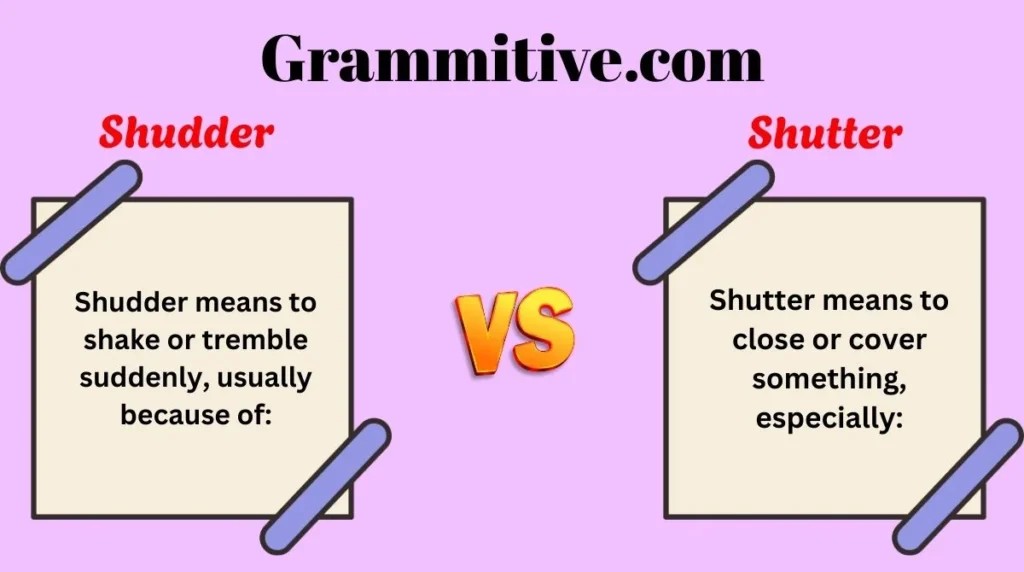
Shudder means to shake or tremble suddenly, usually because of:
- fear
- cold
- shock
- disgust
- strong emotion
It is a body reaction.
When something scares you or makes you uncomfortable, your body may move quickly or shake. That is a shudder.
When to use it
Use shudder when talking about:
- feelings
- physical reactions
- emotions
- fear or cold
It usually describes people or animals, not objects.
Grammar rule
Shudder is mainly:
- a verb → to shudder
- sometimes a noun → a shudder
Forms:
- shudder
- shuddered
- shuddering
- a shudder
Examples
- I shuddered when I heard the loud scream.
- She shuddered in the cold wind.
- The child shuddered with fear.
- He shuddered at the thought of spiders.
- I felt a shudder run down my back.
- She shuddered after watching the horror movie.
- The memory still makes me shudder.
- He gave a small shudder and closed his eyes.
Common learner confusion
Students sometimes think shudder means:
❌ to close something
❌ to shut something
But that’s wrong.
Remember: shudder = body movement, not closing doors or windows.
What Does “Shutter” Mean?
Simple definition
Shutter means to close or cover something, especially:
- windows
- shops
- cameras
It is about blocking light or closing an opening.
When to use it
Use shutter when talking about:
- closing a shop
- covering a window
- camera photography
- stopping business operations
It refers to objects and buildings, not feelings.
Grammar rule
Shutter can be:
- a noun → the shutter
- a verb → to shutter
Forms:
- shutter
- shuttered
- shuttering
- shutters
Examples
- Please shutter the windows before the storm.
- The store shuttered at 9 p.m.
- They shuttered the old factory last year.
- The photographer pressed the shutter button.
- Heavy metal shutters protect the shop.
- The café shuttered during the holidays.
- He forgot to close the shutters.
- The company shuttered its offices.
Common learner confusion
Some students use shutter when they mean fear:
❌ I shuttered when I saw the snake.
This is incorrect.
Because shutter is about closing, not shaking.
Difference Between Shudder and Shutter (Detailed)
These two words may sound alike, but their meanings are completely different.
Quick comparison table
| Feature | Shudder | Shutter |
|---|---|---|
| Meaning | shake or tremble | close or cover |
| Type | feeling/body reaction | object/action |
| Used for | people, emotions | windows, shops, cameras |
| Part of speech | verb, noun | verb, noun |
| Example | I shuddered in fear | Close the shutters |
Usage difference
Shudder → happens inside your body
Shutter → happens to objects or buildings
One is emotional.
One is mechanical.
Grammar logic
You shudder at something
You shutter something
Notice the grammar:
- shudder → often followed by at, with, from
- shutter → takes a direct object
Examples:
- I shuddered at the noise.
- They shuttered the store.
Sentence structure difference
Shudder:
- Subject + shudder + reason
- She shuddered with fear.
Shutter:
- Subject + shutter + object
- They shuttered the windows.
Meaning comparison
Think of it this way:
- Shudder → body moves
- Shutter → door or window moves
Very different ideas.
Grammar Rules You Must Remember
Rule #1: Shudder is about feelings or body reaction
✔ She shuddered with cold.
❌ She shuttered with cold.
Cold makes your body shake, not close.
Rule #2: Shutter usually needs an object
✔ They shuttered the shop.
❌ They shuttered.
You must say what you closed.
Rule #3: Shudder often uses “at” or “with”
✔ He shuddered at the sight.
✔ She shuddered with fear.
These small prepositions are common with this verb.
Rule #4: Shutters are physical things
✔ The house has wooden shutters.
❌ The house has wooden shudders.
Shudders are not objects.
Common Mistakes Students Make
Why mistakes happen
Mostly because:
- both words sound similar
- spelling is close
- pronunciation is fast in speech
- learners guess the meaning
Let’s fix the common errors.
Wrong vs correct examples
❌ I shuttered when I watched the horror movie.
✔ I shuddered when I watched the horror movie.
❌ Please shudder the window.
✔ Please shutter the window.
❌ The company shuddered last year.
✔ The company shuttered last year.
❌ I felt a shutter down my spine.
✔ I felt a shudder down my spine.
Easy correction tips
Ask yourself:
👉 Is it a feeling? → shudder
👉 Is it closing something? → shutter
This question solves 95% of mistakes.
Easy Trick to Remember the Difference
Here’s a simple memory trick students love.
SHUDDER → U → YOU (body)
The word has U.
Think U = you = your body.
So it’s about your body shaking.
SHUTTER → SHUT
See shut inside shutter?
Shut means close.
So shutter = close something.
This small trick helps you remember in seconds.
Daily Life Examples (Very Important)
Here’s how native speakers really use these words in everyday conversations.
- I shudder every time I see a horror movie.
- The cold wind made me shudder.
- She shuddered when the dog barked loudly.
- Don’t forget to shutter the windows tonight.
- The shop shuttered early because of the storm.
- He pressed the camera shutter.
- I still shudder at that memory.
- They shuttered the restaurant during repairs.
- The loud noise made the baby shudder.
- Close the shutters before you sleep.
Notice how natural and simple these sentences feel.
Practice Section
Choose the correct word: shudder or shutter
Questions
- I ______ when I saw the snake.
- Please ______ the door before leaving.
- She felt a ______ down her spine.
- The store ______ last winter.
- He ______ at the scary story.
Answers
- shuddered
- shutter
- shudder
- shuttered
- shuddered
FAQs
1. What is the difference between shudder and shutter?
Shudder means to shake because of fear, cold, or emotion. Shutter means to close or cover something like a window or shop. One is a body reaction, the other is a physical action.
2. Can we use shudder in questions?
Yes. You can say: “Did you shudder when you heard that noise?” It works like a normal verb.
3. Is shutter only used for windows?
No. It is used for windows, shops, businesses, and cameras. It can also mean closing a company permanently.
4. Which word is more common in daily speech?
Shudder is common in emotional stories or conversations. Shutter is common when talking about buildings or photography.
5. Can shudder be a noun?
Yes. Example: “I felt a shudder.” It can describe the shaking itself.
6. Why do learners confuse these words?
Because they sound similar and have almost the same spelling. But their meanings are totally different, so remembering the context helps a lot.
Final Conclusion
Small spelling changes can create big meaning changes in English. Shudder and shutter are perfect examples of that.
One talks about your body shaking with fear or cold. The other talks about closing windows, shops, or camera parts. Mixing them up is easy, but fixing the problem is simple once you understand the logic.
Try to connect each word with its idea. Shudder is about feelings inside you. Shutter is about shutting things outside you. That mental picture makes everything clear.
Keep reading, listening, and using these words in real sentences. Practice a few times, and you won’t forget them again. Soon, you’ll use both words naturally without even thinking.
English becomes easier when you notice these small details. Step by step, your confidence grows.

I am Lucas Bennett, a digital content creator passionate about social media trends and online growth strategies.
I share practical insights and guides to help users better understand and navigate the digital world.