
Many English learners feel confused when they see the words shelve and shelf. They look almost the same. They sound very close too. Just one small letter changes: f becomes v.
Because of this tiny change, students often mix them up in writing and speaking.
You may hear sentences like:
❌ I will shelf the meeting.
❌ Put the books on the shelve.
These sound strange to native speakers. But for learners, the mistake feels natural. The words look like twins.
Still, the meanings are very different. One is mostly a noun. The other is usually a verb. One talks about furniture, and the other talks about postponing or storing something.
Knowing the difference helps you:
- speak clearly
- write correct sentences
- avoid embarrassing mistakes
- sound more natural in daily English
After reading this guide, you will clearly understand:
- what each word means
- when to use each one
- grammar rules
- common mistakes
- simple memory tricks
- real-life examples
By the end, choosing the correct word will feel easy and automatic.
What Does “Shelve” Mean?
Simple definition
Shelve (verb) means:
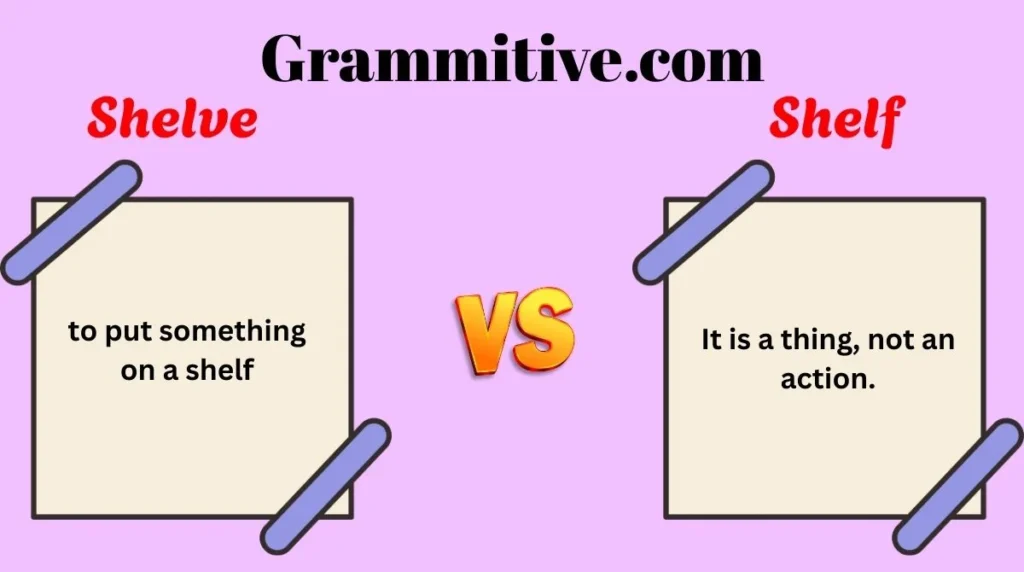
- to put something on a shelf
- to delay or postpone a plan or idea
So, this word is an action.
You do something. That is why it is a verb.
When to use it
Use shelve when:
- storing things on shelves
- stopping or delaying a project
- putting something aside for later
It is often used in offices, schools, and business English.
Grammar rule
Shelve = verb
Forms:
- shelve
- shelves (he/she/it)
- shelved (past)
- shelving (continuous)
Structure:
- shelve + object
Example:
✔ They shelved the plan.
Example sentences
- Please shelve these files alphabetically.
- The manager decided to shelve the project.
- We shelved the idea until next year.
- She shelved the dishes after washing them.
- Let’s shelve this discussion for now.
- He shelved the old books in the basement.
- The company shelved the new product launch.
- I had to shelve my travel plans.
Common learner confusion
Many learners think shelve is just another spelling of shelf.
They say:
❌ Put it on the shelve.
But shelve is not a place. It is an action.
Remember:
- shelf = thing
- shelve = action
What Does “Shelf” Mean?
Simple definition
Shelf (noun) means:
a flat board where you put things like books, food, or clothes.
It is a thing, not an action.
You can touch it.
When to use it
Use shelf when talking about:
- bookcases
- kitchen storage
- supermarkets
- walls
- furniture
It is very common in daily life.
Grammar rule
Shelf = noun
Forms:
- shelf (singular)
- shelves (plural)
Notice:
f → ves
Structure:
- on the shelf
- from the shelf
- off the shelf
Example sentences
- The book is on the shelf.
- Put the plates back on the shelf.
- This shelf is too high for me.
- We bought a new kitchen shelf.
- The toys fell off the shelf.
- That shelf holds many boxes.
- The store shelves are empty.
- I found my keys on the top shelf.
Common learner confusion
Some students write:
❌ I shelved the books on the shelf when they only mean placing books.
Sometimes it’s fine, but often they just need:
✔ I put the books on the shelf.
Using shelve can sound too formal or unnecessary in daily speech.
Difference Between Shelve and Shelf (Detailed)
These two words may look similar, but their grammar and meaning are very different.
Quick comparison table
| Feature | Shelve | Shelf |
|---|---|---|
| Part of speech | Verb | Noun |
| Meaning | put away / delay | flat board storage |
| Action or thing | Action | Thing |
| Example | shelve a plan | on the shelf |
| Past form | shelved | shelves (plural) |
Usage difference
Shelve
- talks about doing something
- often about delaying ideas
- more formal or professional
Shelf
- talks about a physical object
- very common in homes and shops
- everyday vocabulary
Grammar logic
Think simply:
- Verbs = actions → shelve
- Nouns = objects → shelf
If you can replace the word with do/put/delay, use shelve.
If you can replace it with table/board/place, use shelf.
Sentence structure difference
Verb structure:
- subject + shelve + object
Example: They shelved the proposal.
Noun structure:
- on/from/off + the shelf
Example: The milk is on the shelf.
Meaning comparison
- Put the jars on the shelf. → talking about location
- Shelve the jars. → action of placing them
- The idea is on the shelf. → rarely used
- Shelve the idea. → delay it
Notice how meaning changes a lot.
Grammar Rules You Must Remember
Rule #1 – Shelve is always a verb
✔ They shelved the plan.
❌ Put it on the shelve.
If you see “the”, it is probably a noun → shelf.
Rule #2 – Shelf is usually used with prepositions
Common phrases:
- on the shelf
- off the shelf
- from the shelf
✔ Take the box off the shelf.
Rule #3 – Plural of shelf is shelves
Not “shelfs”.
✔ The shelves are full.
❌ The shelfs are full.
Rule #4 – Shelve can mean delay
This meaning is very common in business English.
✔ We shelved the meeting.
= we postponed it
Common Mistakes Students Make
Why mistakes happen
- spelling looks similar
- pronunciation almost same
- learners guess without checking grammar
- mother tongue influence
Mistake 1
❌ Put it on the shelve.
✔ Put it on the shelf.
Tip: place = noun = shelf
Mistake 2
❌ The manager shelfed the plan.
✔ The manager shelved the plan.
Tip: past tense = shelved
Mistake 3
❌ The shelf the idea for later.
✔ They shelved the idea for later.
Tip: action needs verb → shelve
Mistake 4
❌ There are many shelfs.
✔ There are many shelves.
Tip: f → ves change
Easy correction tip
Ask yourself:
👉 “Is this an action or an object?”
If action → shelve
If object → shelf
Easy Trick to Remember the Difference
Here’s a simple memory trick students love.
Think about the letters
Shelf has F
F → furniture
A shelf is furniture.
Shelve has V
V → verb
Shelve is a verb.
Furniture vs verb.
F vs V.
Just one letter tells you everything.
This small trick saves you every time.
Daily Life Examples
These sound like real conversations. Notice how naturally each word is used.
- “Can you put the sugar back on the shelf?”
- “The top shelf is too high for me.”
- “Let’s shelve this topic until tomorrow.”
- “I shelved the old magazines in the garage.”
- “The cereal boxes are on the bottom shelf.”
- “They shelved the movie project because of money problems.”
- “Grab the towel from that shelf.”
- “We might have to shelve our vacation plans.”
- “The store shelves are almost empty today.”
- “She carefully shelved the glass cups.”
Notice how:
- talking about places → shelf
- talking about decisions → shelve
Practice Section
Choose the correct word: shelve or shelf
- Please put the jars on the ______.
- The company decided to ______ the new idea.
- That ______ is broken.
- We ______ the meeting until Monday.
- The books fell off the ______.
Answers
- shelf
- shelve
- shelf
- shelved
- shelf
FAQs
What is the difference between shelve and shelf?
Shelf is a noun that means a flat board for storage. Shelve is a verb that means to put something away or delay it. One is an object, the other is an action.
Can we use shelve in daily conversation?
Yes, but mostly for delaying plans or ideas. In normal home situations, people usually say “put on the shelf” instead of “shelve.”
Is shelve formal or informal?
It sounds slightly more formal or business-like. It is common in offices and meetings when talking about postponing projects.
What is the plural of shelf?
The plural is shelves. The spelling changes from f to ves. This is a common pattern in English nouns.
Can shelf be used as a verb?
In modern English, almost never. Some dictionaries show it as a rare verb, but learners should treat it as a noun only.
Why do learners confuse these words?
They look and sound similar. The spelling difference is small, so many people think they mean the same thing. Grammar practice helps avoid this mistake.
Final Conclusion
Small spelling differences can create big confusion in English. Shelve and shelf are perfect examples. One tiny letter changes everything. One word is an action. The other is an object.
Once you remember that shelf is furniture and shelve is a verb, the problem becomes simple.
When speaking or writing, pause for a second and ask yourself:
“Am I talking about a thing or an action?”
That quick question usually gives you the correct answer.
Practice using these words in daily sentences. Read them aloud. Listen to how native speakers use them. Over time, the difference will feel natural.
English becomes easier when you focus on small details like this. Keep learning step by step, and your confidence will grow every day.

I am Lucas Bennett, a digital content creator passionate about social media trends and online growth strategies.
I share practical insights and guides to help users better understand and navigate the digital world.