

English can be funny sometimes.
Two small words can create big confusion.
Many students often ask:
Should I say “I will send you the file” or “I will send to you the file”?
Both look correct. Both use the same verb. Both talk about giving something. So why does one sound natural and the other sounds strange?
This tiny difference causes problems in emails, messages, exams, and daily speaking. Even intermediate learners mix them up.
The good news is simple: once you understand the pattern, this topic becomes very easy.
You don’t need hard grammar terms. You just need clear logic and a few real-life examples.
After reading this guide, you will clearly know:
- when to say send you
- when to say send to you
- which one sounds natural in everyday English
- which structure native speakers prefer
- and how to avoid common mistakes forever
By the end, you’ll feel confident writing emails, chatting with friends, or speaking in class without second-guessing yourself.
Let’s make it simple and friendly — like a classroom talk.
What Does “Send You” Mean?
Simple meaning
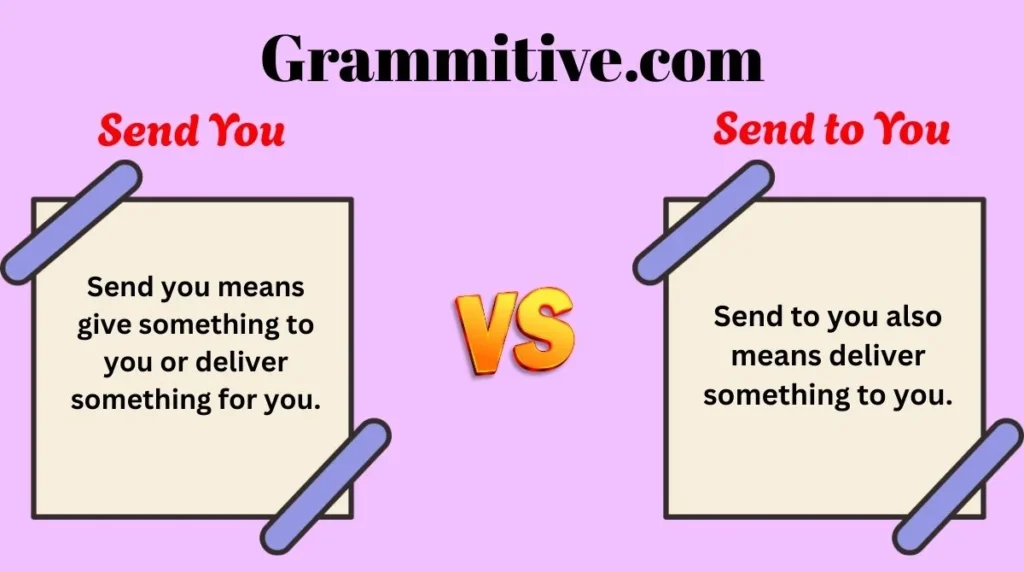
Send you means give something to you or deliver something for you.
It shows:
- who receives something (you)
- without using to
It’s shorter and smoother.
Native speakers use this structure most of the time.
When to use it
Use send you when:
- you mention the receiver directly after the verb
- you talk about people (me, you, him, her, them)
- you want natural, everyday English
This is called the double object pattern:
send + person + thing
Grammar rule
Structure:
Subject + send + person + thing
Examples:
- I send you a message.
- She sent me a photo.
- They will send him the details.
Notice: No “to” here.
Examples
- I will send you the report tonight.
- She sent me a birthday gift.
- Can you send him the address?
- They sent us an email yesterday.
- Please send her the documents.
- I’ll send you the link now.
- He sent them an invitation.
- We are sending you the tickets.
All these sound smooth and natural.
Common learner confusion
Many learners think:
“Send needs ‘to’ because it means movement.”
So they say:
❌ I will send to you the file.
But English doesn’t always work like logic. Some verbs allow two objects without to.
Send is one of those verbs.
So send you something is completely correct and very common.
What Does “Send to You” Mean?
Simple meaning
Send to you also means deliver something to you.
The meaning is the same.
But the structure is different.
Here we focus more on:
- the thing first
- then the receiver
When to use it
Use send to you when:
- the thing comes first
- the receiver comes later
- you want to emphasize the object
- or you sound a bit more formal
Grammar rule
Structure:
Subject + send + thing + to + person
Examples:
- I send the file to you.
- She sent a message to me.
Here to is necessary.
Examples
- I will send the report to you tonight.
- She sent the gift to me.
- Can you send the address to him?
- They sent an email to us.
- Please send the documents to her.
- I’ll send the link to you.
- He sent an invitation to them.
- We are sending the tickets to you.
All correct — just slightly more formal or less common in casual speech.
Common learner confusion
Students sometimes use this structure everywhere because:
“In school, teachers say ‘send to someone.’”
So they think:
✔ send to you is always right
❌ send you is wrong
But that’s not true.
Both are correct. One is just more natural.
Difference Between “Send You” and “Send to You” (Detailed)
Now comes the big question.
If both are correct, what is the real difference?
Here is a clear comparison.
Quick Comparison Table
| Feature | Send You | Send to You |
|---|---|---|
| Structure | send + person + thing | send + thing + to + person |
| “to” used? | No | Yes |
| Sounds | Natural, casual | Slightly formal |
| Common in speech | Very common | Less common |
| Focus | Person first | Thing first |
| Length | Short | Longer |
Usage difference
Send you feels friendly and conversational.
Used in:
- daily talk
- chats
- emails
- quick messages
Send to you feels:
- careful
- sometimes formal
- used when the object is more important
Grammar logic
English has two patterns:
Pattern 1 (Double object)
send + person + thing
→ send you the file
Pattern 2 (Prepositional)
send + thing + to + person
→ send the file to you
Both are grammatically correct.
But Pattern 1 is faster and easier to say.
That’s why native speakers prefer it.
Sentence structure difference
Look closely:
I sent you the photo.
(person first)
I sent the photo to you.
(thing first)
Same meaning. Different focus.
Meaning comparison
Usually, meaning does NOT change.
But sometimes emphasis changes.
Example:
“I sent YOU the photo.” (maybe not someone else)
“I sent the PHOTO to you.” (maybe not a message)
Small stress difference only.
Grammar Rules You Must Remember
Rule #1 – People come directly after the verb
✔ I sent you a message.
❌ I sent to you a message.
Never put to you before the object.
Rule #2 – Use “to” when the thing comes first
✔ I sent the message to you.
❌ I sent the message you.
Don’t remove “to” here.
Rule #3 – Pronouns usually prefer double object
With me, you, him, her, us, them, use:
✔ send you
✔ send me
✔ send him
This sounds more natural.
Rule #4 – Don’t mix both patterns
❌ I sent you to the file.
❌ I sent to you it.
Use only one structure at a time.
Common Mistakes Students Make
Why mistakes happen
- direct translation from native language
- overthinking grammar
- thinking “to” is always needed
- copying textbook style only
Wrong vs Correct
❌ I will send to you the details.
✔ I will send you the details.
❌ Please send me to the document.
✔ Please send me the document.
❌ She sent to him it.
✔ She sent it to him.
✔ She sent him it (less common but correct)
Easy correction tips
When speaking fast → use send you
When writing formal → either is fine
If confused → choose the shorter one
Shorter is usually more natural.
Easy Trick to Remember the Difference
Here’s a simple classroom trick.
Think like this:
When giving something to a person in real life, you put the person first.
Example:
You say, “Here, Ali, take this book.”
Not:
“Here, this book, Ali.”
So English works the same way.
Person first → send you
If you remember:
👉 People before things
You will almost always choose the correct structure.
Daily Life Examples (Very Important)
These sound exactly like real conversation.
- I’ll send you the notes after class.
- Can you send me the password?
- She sent him a voice message.
- I already sent you the money.
- Please send us the location.
- He sent her flowers yesterday.
- I’ll send you the photo on WhatsApp.
- They sent me the results this morning.
- Don’t worry, I’ll send you the link.
- Can you send them the invitation?
Notice how natural these feel.
You rarely hear:
“I’ll send the notes to you after class.”
It’s correct but less casual.
Practice Section
Choose the correct option.
- I will send ___ the email.
(a) you
(b) to you - She sent the gift ___ yesterday.
(a) you
(b) to you - Can you send ___ the address?
(a) me
(b) to me - They sent the message ___
(a) him
(b) to him - Please send ___ the tickets.
(a) us
(b) to us
Answers
1 → a
2 → b
3 → a
4 → b
5 → a
FAQs
What is the difference between send you and send to you?
Both mean the same thing. The first one is shorter and more natural. The second one uses “to” and sounds slightly formal. Native speakers mostly use the first form in daily speech.
Can we use send you in questions?
Yes, absolutely. It’s very common.
Example: “Can you send me the file?”
This sounds perfect and natural.
Is send to you more formal?
Yes, a little. It often appears in careful writing or when the object is important. But both forms are correct in grammar.
Which one do native speakers use more?
Native speakers usually say “send you” because it’s faster and easier. It feels more conversational.
Can I use both in the same sentence?
No. Choose one pattern only. Mixing both makes the sentence incorrect and confusing.
Is this rule only for send?
No. Many verbs work the same way.
For example: give, show, tell, bring, offer.
Example: “Give me the pen” or “Give the pen to me.”
Final Conclusion
Small grammar points often feel scary at first. But this one is actually very friendly once you see the pattern.
Both send you and send to you are correct English. The difference is mostly about structure and natural sound, not meaning.
If you remember one simple idea — people usually come first — you will rarely make mistakes.
In daily speech, use send you the file. It sounds smooth and native-like. In formal writing, you can use either structure comfortably.
The best way to learn is practice. Use these sentences in real life. Send messages. Write emails. Speak out loud. The more you use them, the more natural they feel.
Grammar becomes easy when it feels real, not memorized.
Keep practicing, and soon you won’t even think about this rule — it will just come naturally.

I am Lucas Bennett, a digital content creator passionate about social media trends and online growth strategies.
I share practical insights and guides to help users better understand and navigate the digital world.