
English learners often stumble over small words like seem and seems. At first glance, they look almost identical. You may ask yourself:
“When should I use seem? When is seems correct?” This tiny difference can feel confusing because it depends on grammar, subject-verb agreement, and context.
Yet, understanding this distinction is vital for clear and natural English.
In daily conversations, written messages, or even exams, using the wrong form can make sentences sound awkward.
For example, “She seem happy” feels off, but “She seems happy” sounds correct. Without clarity on this topic, students often hesitate, overthink, or make repeated mistakes.
By understanding seem and seems, learners gain confidence. They can express thoughts smoothly, describe feelings, or give opinions in natural English.
After reading this guide, you will clearly know:
- The meaning and use of seem and seems
- How grammar rules affect these words
- Simple ways to avoid mistakes
- Real-life examples for easy understanding
This article explains everything in simple English, with step-by-step examples, tricks, and practice sentences.
Whether you’re speaking with friends, writing essays, or reading English books, these tips will make your English sound more natural and accurate.
What Does “Seem” Mean?
Definition
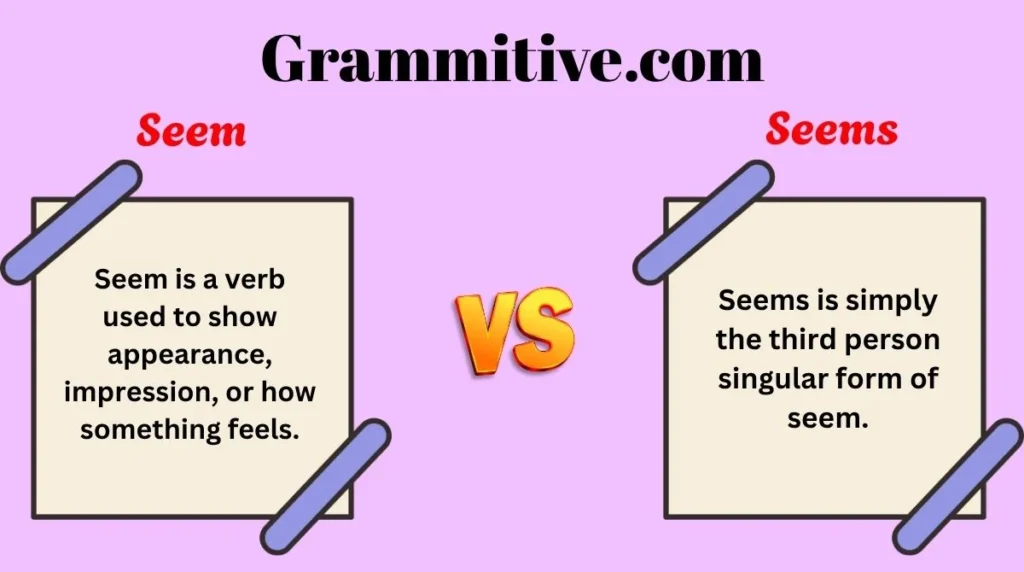
Seem is a verb used to show appearance, impression, or how something feels. It does not state a fact—it expresses how something looks, feels, or appears to someone.
- Example: “It seems difficult” means “It looks difficult” or “I think it is difficult.”
When to Use Seem
- To describe feelings or impressions
- To express uncertainty or guesses
- To talk about something that is not fully proven
Grammar Rule
Seem is the base form of the verb. It is usually paired with:
- Plural subjects: They seem tired.
- Modal verbs: It might seem strange.
- Infinitives: He seems to know the answer.
Example Sentences
- They seem excited about the trip.
- The instructions seem confusing at first.
- It seems like a good idea.
- My friends seem happy today.
- These flowers seem fresh.
- The weather seems cold outside.
- Your explanation seems correct.
- The problem seems serious.
Common Learner Confusion
Many students confuse seem with seems because both relate to the same idea. The key is subject-verb agreement. If the subject is plural, use seem. Example: “They seem tired.” Using seems here is wrong.
What Does “Seems” Mean?
Definition
Seems is simply the third person singular form of seem. It is used when the subject is he, she, it, or singular nouns.
- Example: “She seems tired” = “It looks like she is tired.”
When to Use Seems
- For singular subjects (one person, thing, or idea)
- To describe feelings, impressions, or appearances
- When speaking about someone or something in the third person
Grammar Rule
Seems follows standard subject-verb agreement rules in the present tense:
- Singular subject → seems
- Plural subject → seem
Example Sentences
- He seems worried about the test.
- She seems happy with her new job.
- It seems impossible to finish on time.
- This idea seems interesting.
- The cake seems delicious.
- My brother seems excited about the movie.
- The cat seems tired after playing.
- That plan seems risky.
Common Learner Confusion
Beginners often use seem for singular subjects: “He seem tired” is wrong. Others overcorrect and say seems with plural subjects: “They seems happy” is incorrect. Always match the verb form with the subject.
Difference Between Seem and Seems
Understanding the difference is simple once you know the grammar logic.
| Feature | Seem | Seems |
|---|---|---|
| Form | Base verb | Third person singular form |
| Subject | Plural subjects / I / you / we | He / she / it / singular nouns |
| Tense | Present (can also appear with modals) | Present (third person singular only) |
| Example Sentence | They seem happy. | She seems happy. |
| Meaning | Looks / feels (plural) | Looks / feels (singular) |
| Confusion Source | Using with singular subjects | Using with plural subjects |
Usage Difference
- Seem = used for plural subjects or with modals
- Seems = used for singular subjects only
Grammar Logic
English verbs change slightly depending on the subject. This is called subject-verb agreement.
- Singular → add s in present tense → seems
- Plural → base form → seem
Sentence Structure Difference
- Singular: [Subject] + seems + adjective/noun → She seems tired.
- Plural: [Subject] + seem + adjective/noun → They seem tired.
Meaning Comparison
The meaning of both is almost identical. The difference is purely grammatical. Always check the subject before choosing the form.
Grammar Rules You Must Remember
Rule #1: Subject-Verb Agreement
- Singular → seems
- Plural → seem
Example:
- Correct: He seems tired.
- Correct: They seem tired.
- Wrong: He seem tired.
- Wrong: They seems tired.
Rule #2: With Modal Verbs
- Use base form after modals (can, might, should).
Example:
- It might seem strange.
- They should seem confident.
Rule #3: With Infinitives
- Use seem + infinitive to describe actions.
Example:
- He seems to understand the lesson.
- They seem to enjoy the party.
Rule #4: Expressing Opinions
- Seem/seems expresses impressions, not facts.
Example:
- She seems kind. (impression)
- It seems expensive. (guess)
Common Mistakes Students Make
Mistake #1: Using seem with singular subjects
- Wrong: He seem happy.
- Correct: He seems happy.
Mistake #2: Using seems with plural subjects
- Wrong: They seems ready.
- Correct: They seem ready.
Mistake #3: Forgetting subject-verb agreement after modal verbs
- Wrong: She can seems happy.
- Correct: She can seem happy.
Tip: Always check if the subject is singular or plural. For modals, use the base form.
Easy Trick to Remember the Difference
Think of this:
- S in seems = S for singular → He/She/It seems.
- No S in seem = plural → They/We/I/You seem.
Real-life logic: Imagine pointing at one thing → seems; pointing at many things → seem.
Memory trick makes it quick: “Singular adds S, plural does not.”
Daily Life Examples
Here are sentences you might use every day:
- She seems tired after work.
- They seem happy about the party.
- It seems like a good day to walk.
- He seems nervous before the exam.
- The kids seem excited to play outside.
- This movie seems interesting.
- The instructions seem easy to follow.
- My friends seem upset today.
- It seems cold outside, better wear a jacket.
- The new plan seems risky.
These examples show how seem and seems fit naturally in conversations.
Practice Section
Choose the correct form:
- She ___ ready for the test. (seem / seems)
- They ___ happy with the results. (seem / seems)
- It ___ too difficult to finish today. (seem / seems)
- He ___ to understand the rules. (seem / seems)
- My friends ___ excited about the trip. (seem / seems)
Answers:
- seems
- seem
- seems
- seems
- seem
FAQs
1. What is the difference between seem and seems?
Seem is used with plural subjects or after modals; seems is for singular subjects. The meaning is the same.
2. Can we use seem in questions?
Yes, for example: “Does she seem happy?” or “Do they seem ready?”
3. Is seems formal or informal?
Seems is neutral; it works in spoken and written English.
4. Can I use seem and seems interchangeably?
No, always match with the subject. Singular → seems, plural → seem.
5. What mistakes do learners commonly make?
The most common mistakes are using seem for singular subjects or seems for plural subjects.
6. Can I use seem/seems with adjectives or nouns?
Yes, for example: “She seems nice” or “It seems a problem.” Both are correct.
Final Conclusion
Using seem and seems correctly is easier than it looks. The main trick is checking the subject—singular or plural.
These words are essential in English because they help describe feelings, appearances, and opinions naturally.
With practice, you can use them confidently in conversations, emails, or writing.
Remember the simple rule: singular → seems, plural → seem. Practice with daily examples and your sentences will sound smooth and natural.
Don’t worry about mistakes—every learner improves by noticing patterns. Soon, you’ll instinctively choose the right form without thinking.
English is full of small words that make a big difference, and mastering seem vs seems is a step toward fluency.
Keep practicing, listen carefully, and your sentences will always sound right.

I am Lucas Bennett, a digital content creator passionate about social media trends and online growth strategies.
I share practical insights and guides to help users better understand and navigate the digital world.