

Small English sentences often create big confusion.
“See you Monday.”
“See you on Monday.”
Both sound correct. Both are common. Both are used by native speakers every day.
So which one is right?
Many English learners stop and think when they want to say goodbye. They wonder: Do I need “on”? Or can I remove it?
Some students feel nervous speaking because they are afraid of making a grammar mistake. Others copy what they hear without really understanding the rule.
This topic is important because we use these phrases all the time — at school, at work, with friends, in emails, and on the phone.
Saying goodbye naturally makes your English sound smooth and confident. Even small words like on can change how natural you sound.
The good news is that this grammar point is not difficult. It just needs a clear explanation.
After reading this guide, you will clearly understand:
- when to say see you Monday
- when to say see you on Monday
- which one is more formal or casual
- how native speakers really talk
- and how to never confuse them again
Everything will be explained in simple English with real-life examples, just like a friendly classroom lesson.
What Does “See You Monday” Mean?
Simple definition
“See you Monday” means:
👉 I will see you on Monday.
It is a short, casual way to say goodbye.
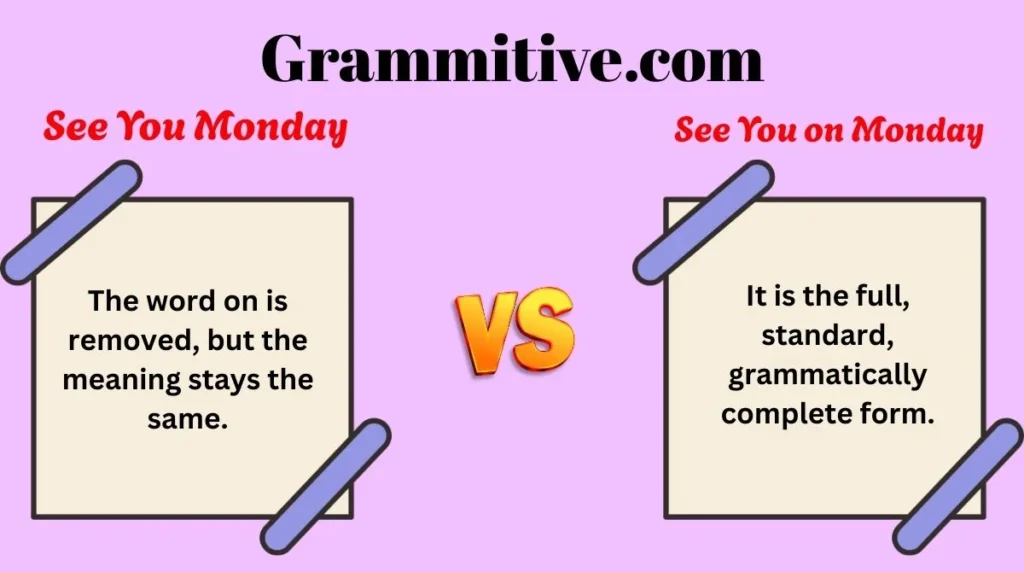
The word on is removed, but the meaning stays the same.
When to use it
This form is common in:
- casual conversations
- spoken English
- texts or messages
- friends and coworkers
- informal emails
It sounds relaxed and natural.
Native speakers often drop small words like on, the, or to when speaking quickly.
Grammar rule
This is called preposition omission.
Normally, we say:
- on Monday
- on Tuesday
- on Friday
But in informal speech, we sometimes drop on after verbs like:
- see
- call
- meet
- text
- catch
So:
✔ See you on Monday
✔ See you Monday (shorter, casual)
Both are correct.
Example sentences
Here are some natural examples:
- See you Monday at school.
- Thanks for coming. See you Monday!
- Bye, guys. See you Monday morning.
- I’ll finish the report. See you Monday.
- Have a good weekend. See you Monday.
- See you Monday after work.
- Okay, class is over. See you Monday.
- Great game today. See you Monday for practice.
Notice how friendly and easy these sound.
Common learner confusion
Many learners think:
❌ “This must be wrong because ‘on’ is missing.”
But it’s not wrong. It’s just informal.
English speakers often shorten sentences when talking fast. It feels more natural.
Think about it like this:
- “Going to” → “gonna”
- “Want to” → “wanna”
- “See you on Monday” → “See you Monday”
Spoken English loves shortcuts.
What Does “See You on Monday” Mean?
Simple definition
“See you on Monday” means:
👉 I will meet or see you on Monday.
It is the full, standard, grammatically complete form.
When to use it
This version is better for:
- formal writing
- professional emails
- business settings
- presentations
- speaking carefully or politely
It sounds a bit more complete and proper.
Grammar rule
In English, we use on with days of the week.
This is the basic preposition rule:
- on Monday
- on Tuesday
- on my birthday
- on Christmas Day
So grammatically, on Monday is the standard structure.
When we say “See you on Monday,” we follow the full rule.
Example sentences
Look at these examples:
- I will see you on Monday at the office.
- Thank you for the meeting. See you on Monday.
- We will discuss this on Monday.
- The class starts on Monday.
- Let’s meet on Monday afternoon.
- See you on Monday for the interview.
- The doctor will see you on Monday.
- I’ll call you on Monday morning.
These sentences feel more formal or careful.
Common learner confusion
Some students believe:
❌ “This is the only correct form.”
That’s not true.
It is correct, but not the only option.
Both forms are correct. The difference is mostly about style and formality, not grammar mistakes.
Difference Between “See You Monday” and “See You on Monday” (Detailed)
The meaning is almost the same. The difference is small but important.
Quick comparison table
| Feature | See you Monday | See you on Monday |
|---|---|---|
| Grammar | shortened | full form |
| Preposition | dropped | included |
| Tone | casual | neutral/formal |
| Spoken English | very common | common |
| Writing | less common | more common |
| Sounds | relaxed | proper/complete |
Usage difference
“See you Monday” feels friendly and quick.
You might say it to:
- classmates
- friends
- coworkers
- family
“See you on Monday” feels slightly more professional.
You might say it to:
- your boss
- a client
- a teacher
- in an email
Grammar logic
The full grammar rule says:
👉 Use on with days.
But English also allows informal omission of prepositions in speech.
So both follow natural English patterns.
Sentence structure difference
Full structure:
See + you + on + Monday
Short structure:
See + you + Monday
We simply remove the preposition.
Nothing else changes.
Meaning comparison
Important point:
👉 The meaning does NOT change.
Both mean exactly the same thing.
The only difference is tone.
Grammar Rules You Must Remember
Rule #1: Use “on” with days in standard grammar
We normally say:
- on Monday
- on Friday
- on Sunday
Example:
✔ The meeting is on Monday.
Rule #2: You can drop “on” in casual speech
After verbs like see, meet, call, text, we often remove “on.”
Example:
✔ See you Monday.
✔ Meet me Tuesday.
Rule #3: Use the full form in formal writing
Business emails or official messages sound better with “on.”
Example:
✔ I look forward to seeing you on Monday.
Rule #4: Both forms are correct, not wrong
Never think one is a mistake.
Example:
✔ See you Monday (casual)
✔ See you on Monday (formal)
Both are natural.
Common Mistakes Students Make
Why mistakes happen
Students often:
- translate from their own language
- memorize strict rules
- fear breaking grammar rules
- overthink small words
This causes stress.
But English is flexible.
Wrong vs correct examples
❌ See you in Monday
✔ See you on Monday
❌ See you at Monday
✔ See you on Monday
❌ See you the Monday
✔ See you Monday
❌ See you on the Monday (unless specific Monday)
✔ See you on Monday
Easy correction tips
Remember:
- Days → on
- Casual speech → can remove on
- Never use in/at with days
That solves most problems.

Easy Trick to Remember the Difference
Here’s a simple memory trick.
Think like this:
👉 Formal = full words
👉 Casual = shorter
So:
- talking to boss → use on
- talking to friend → drop on
Another easy idea:
If you’re texting fast, you’ll probably say:
“See you Monday”
If you’re writing an email, you’ll probably write:
“See you on Monday”
Short = casual
Long = formal
Easy.
Daily Life Examples (Very Important)
These sound exactly like real conversations.
- “Bye, Jake. See you Monday!”
- “Have a nice weekend. See you on Monday.”
- “Okay class, homework due Monday. See you Monday.”
- “Thanks for your time today. See you on Monday morning.”
- “We’ll finish this next week. See you Monday.”
- “Safe trip home. See you on Monday at the office.”
- “Practice starts at six. See you Monday!”
- “I’ll send the files tonight. See you on Monday.”
- “Don’t forget the test. See you Monday.”
- “Great meeting. See you on Monday, everyone.”
Both versions appear naturally in everyday speech.
Practice Section
Choose the correct option.
1
I’ll talk to you ___ Monday.
a) in
b) on
2
Bye everyone. See you ___ Monday!
a) on
b) (no word)
3
The meeting is ___ Monday at 10.
a) on
b) at
4
Thanks for today. See you ___ Monday morning.
a) on
b) in
5
Okay team, see you ___!
a) Monday
b) in Monday
Answers
1 → on
2 → (no word)
3 → on
4 → on
5 → Monday
FAQs (SEO Focused)
What is the difference between “see you Monday” and “see you on Monday”?
The meaning is the same. The difference is style. “See you Monday” is casual and spoken. “See you on Monday” is more formal and complete.
Is “see you Monday” grammatically correct?
Yes. It is correct in informal English. Native speakers often drop the preposition “on” in casual speech.
Can we use “see you Monday” in writing?
It’s okay in texts or friendly messages. But for formal emails or professional writing, “see you on Monday” sounds better.
Which one sounds more natural to native speakers?
Both are natural. In everyday conversation, many people prefer “see you Monday” because it’s shorter and faster.
Can I use this pattern with other days?
Yes.
See you Tuesday
Meet you Friday
Call you Sunday
This works the same way.
Is “on Monday” always required?
Not always. It is required in formal grammar. But in casual spoken English, it can be dropped after certain verbs like see or meet.
Final Conclusion
Small grammar points like this can feel confusing at first. One tiny word — “on” — makes learners stop and think. But once you understand the pattern, it becomes simple and natural.
Both “see you Monday” and “see you on Monday” mean exactly the same thing. The only difference is tone. One sounds relaxed and friendly. The other sounds a bit more formal and careful.
When speaking with friends, classmates, or coworkers, the shorter version is perfectly fine. When writing emails or talking in professional situations, using “on Monday” feels safer and more polite.
The key is not memorizing rules but listening to how real people talk. Practice saying both forms out loud. Use them in daily life. Soon, you won’t even think about it — the right phrase will come automatically.
That’s when your English starts to sound truly natural.

I am Lucas Bennett, a digital content creator passionate about social media trends and online growth strategies.
I share practical insights and guides to help users better understand and navigate the digital world.