
Many English learners feel confused when they see the words schema and schematic. They look similar. They sound similar.
Both come from the same root word. So it’s easy to think they mean the same thing.
But they don’t.
One word is mostly used in psychology, education, and thinking. The other is used in engineering, drawings, and diagrams. If you mix them up, your sentence may sound strange or even wrong to native speakers.
This confusion happens a lot because English borrows many words from Greek and Latin.
These words often look alike but have very different jobs in a sentence. That’s exactly what happens here.
The good news? Once you understand the basic idea behind each word, the difference becomes simple and logical.
By the time you finish reading, you will clearly understand:
- What schema means
- What schematic means
- How they are used in grammar
- When to choose each word
- Common mistakes to avoid
- Easy tricks to remember forever
Think of this lesson like a friendly classroom talk. Simple words. Clear examples. Real-life situations. No heavy grammar terms.
Ready? Let’s start with the first word.
What Does “Schema” Mean?
Simple definition
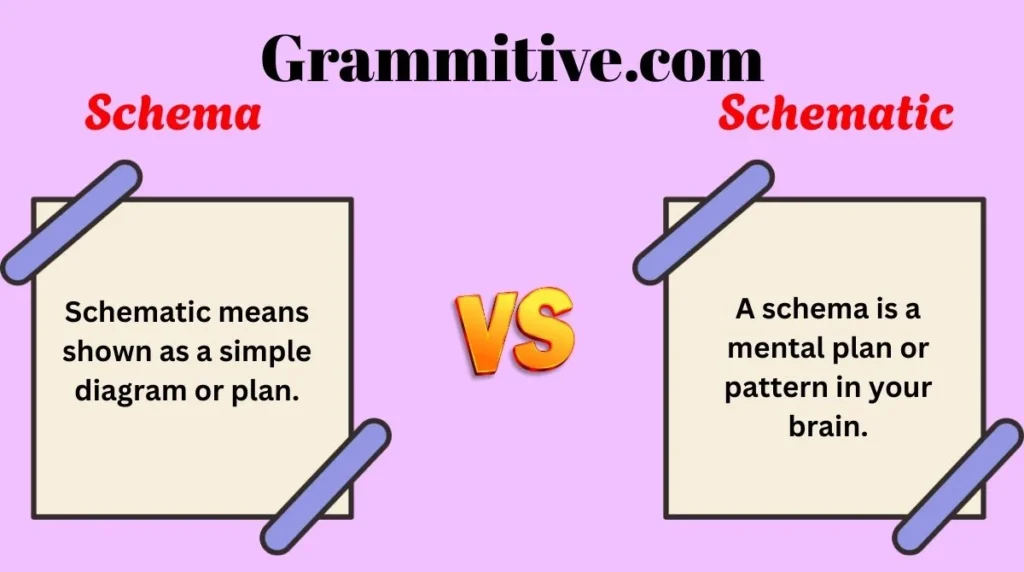
A schema is a mental plan or pattern in your brain.
It is how your mind organizes knowledge, ideas, or experiences.
In very simple English:
👉 Schema = a thinking structure inside your mind
When to use it
Use schema when talking about:
- Psychology
- Learning
- Memory
- Thinking patterns
- How people understand the world
Teachers, researchers, and students often use this word.
Grammar rule
- Schema is a noun
- Singular: schema
- Plural: schemas (most common) or schemata (formal/academic)
You cannot use it as an adjective.
❌ schema drawing
✅ schematic drawing
Example sentences
- Children develop a schema about animals when they visit a zoo.
- My brain has a schema for birthdays and parties.
- Reading books helps build new schemas.
- The teacher explained the learning schema to the class.
- His travel schema changed after visiting other countries.
- Babies form schemas from daily experiences.
- This game helps students build a math schema.
- We use old schemas to understand new information.
Common learner confusion
Students often think schema = diagram or picture.
But that’s not correct.
Remember:
- Schema → inside the brain
- Not something you draw on paper
If you can see it physically, it’s probably not schema.
What Does “Schematic” Mean?
Simple definition
Schematic means shown as a simple diagram or plan.
It describes something that is:
- simplified
- symbolic
- not detailed
- shown with lines or shapes
In easy words:
👉 Schematic = diagram-style or plan-style
When to use it
Use schematic when talking about:
- electrical circuits
- maps
- technical drawings
- blueprints
- system plans
- machine designs
Engineers and designers use this word a lot.
Grammar rule
- Schematic is usually an adjective
- Sometimes it can be a noun (a schematic = a diagram)
Examples:
- schematic diagram (adjective)
- I printed the schematic. (noun)
Example sentences
- The electrician looked at the schematic before fixing the wire.
- This book includes a schematic map of the subway.
- The machine’s schematic shows every part clearly.
- We drew a schematic of the house plan.
- Engineers study schematics every day.
- The teacher showed a schematic drawing on the screen.
- The diagram is schematic, not realistic.
- Please send me the schematic for the circuit board.
Common learner confusion
Some learners say:
❌ “I made a schema of the machine.”
This sounds wrong.
Because machines use schematics, not schemas.
Remember:
- Physical drawing → schematic
- Brain idea → schema
Difference Between Schema and Schematic (Detailed)
Here is where everything becomes crystal clear.
Quick comparison table
| Feature | Schema | Schematic |
|---|---|---|
| Part of speech | Noun | Adjective (mostly) |
| Field | Psychology, learning | Engineering, design |
| Meaning | Mental pattern | Diagram or plan |
| Visible or invisible | Invisible (in brain) | Visible (on paper/screen) |
| Example | memory schema | schematic diagram |
| Plural | schemas | schematics |
Usage difference
Think about where it exists.
If it exists inside your mind, choose schema.
If it exists on paper or screen, choose schematic.
That’s the key difference.
Grammar logic
Schema
- always a noun
- cannot describe another noun
Schematic
- usually describes another noun
- works like an adjective
Example:
✅ schematic drawing
❌ schema drawing
Because “drawing” needs an adjective.
Sentence structure difference
Schema structure:
- a schema
- the schema
- build a schema
- develop schemas
Schematic structure:
- schematic map
- schematic design
- a schematic
- draw a schematic
Notice how one is abstract and the other is physical.
Meaning comparison
- Schema → how the brain understands
- Schematic → how something is visually explained
One is about thinking, the other is about showing.
Grammar Rules You Must Remember
Rule #1: Schema is always a noun
✅ She built a reading schema.
❌ She built a schema drawing.
Rule #2: Schematic usually works as an adjective
✅ schematic diagram
✅ schematic model
It describes something.
Rule #3: Use schemas for plural (common English)
Both are correct:
- schemas
- schemata (formal)
But everyday English prefers schemas.
Example:
Students develop many schemas while learning.
Rule #4: Don’t mix mental vs physical meaning
Brain → schema
Paper → schematic
Example:
✅ The brain forms schemas.
✅ The engineer draws a schematic.
Common Mistakes Students Make
Why mistakes happen
Because:
- words look similar
- same root
- both sound technical
- not taught clearly in schools
So learners guess — and guessing causes errors.
Mistake 1
❌ I made a schema of the building plan.
✅ I made a schematic of the building plan.
Tip: If you draw it → schematic.
Mistake 2
❌ Children use schematics to understand language.
✅ Children use schemas to understand language.
Tip: Thinking → schema.
Mistake 3
❌ This book explains the schematic of memory.
✅ This book explains the schema of memory.
Memory is mental, not a drawing.
Easy correction tip
Ask yourself:
“Can I touch it?”
Yes → schematic
No → schema
Simple and fast.
Easy Trick to Remember the Difference
Here’s a small memory trick my students love.
Think of the letters
Schema → brain idea
Schema starts with “schem-”
Sounds like scheme or system
Your brain has systems.
So schema = system in the mind.
Schematic → machine or map
Schematic ends with “-matic”
Think of:
- automatic
- dramatic
- cinematic
These describe things you can see.
So schematic describes something visual.
Another easy rule:
👉 Mind = schema
👉 Machine = schematic
They even start with the same letter sound.
Easy, right?
Daily Life Examples (Very Important)
Here are real spoken English examples you might hear every day.
- “Kids build language schemas very fast.”
- “Can you send me the schematic for this fan?”
- “My brain has a schema for birthdays and gifts.”
- “Look at the schematic before you connect the wires.”
- “Teachers help students develop reading schemas.”
- “This schematic shows where the pipes go.”
- “Our travel schema changed after moving abroad.”
- “The mechanic checked the schematic of the engine.”
- “Babies create schemas from daily life.”
- “I printed the schematic from the website.”
Notice how natural they sound when the right word is used.
Practice Section
Choose the correct word: schema or schematic
Questions
- The electrician studied the ______ before repairing the circuit.
- Children build a reading ______ in school.
- The engineer drew a ______ diagram.
- Memory works using mental ______.
- Please email me the ______ for the device.
Answers
- schematic
- schema
- schematic
- schemas
- schematic
FAQs (SEO Focused)
1. What is the difference between schema and schematic?
Schema is a mental pattern in the brain. Schematic is a visual diagram or plan. One is about thinking, the other is about drawing or showing.
2. Can we use schema in everyday English?
Yes, but mostly in education or psychology topics. Regular daily conversation uses it less often.
3. Is schematic formal or informal?
It is neutral. Very common in technical and engineering language. Not usually used in casual talk unless discussing machines or plans.
4. Can schematic be a noun?
Yes. You can say “I checked the schematic.” It means a diagram or plan.
5. What is the plural of schema?
The common plural is schemas. The academic form is schemata, but it sounds very formal.
6. Why do learners confuse these words?
Because they look almost the same and come from the same root. But their meanings developed differently over time.
Final Conclusion
Schema and schematic may look like twins, but they live in different worlds.
One belongs to the mind. The other belongs to machines and drawings.
When talking about learning, memory, or thinking patterns, use schema.
When talking about diagrams, maps, or technical plans, use schematic.
That small difference makes your English sound much more natural and correct.
Try to notice these words in books, manuals, and conversations. Practice using them in your own sentences. The more you see them, the easier they become.
Language is full of small details like this. Once you understand them, your confidence grows fast.
Keep practicing. Your English brain is building new schemas every day.

I am Lucas Bennett, a digital content creator passionate about social media trends and online growth strategies.
I share practical insights and guides to help users better understand and navigate the digital world.