

Many English learners feel stuck when they use the word recommend.
They stop speaking mid-sentence and think:
“Should I say recommend to… or recommend for… or maybe recommend someone something?”
It’s a small question, but it causes big confusion.
You might say:
❌ I recommended this movie to watch.
❌ She recommended me for buy a laptop.
Both sound strange to native speakers. But why?
The problem is not vocabulary. It’s grammar patterns. English verbs often change meaning depending on the preposition after them. And recommend is one of those tricky verbs.
This topic matters a lot in daily life. We recommend restaurants, apps, books, doctors, courses, jobs, and even people.
It’s used in conversations, emails, interviews, and school writing. If you use the wrong form, your sentence may sound unnatural or confusing.
By the time you finish reading, you will clearly understand:
- when to use recommend to
- when to use recommend for
- how sentence structure changes
- common mistakes to avoid
- easy tricks to remember everything
Think of this as a friendly classroom chat, not a heavy grammar lecture. Step by step, it will feel simple and natural.
What Does “Recommend To” Mean?
Simple meaning
Recommend to means:
👉 suggest something to a person
You are giving advice or sharing an idea with someone.
The focus is on who receives the suggestion.
When do we use it?
Use recommend to + person when:
- you suggest a movie to a friend
- you advise a student
- you tell someone what they should try
- you share your opinion directly with someone
The key idea:
A person comes after “to.”
Grammar rule
Structure:
recommend + something + to + someone
or
recommend + to + someone + that + clause
Examples
- I recommended this book to my sister.
- She recommended a good doctor to me.
- The teacher recommended this website to the class.
- Can you recommend a hotel to us?
- He recommended a new app to his friends.
- My coach recommended yoga to me.
- They recommended the restaurant to tourists.
- I strongly recommend this movie to everyone.
Common learner confusion
Many students say:
❌ I recommended to my sister this book.
This word order sounds wrong.
English prefers:
✅ I recommended this book to my sister.
Remember:
thing first → person after “to.”
What Does “Recommend For” Mean?
Simple meaning
Recommend for means:
👉 suggest someone or something for a purpose, job, position, or use
Here, the focus is on the purpose or role.
When do we use it?
Use recommend for when:
- suggesting someone for a job
- nominating a person for a prize
- choosing something for a specific use
- saying something is good for a situation
The key idea:
There is a purpose after “for.”
Grammar rule
Structure:
recommend + someone/something + for + purpose/job/use
Examples
- I recommended John for the manager position.
- The teacher recommended her for a scholarship.
- This cream is recommended for dry skin.
- The doctor recommended this medicine for headaches.
- They recommended me for the award.
- This laptop is recommended for students.
- She recommended him for the leadership role.
- This route is recommended for beginners.
Common learner confusion
Students often think for and to are the same.
But compare:
- recommend this book to Sarah (person receives suggestion)
- recommend this book for children (purpose/use group)
Different meaning. Different structure.
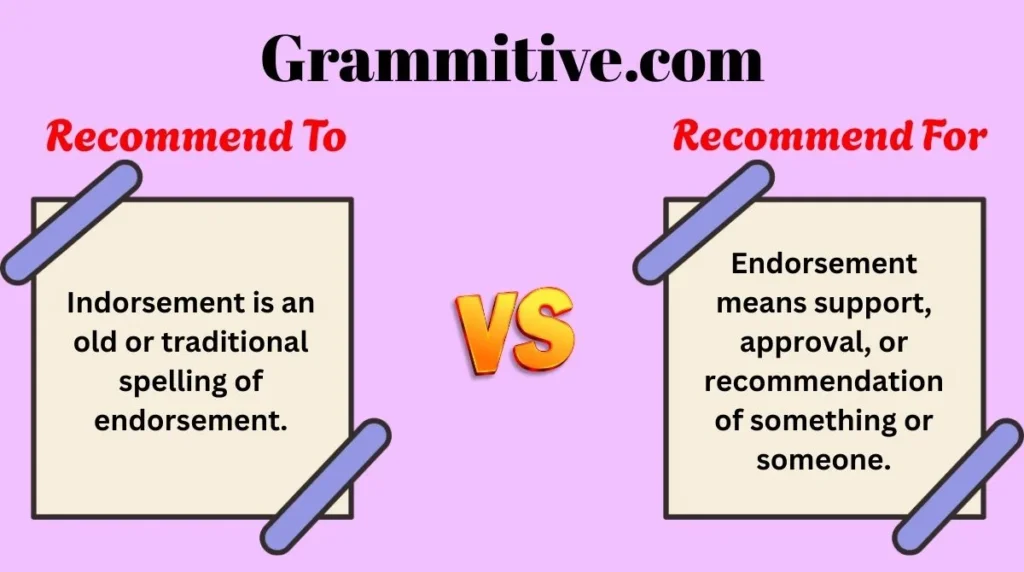
Difference Between Recommend To and Recommend For (Detailed)
This is where things become clear.
Quick comparison table
| Feature | Recommend to | Recommend for |
|---|---|---|
| Focus | Person | Purpose/role |
| Meaning | Suggest to someone | Suggest for use/job |
| After preposition | Person | Function or goal |
| Example | to my friend | for the job |
Usage difference
Recommend to → advice goes TO a person
Recommend for → something is suitable FOR a purpose
Think:
- Who receives it? → to
- What is it used for? → for
Grammar logic
English often uses:
- to = direction/person
- for = purpose/benefit
Same idea here.
Examples:
- give something to someone
- buy something for someone
Recommend follows a similar logic.
Sentence structure difference
Recommend to
recommend + thing + to + person
Example:
I recommended the course to Maria.
Recommend for
recommend + person/thing + for + purpose
Example:
I recommended Maria for the course.
Notice how Maria moves to a different place and the meaning changes.
Meaning comparison
Look carefully:
- I recommended Maria to the manager.
→ I suggested the manager should meet or consider Maria. - I recommended Maria for the manager position.
→ I suggested Maria should become the manager.
Small change. Big difference.
Grammar Rules You Must Remember
Rule #1 – Use “to” for a person receiving advice
I recommended this app to my brother.
If someone is listening to your suggestion → use to.
Rule #2 – Use “for” for jobs, roles, or purposes
She recommended me for the team leader role.
If there is a purpose → use for.
Rule #3 – Never use “recommend someone something”
English does NOT say:
❌ I recommended him the book.
Always add a preposition:
✅ I recommended the book to him.
Rule #4 – “Recommend + -ing” is also common
Sometimes we skip prepositions:
I recommend trying this café.
She recommends studying every day.
This pattern is simple and very natural.
Common Mistakes Students Make
These errors happen because many languages translate differently.
Mistake 1
❌ I recommended him the movie.
✅ I recommended the movie to him.
Tip: Always check for to.
Mistake 2
❌ She recommended me to the job.
✅ She recommended me for the job.
Tip: Job → always for.
Mistake 3
❌ This phone is recommended to gamers.
Better:
✅ This phone is recommended for gamers.
Because “gamers” shows purpose or target group.
Mistake 4
❌ I recommend to buy this.
✅ I recommend buying this.
After recommend, use -ing form.
Why mistakes happen
- direct translation from native language
- forgetting prepositions
- mixing “to” and “for”
- overthinking grammar
Keep sentences simple. English loves simple patterns.
Easy Trick to Remember the Difference
Here’s a small memory trick students like.
TO = person
FOR = purpose
Say it out loud:
“TO people, FOR purpose.”
If you can point to a person → use to
If you can answer “why/what for?” → use for
Examples:
Why this cream? → for dry skin
Who gets the advice? → to my sister
It’s almost like road signs. Once you see it, you don’t forget.

Daily Life Examples (Spoken English)
These are natural sentences you may hear every day.
- I recommend this café to you.
- Can you recommend a movie to us tonight?
- This chair isn’t recommended for back pain.
- She recommended me for the internship.
- My friend recommended this game to me.
- This shampoo is recommended for damaged hair.
- The teacher recommended that I study more.
- I’d recommend this place to anyone visiting the city.
- He was recommended for promotion.
- I highly recommend trying their pizza.
Notice how casual and short they sound. That’s real English.
Practice Section
Choose to or for.
- I recommended the dentist ___ my parents.
- She was recommended ___ the award.
- Can you recommend a hotel ___ us?
- This cream is recommended ___ sensitive skin.
- The boss recommended me ___ the new role.
Answers
- to
- for
- to
- for
- for
If you got 4 or 5 correct, you’re doing great.
FAQs
1. What is the difference between recommend to and recommend for?
Use recommend to when giving advice to a person.
Use recommend for when suggesting someone or something for a purpose, job, or use.
It depends on whether the focus is a person or a role.
2. Can we use recommend without to or for?
Yes.
You can say:
“I recommend reading this book.”
Using the -ing form is very common and natural.
3. Is recommend formal or informal?
It works in both.
You can use it in daily speech, emails, business meetings, and academic writing.
It’s polite and professional.
4. Can we say “recommend me something”?
No.
This structure is incorrect.
Say: “Recommend something to me.”
5. Can recommend be used in passive voice?
Yes.
“This product is recommended for children.”
“He was recommended for the job.”
Very common in advertisements and reports.
6. Which is more common in conversation?
Native speakers often use:
“I recommend trying…”
It sounds relaxed and friendly.
But “recommend to” is also very common.
Final Conclusion
Prepositions can feel small, but they change meaning in a big way. That’s why recommend to and recommend for often confuse learners. Once you notice the simple logic, everything becomes easier.
If advice goes to a person, use to.
If something is suitable for a purpose or role, use for.
That’s really the heart of it.
Don’t worry about being perfect at first. Speak slowly. Make simple sentences. The more you hear and use these patterns, the more natural they feel.
Soon, you won’t even think about the rule. Your brain will choose the correct preposition automatically.
Keep practicing with movies, conversations, and daily life situations. Try making five sentences every day. Small habits bring big improvement.
English becomes friendly when you treat it like a tool, not a test.

I am Lucas Bennett, a digital content creator passionate about social media trends and online growth strategies.
I share practical insights and guides to help users better understand and navigate the digital world.