
English spelling can be tricky. Some words look almost the same but mean very different things. One small letter can change everything. That is exactly what happens with russle and rustle.
Many learners see these two words and feel confused. They sound similar when spoken fast. They also look similar on paper.
Because of that, students often mix them up while writing emails, stories, or school assignments.
You may have typed russle when you actually meant rustle. Or maybe you heard someone say it and weren’t sure which spelling was correct. Don’t worry. This is a very common mistake, even for native speakers.
Understanding the difference is important because only one of these words is correct in standard English. The other is usually a spelling mistake or a rare variation.
Using the wrong one can make your writing look careless or unprofessional.
By the end of this guide, you will clearly know:
- which spelling is correct
- what the word really means
- how to use it in sentences
- easy grammar rules
- memory tricks
- real-life examples
Everything is explained in simple, friendly English — just like a teacher talking in class.
What Does “Russle” Mean?
Here’s something surprising.
“Russle” is not a standard English word.
Yes, really.
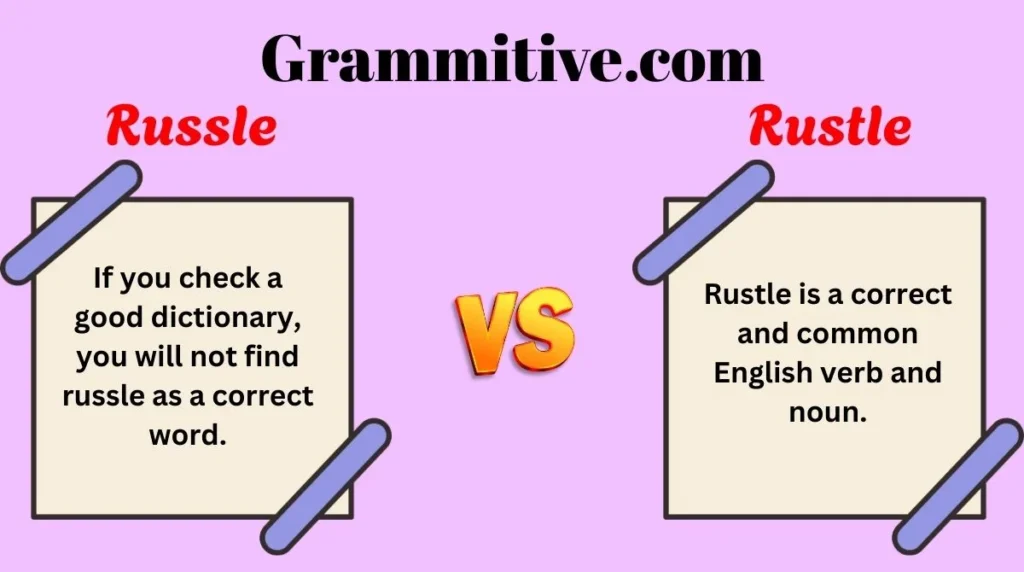
If you check a good dictionary, you will not find russle as a correct word. Most of the time, it is simply a misspelling of “rustle.”
So why do people write russle?
There are a few reasons:
- Typing mistakes
- Hearing the word incorrectly
- Confusing it with words like wrestle or tussle
- Spelling based on sound
English has many silent letters, so learners guess the spelling. That guess sometimes becomes russle.
Is it ever correct?
In very rare cases, Russle may appear:
- as a surname (family name)
- as a brand name
- or in very old regional spellings
But in everyday English grammar, you should NOT use russle.
Grammar rule
If you want to talk about:
- leaves making soft noise
- clothes moving
- animals or people moving quietly
- stealing cattle (old meaning)
You must use rustle, not russle.
Example sentences (showing wrong usage)
❌ I heard the russle of the trees.
❌ Something russled in the bushes.
❌ Her dress made a soft russle sound.
All of these are incorrect spellings.
Corrected versions
✅ I heard the rustle of the trees.
✅ Something rustled in the bushes.
✅ Her dress made a soft rustle sound.
Common learner confusion
Students often think:
“Russle looks right because it sounds like ‘tussle’ or ‘mussel’.”
That’s understandable. But English spelling does not always follow sound patterns.
So remember:
Russle = spelling mistake (usually)
What Does “Rustle” Mean?
Now we come to the real word.
Rustle is a correct and common English verb and noun.
It describes a soft, light, whispering sound made by movement.
Simple definition
Rustle (verb)
→ to make a soft sound when something moves
Rustle (noun)
→ the soft sound itself
When to use it
Use rustle when talking about:
- leaves moving in the wind
- paper or plastic moving
- clothes brushing together
- grass moving
- quiet movement in bushes
- animals moving softly
It often appears in stories, nature descriptions, and everyday speech.
Grammar forms
- rustle (base form)
- rustles (present)
- rustled (past)
- rustling (continuous)
- a rustle (noun)
Example sentences
- The leaves rustled in the wind.
- I heard a rustle behind the door.
- The mouse rustled through the paper.
- Her silk dress rustled as she walked.
- The trees rustle at night.
- He rustled the newspaper while reading.
- There was a soft rustling in the grass.
- The plastic bag rustled loudly.
Extra meaning (interesting fact)
In American history, rustle also means:
→ to steal cattle or horses
Example:
The thieves rustled cows from the farm.
This meaning is old-fashioned but still appears in western movies and books.
Common learner confusion
Students often mix it with:
- wrestle
- tussle
- hustle
- russle (wrong spelling)
These words look similar but mean very different things.
So be careful.
Difference Between Russle and Rustle (Detailed)
Here is the most important part.
Quick truth
Only rustle is correct in standard English.
Russle is usually wrong.
Comparison table
| Feature | Russle | Rustle |
|---|---|---|
| Correct spelling? | ❌ No | ✅ Yes |
| Dictionary word? | No | Yes |
| Part of speech | None | Verb & noun |
| Meaning | None | Soft moving sound |
| Common use | Typo | Everyday English |
| Should you use it? | No | Yes |
Usage difference
- If you mean sound or movement, use rustle
- Never use russle in normal writing
Grammar logic
English words ending in -stle often keep the t:
- whistle
- bristle
- jostle
- rustle
So rustle follows a real pattern.
But russle breaks that pattern.
Sentence structure difference
Correct:
- The leaves rustled.
- I heard a rustle.
Incorrect:
- The leaves russled.
- I heard a russle.
Meaning comparison
- rustle → has meaning
- russle → no meaning
That’s the simplest way to think about it.
Grammar Rules You Must Remember
Rule #1: Always spell it with “st”
Correct: rustle
Wrong: russle
Example:
✅ The grass rustled softly.
Rule #2: Use as verb or noun
Verb:
✅ The paper rustled.
Noun:
✅ I heard a rustle.
Rule #3: Add -ed for past tense
Correct form: rustled
Example:
✅ Something rustled in the box.
Not: russled ❌
Rule #4: Use for soft sounds only
Rustle is gentle and quiet.
Soft: rustle ✅
Loud crash: ❌
Big bang: ❌
Example:
✅ The curtain rustled in the breeze.
Common Mistakes Students Make
Mistakes usually happen because of sound. When we speak fast, rustle sounds like “russle.”
Let’s look at typical problems.
Mistake 1: Wrong spelling
❌ I heard a russle.
✅ I heard a rustle.
Tip: Remember the “t”.
Mistake 2: Using for loud sounds
❌ The door rustled loudly.
Better: The door slammed loudly.
Rustle is soft, not loud.
Mistake 3: Mixing with wrestle
❌ The boys rustled on the ground.
Correct: The boys wrestled on the ground.
Rustle = sound
Wrestle = fight
Easy correction tips
- Think: “soft sound”
- Check spelling twice
- Look for the “t”
- Read aloud
Easy Trick to Remember the Difference
Here’s a simple memory trick students love.
The “T for Trees” trick
Think of:
RusTle → T → Trees
Leaves in trees make a soft sound.
Trees → rustle.
If there is no “T”, there are no trees, and no word.
So:
- rustle = real
- russle = not real
This small trick helps your brain remember quickly.

Daily Life Examples (Very Important)
These are simple sentences you might hear in normal conversations.
- “Did you hear that rustle outside?”
- “The bag rustled when I touched it.”
- “I love the rustle of leaves in autumn.”
- “Something rustled in the bushes.”
- “Her skirt rustled as she walked past.”
- “The newspaper rustled while Grandpa read it.”
- “The wind made the curtains rustle.”
- “I woke up to the rustling of paper.”
- “Don’t rustle the chips bag during the movie!”
- “The dog heard a rustle and started barking.”
These examples show how natural and common the word is.
Practice Section
Choose the correct word: rustle or russle
Questions
- I heard a ______ in the garden.
- The leaves ______ in the wind.
- Her dress made a soft ______ sound.
- Something ______ behind the door.
- The plastic bag ______ loudly.
Answers
- rustle
- rustled
- rustle
- rustled
- rustled
If you wrote russle anywhere, fix it.
FAQs (SEO Focused)
1. What is the difference between russle and rustle?
Rustle is a correct English word that means a soft moving sound. Russle is usually a spelling mistake and not accepted in standard dictionaries.
2. Is russle ever correct?
Not in normal English writing. It may appear as a name or typo, but for grammar and vocabulary, it is incorrect.
3. Can we use rustle in questions?
Yes, of course.
Example: “Did you hear something rustle outside?”
It works like any normal verb or noun.
4. Is rustle formal or informal?
It is neutral. You can use it in stories, essays, daily speech, and even formal writing. It sounds natural everywhere.
5. What kind of sound does rustle describe?
A soft, light, gentle sound. Leaves, paper, clothes, or grass often make this sound.
6. Why do people spell rustle as russle?
Because the “t” is silent when we speak. So learners write what they hear. English spelling can be tricky that way.
Final Conclusion
Small spelling mistakes can change your writing more than you think. Words like russle and rustle show how one missing letter can create confusion.
The good news is that this topic is very easy once you understand the truth.
Only rustle is correct. It means a soft, gentle sound made by movement. You will hear it with leaves, paper, clothes, or grass. It works as both a verb and a noun.
On the other hand, russle is simply a common spelling error that should be avoided.
Keep the “T for Trees” trick in mind. Picture leaves moving in the wind. That image will guide you to the right spelling every time.
Practice using the word in daily life. Read stories, notice sounds around you, and try making your own sentences. Soon, it will feel natural and easy.
Good spelling builds confidence. And confidence makes English more fun.

I am Lucas Bennett, a digital content creator passionate about social media trends and online growth strategies.
I share practical insights and guides to help users better understand and navigate the digital world.