
Many English learners feel confused when they see phrases like “result in” and “result to.”
They look almost the same.
Only one small word changes. But that small word can change everything.
You may hear someone say:
- “Smoking results in cancer.”
- “His mistake resulted in failure.”
But then you wonder… can we also say result to?
Some students try sentences like:
- ❌ “This will result to problems.”
It sounds close. It feels logical. But native speakers don’t say it.
Prepositions are tricky in English. They don’t always follow clear logic. Sometimes you simply need to learn which one is correct and why. And this small mistake can make your English sound unnatural very fast.
Understanding this topic is important because we use result in often in daily speech, school writing, business English, and exams.
By the end, you will clearly understand:
- what “result in” means
- whether “result to” is correct or not
- the grammar rules
- common mistakes
- easy memory tricks
- lots of real-life examples
After reading, you won’t hesitate again when choosing the right phrase.
What Does “Result In” Mean?
Simple Definition
Result in = to cause something to happen
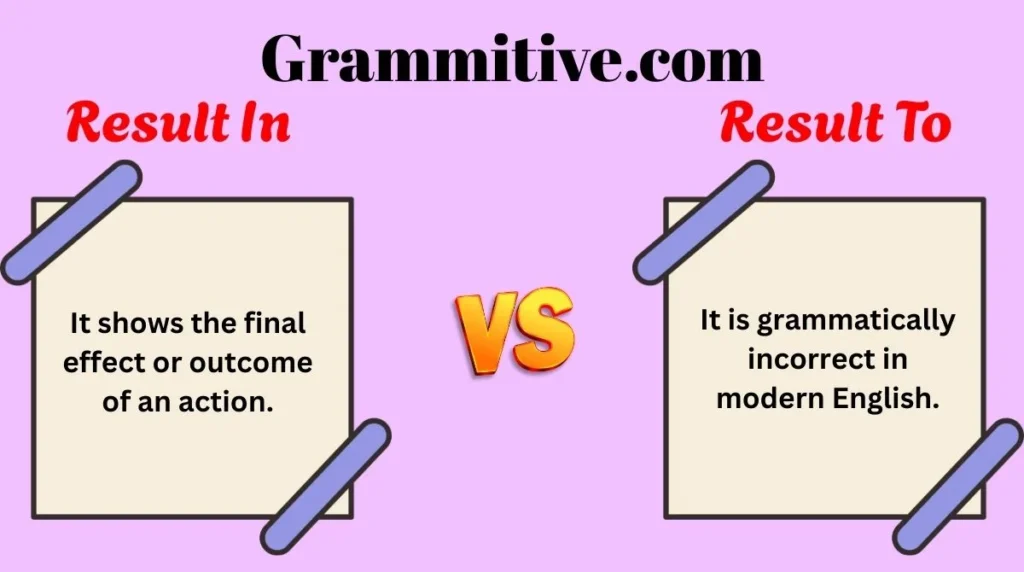
It shows the final effect or outcome of an action.
Think of it like this:
👉 Something happens → and because of that, another thing happens.
The second thing is the result.
When to Use It
Use result in when you talk about:
- effects
- consequences
- outcomes
- final results
It is very common in both spoken and written English.
Grammar Rule
Structure:
Subject + result(s) in + noun / gerund (-ing form)
Examples:
- result in + problems
- result in + damage
- result in + losing money
Example Sentences (6–8)
- Smoking results in serious health problems.
- Heavy rain resulted in flooding.
- His hard work resulted in success.
- The accident resulted in two injuries.
- Poor planning can result in failure.
- The fight resulted in a broken window.
- Eating too much sugar results in weight gain.
- One small mistake resulted in big losses.
Common Learner Confusion
Many students think:
“Result” = cause → so maybe we can use any preposition.
But English doesn’t work that way.
We always use result in, not other prepositions.
Even if another preposition sounds logical, it’s wrong.
What Does “Result To” Mean?
Simple Definition
Here’s something important:
👉 “Result to” is NOT standard English.
It is not used by native speakers.
It is grammatically incorrect in modern English.
When to Use It
Short answer:
👉 Never. Don’t use it.
You should avoid it completely.
Grammar Rule
There is no grammar rule for “result to” because it isn’t a correct structure.
If you write or say it, teachers will mark it wrong.
Example Sentences (Wrong vs Correct)
❌ This mistake resulted to problems.
✅ This mistake resulted in problems.
❌ The storm resulted to damage.
✅ The storm resulted in damage.
❌ His actions resulted to failure.
✅ His actions resulted in failure.
❌ Lack of sleep results to stress.
✅ Lack of sleep results in stress.
❌ The fight resulted to injuries.
✅ The fight resulted in injuries.
❌ Careless driving resulted to an accident.
✅ Careless driving resulted in an accident.
Why Learners Get Confused
There are two big reasons:
1. Translation from other languages
Some languages use prepositions that mean “to.”
Students translate directly → mistake happens.
2. Logic thinking
They think:
“Result goes TO something.”
But English doesn’t follow that logic. It uses IN, not TO.
So this is simply something to memorize.
Difference Between Result In and Result To (Detailed)
Even though one is correct and one is not, it helps to compare them clearly.
Comparison Table
| Feature | Result in | Result to |
|---|---|---|
| Correct English? | ✅ Yes | ❌ No |
| Used by native speakers | Yes | No |
| Meaning | Cause something to happen | No meaning |
| Grammar status | Standard phrase | Incorrect |
| Used in exams | Yes | Never |
Usage Difference
- result in → shows the outcome
- result to → grammatical mistake
Grammar Logic
English verbs often “partner” with specific prepositions.
Examples:
- depend on
- listen to
- believe in
- result in
These are fixed combinations.
You cannot change the preposition.
Sentence Structure Difference
Correct:
- Action → result in → outcome
Wrong:
- Action → result to → outcome
Meaning Comparison
Only result in gives clear meaning.
“Result to” sounds strange and confuses listeners.
If you say it in conversation, people may pause and try to understand you.
So it’s better to avoid it completely.
Grammar Rules You Must Remember
Rule #1 — Always use “result in” for outcomes
Correct:
The fire resulted in damage.
Wrong:
The fire resulted to damage.
Rule #2 — Use noun or -ing form after it
Correct:
The mistake resulted in losing money.
Wrong:
The mistake resulted in lose money.
Rule #3 — Past form is “resulted in”
Correct:
The crash resulted in traffic delays.
Rule #4 — It can be formal or neutral
You can use it in:
- school essays
- reports
- news
- daily speech
Example:
Too much screen time results in eye strain.
Common Mistakes Students Make
Why mistakes happen
- translation habits
- guessing prepositions
- copying wrong English online
- not learning fixed phrases
Wrong vs Correct Examples
❌ Lack of sleep results to stress.
✅ Lack of sleep results in stress.
❌ This may result to problems later.
✅ This may result in problems later.
❌ His anger resulted to a fight.
✅ His anger resulted in a fight.
Easy Correction Tips
Tip 1: If you say “result,” automatically think “IN.”
Tip 2: Never test other prepositions.
Tip 3: Practice speaking aloud.
The more you hear it, the more natural it feels.
Easy Trick to Remember the Difference
Here’s a simple memory trick students love.
Think of a container
Imagine:
👉 Results go IN a box.
The outcome goes inside the result.
So:
Cause → result → goes IN something
Example:
Hard work → results → IN success
Picture success inside a box.
It sounds silly, but memory tricks work!
Daily Life Examples (Very Important)
These sentences sound natural in conversation.
- Studying late at night can result in tiredness.
- Too much junk food results in stomach pain.
- His joke resulted in loud laughter.
- The meeting resulted in a new plan.
- Not saving money may result in problems later.
- The argument resulted in silence.
- Bad weather resulted in canceled flights.
- Practice results in improvement.
- One small leak resulted in a huge mess.
- His kindness resulted in many friends.
You may hear these types of sentences every day.
Practice Section
Choose the correct option: in or to
- Smoking results ___ lung disease.
- His mistake resulted ___ failure.
- Heavy snow resulted ___ school closures.
- Careless spending results ___ debt.
- The fight resulted ___ injuries.
Answers
- in
- in
- in
- in
- in
Always in.
FAQs (SEO Focused)
1. What is the difference between result in and result to?
“Result in” is correct and means “to cause an outcome.”
“Result to” is incorrect and not used in English. Always use “in.”
2. Can we ever use result to in English?
No. Modern English does not use this form. It sounds unnatural and grammatically wrong.
3. Is result in formal or informal?
It works in both. You can use it in essays, reports, news, and daily conversations.
4. Can we use result in questions?
Yes.
Example: Did the test result in any changes?
5. What comes after result in?
Usually a noun or -ing form.
Example: resulted in success, resulted in losing money.
6. Is result in the same as cause?
Very similar.
“Cause” is more direct.
“Result in” sounds slightly more formal and softer.
Final Conclusion
Small grammar points like this can feel annoying at first. Just one preposition. Just one tiny word. But that small word can change your whole sentence.
The good news is that this topic is simple once you understand it clearly.
Remember only one thing:
Result always goes with IN.
Never “to.”
If something causes an outcome, use:
result in + effect
Practice with daily examples. Say the sentences aloud. Notice how native speakers use it in movies, books, or news.
After some time, it will feel completely natural.
English becomes easier when you learn patterns like this. One step at a time, one phrase at a time. Keep practicing and your confidence will grow every day.

I am Lucas Bennett, a digital content creator passionate about social media trends and online growth strategies.
I share practical insights and guides to help users better understand and navigate the digital world.