
English has many word pairs that look almost the same but feel confusing. You see them in books, news articles, and everyday speech. Then you stop and think, “Wait… are these two words different or the same?”
Resilience and resiliency are one of those tricky pairs.
Both words sound alike. Both talk about strength. Both appear in serious topics like health, psychology, engineering, and even daily conversations. So it’s easy to wonder:
Are they synonyms?
Is one more correct?
Which one should learners use?
Many students feel nervous about choosing the “wrong” word. Some think one is British and the other American.
Others think one is formal and the other casual. And sometimes teachers explain it in a very technical way, which makes it even harder to understand.
The good news? The difference is actually simple once you see it clearly.
By the end, you’ll understand:
- the meaning of each word
- when to use each one
- the small grammar difference
- which one native speakers prefer
- and how to remember everything easily
You’ll also see many real-life examples, not textbook sentences. That way, you can use these words naturally in your own English.
What Does “Resilience” Mean?
Simple definition
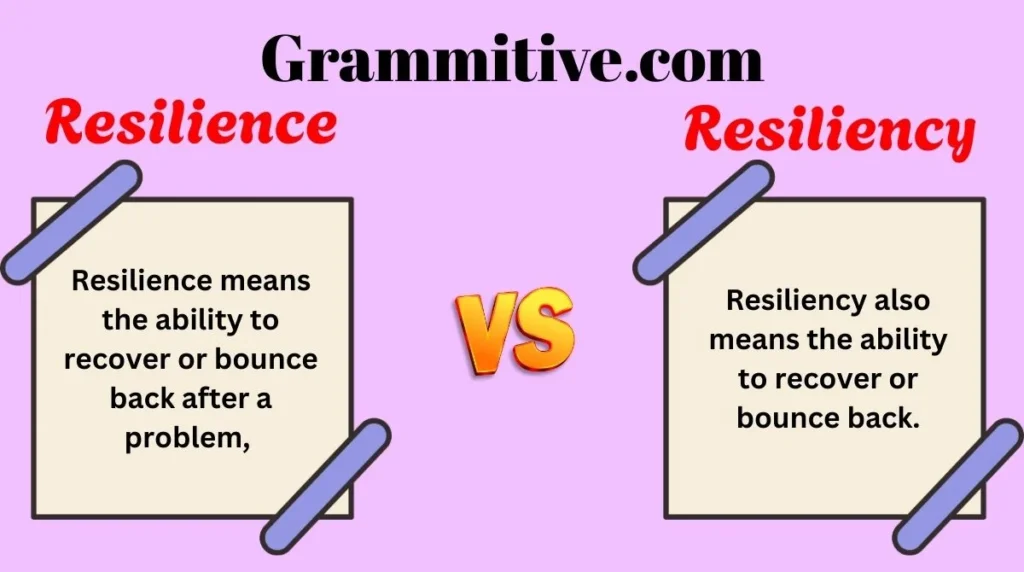
Resilience means the ability to recover or bounce back after a problem, difficulty, or shock.
It describes strength inside a person, system, or material.
Think of it like this:
You fall → you stand up again → that’s resilience.
When to use it
Use resilience when talking about:
- people’s emotions or mental strength
- communities after disasters
- systems or businesses surviving problems
- general everyday English
This is the most common form in modern English.
Grammar rule
Resilience is a noun.
It comes from the adjective resilient.
Structure:
- resilient (adjective)
- resilience (noun)
This is the standard and traditional noun form.
Example sentences (6–8)
- Her resilience helped her survive a very hard year.
- Children often show amazing resilience after change.
- The city showed great resilience after the earthquake.
- Exercise builds both physical and mental resilience.
- We admire his resilience during tough times.
- Teachers help students develop resilience.
- Good sleep improves your body’s resilience to stress.
- The company’s resilience kept it alive during the crisis.
Common learner confusion
Many learners think:
“Resilience sounds more formal. Maybe I shouldn’t use it in daily speech.”
But that’s not true.
Native speakers use resilience everywhere — in conversation, news, and writing.
It’s the safe and natural choice almost every time.
What Does “Resiliency” Mean?
Simple definition
Resiliency also means the ability to recover or bounce back.
Yes — the meaning is almost the same.
There is no big difference in meaning.
So why does this word exist?
Because English often creates nouns using -ency or -iency endings. Both forms sometimes develop over time.
When to use it
Resiliency appears more in:
- technical writing
- engineering
- materials science
- academic papers
- some American English contexts
It is less common in everyday speech.
Grammar rule
This is also a noun, made from resilient.
Structure:
- resilient
- resiliency
So grammatically, it works the same way as resilience.
But it sounds slightly longer and heavier.
Example sentences (6–8)
- The engineer tested the resiliency of the metal.
- This foam has high resiliency after pressure.
- The material’s resiliency makes it useful for sports shoes.
- Scientists studied the resiliency of the ecosystem.
- The bridge design improves structural resiliency.
- The report measured soil resiliency after flooding.
- This mattress is known for its resiliency.
- The system’s resiliency reduces downtime.
Common learner confusion
Students sometimes think:
“Resiliency sounds more correct because it’s longer.”
But longer doesn’t mean better.
In normal English conversation, resiliency can sound unusual or too technical.
That’s why many teachers recommend using resilience most of the time.
Difference Between Resilience and Resiliency (Detailed)
Here’s where things become clear.
Quick comparison table
| Feature | Resilience | Resiliency |
|---|---|---|
| Meaning | Ability to recover | Same meaning |
| Commonness | Very common | Less common |
| Style | General English | Technical/academic |
| Sounds | Natural | Slightly formal/scientific |
| Best for learners | Yes | Usually avoid |
| Native speaker preference | Strong | Limited |
Usage difference
Resilience
- everyday life
- emotions
- people
- schools
- news articles
Resiliency
- materials
- machines
- scientific writing
- engineering reports
So the difference is mostly about style and context, not meaning.
Grammar logic
Both words are:
- abstract nouns
- uncountable
- used with “have,” “show,” “build,” “develop”
Example:
- She has resilience.
- The material has resiliency.
Same grammar. Different tone.
Sentence structure difference
Notice how they “feel”:
Natural:
✔ Her resilience impressed everyone.
Less natural in daily speech:
✘ Her resiliency impressed everyone.
But in engineering:
✔ The foam’s resiliency is excellent.
So context decides.
Meaning comparison
Think of it like this:
Resilience = human strength
Resiliency = technical strength
Not always, but usually.
Grammar Rules You Must Remember
Rule #1: Both are nouns
Correct:
- Resilience is important.
- Resiliency is important.
Wrong:
- She is very resilience. ❌
(Use “resilient” here)
Correct:
- She is very resilient. ✔
Rule #2: Use “resilience” for people
Correct:
- Kids have natural resilience.
Not natural:
- Kids have natural resiliency.
Rule #3: Use “resiliency” mainly for materials
Correct:
- The rubber shows strong resiliency.
More common:
- The rubber shows strong resilience.
Both okay, but the first sounds technical.
Rule #4: Both are uncountable nouns
Wrong:
- many resiliences ❌
Correct:
- a lot of resilience ✔
Wrong:
- two resiliencies ❌
Correct:
- high resiliency ✔
Common Mistakes Students Make
Why mistakes happen
- Words look similar
- Dictionaries show both
- Teachers don’t explain usage
- Students overthink
Wrong vs correct examples
❌ She showed great resiliency during her exams.
✔ She showed great resilience during her exams.
❌ This child has strong resiliency skills.
✔ This child has strong resilience.
❌ Many resiliencies helped the team.
✔ A lot of resilience helped the team.
Easy correction tips
- Talking about people → choose resilience
- Talking about machines → either is fine
- Unsure → always choose resilience
It’s the safest option.
Easy Trick to Remember the Difference
Here’s a simple memory trick.
Think about word length
Resilience = shorter = everyday speech
Resiliency = longer = technical/scientific
Short words feel natural.
Long words feel academic.
So:
Talking to a friend? → resilience
Writing a science report? → resiliency (optional)
Real-life logic
When you comfort someone, you don’t say:
“Wow, your resiliency is impressive.”
You say:
“Your resilience is amazing.”
It sounds warmer and more human.
Daily Life Examples (Very Important)
These sound like real conversations.
- “She has so much resilience after losing her job.”
- “Kids are stronger than we think. Their resilience is amazing.”
- “We need resilience to handle stress at work.”
- “This team’s resilience helped them win the game.”
- “Therapy builds emotional resilience.”
- “Grandparents often teach us resilience.”
- “The phone case has good resiliency against drops.”
- “That foam’s resiliency keeps it from breaking.”
- “Life tests your resilience every day.”
- “Meditation improves mental resilience.”
Notice how almost all daily sentences use resilience.
Practice Section
Choose the correct word.
- Children show great ______ after failure.
- The rubber’s ______ makes it flexible.
- We need emotional ______ in tough times.
- Engineers tested the material’s ______.
- Her ______ helped her recover quickly.
Answers
- resilience
- resiliency (or resilience)
- resilience
- resiliency
- resilience
FAQs (SEO Focused)
What is the difference between resilience and resiliency?
Both mean the ability to recover or bounce back. The difference is usage. Resilience is common in everyday English, while resiliency appears more in technical or scientific contexts.
Which word is more common in modern English?
Resilience is much more common. Native speakers use it in daily speech, books, and news. It’s the safer choice for learners.
Can we use resiliency for people?
Yes, grammatically you can, but it sounds unnatural. Most people prefer resilience when talking about emotions or personal strength.
Is resiliency formal or informal?
It sounds more formal and technical. You often see it in engineering, science, or academic writing rather than casual conversation.
Are both words correct?
Yes. Both are correct nouns. They have almost the same meaning. The difference is style and frequency.
Which one should English learners use?
Use resilience most of the time. It fits nearly every situation and sounds natural to native speakers.
Final Conclusion
English sometimes gives us two words that mean almost the same thing. That can feel confusing at first, but small patterns make everything clearer.
Resilience is the everyday hero. It’s warm, simple, and natural. You hear it when talking about people, feelings, and life challenges. Teachers, parents, and friends use it all the time.
Resiliency is not wrong. It simply lives more in technical or scientific spaces. Engineers and researchers use it when talking about materials and systems.
So there’s no need to stress. If you remember just one thing, remember this:
When in doubt, choose resilience.
Practice using it in your daily English. Add it to your conversations. Write a few sentences with it. The more you use it, the more natural it will feel.
Language grows through use, not fear.

I am Lucas Bennett, a digital content creator passionate about social media trends and online growth strategies.
I share practical insights and guides to help users better understand and navigate the digital world.