
English has many words that look simple but feel confusing when you actually try to use them.
One of those words is “reside.”
At first, it seems easy. It just means to live somewhere, right?
But then you hear sentences like:
- I reside in Canada
- She resides at 25 King Street
- They reside on the island
Suddenly, you stop and think…
Which preposition is correct?
Why not use the same one every time?
This small choice — in, on, or at — can change your sentence. And for English learners, this tiny difference often causes big confusion.
Introduction
Many students believe “reside” is just a fancy word for “live.” That is partly true. But when you use reside, the preposition after it becomes very important. Choosing the wrong one can sound unnatural or grammatically incorrect.
This problem happens because English uses location prepositions in different ways:
- in → inside an area
- on → on a surface or island
- at → exact point or address
Native speakers use these automatically. Learners often have to stop and think.
Understanding this topic helps you:
- sound more formal and professional
- write correct emails and documents
- fill forms properly
- speak clearly about your address
- avoid embarrassing mistakes
After reading this guide, you will clearly know:
- when to use reside in
- when to use reside on
- when to use reside at
- how they are different
- easy tricks to remember
Everything is explained in simple English with many real examples.
By the end, you won’t guess anymore — you’ll choose correctly with confidence.
What Does “Reside in” Mean?
Simple meaning
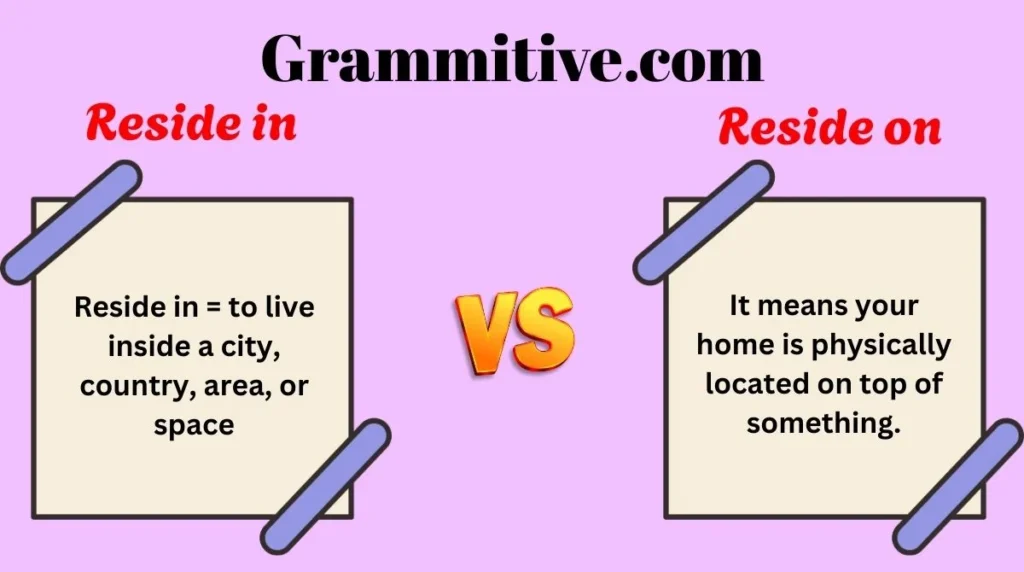
Reside in = to live inside a city, country, area, or space
It talks about being inside a large place.
Think of it like being inside a box.
When to use it
Use reside in for:
- countries
- cities
- states
- neighborhoods
- buildings
- rooms
- general areas
If the place feels big or wide, use in.
Grammar rule
Subject + reside(s) + in + area/place
Examples:
Example sentences
- I reside in Canada.
- She resides in New York City.
- They reside in a small village.
- My grandparents reside in the countryside.
- He resides in an apartment near the lake.
- Many students reside in the dormitory.
- We reside in the northern part of town.
- The manager resides in this building.
Common learner confusion
Many students wrongly say:
❌ I reside at Canada
❌ She resides on London
This sounds strange because countries and cities are areas, not points or surfaces.
Always remember:
👉 Big place → in
What Does “Reside on” Mean?
Simple meaning
Reside on = to live on a surface, island, or piece of land
It means your home is physically located on top of something.
When to use it
Use reside on for:
- islands
- streets (sometimes)
- farms
- floors
- campuses
- land surfaces
Anything that feels like a surface or flat area.
Grammar rule
Subject + reside(s) + on + surface/land
Example sentences
- They reside on a small island.
- She resides on Green Street.
- We reside on the second floor.
- He resides on his family farm.
- The cohort resides on protected land.
- My aunt resides on the coast.
- Several birds reside on this tree.
- The monks reside on the mountain.
Common learner confusion
Students often say:
❌ I reside in an island
But English sees an island like a surface, not a container.
So we say:
✅ on an island
It’s about how English imagines space.
What Does “Reside at” Mean?
Simple meaning
Reside at = to live at a specific point or exact address
It focuses on precise location.
When to use it
Use reside at for:
- house numbers
- exact addresses
- specific buildings
- institutions
It answers the question: Where exactly?
Grammar rule
Subject + reside(s) + at + exact place
Example sentences
- I reside at 221 Baker Street.
- She resides at Apartment 5B.
- They reside at this address.
- He resides at the corner house.
- The director resides at the official residence.
- My cousin resides at 45 Maple Road.
- We reside at the university campus.
- The patient resides at the care center.
Common learner confusion
Students sometimes use in:
❌ I reside in 25 King Street
But a street address is a point, not an area.
So we use:
✅ at
Difference Between Reside in, on, and at (Detailed)
Understanding the difference is easier when you compare them side by side.
Quick comparison table
| Preposition | Type of location | Size idea | Example |
|---|---|---|---|
| in | area/container | big | reside in Tokyo |
| on | surface/land | flat | reside on an island |
| at | exact point | specific | reside at 25 Main St |
Usage difference
In → inside boundaries
On → on top of a surface
At → exact spot
Grammar logic
English uses spatial thinking:
- in = inside
- on = touching surface
- at = point
This is not only for “reside.”
It works for many verbs: live, stay, work, study.
Sentence structure difference
- I reside in Canada.
- I reside on this island.
- I reside at 42 Lake Road.
Notice how the place changes type.
Meaning comparison
Think of zooming a map:
Country → city → street → house
- country/city → in
- street/land → on
- house number → at
As you zoom closer, you change prepositions.
Grammar Rules You Must Remember
Rule #1 – Big areas use “in”
I reside in Germany.
She resides in a small town.
Rule #2 – Surfaces and islands use “on”
They reside on an island.
We reside on the third floor.
Rule #3 – Exact addresses use “at”
He resides at 12 King Street.
She resides at the hospital.
Rule #4 – “Reside” is formal
Use “reside” mostly in:
- official forms
- legal writing
- professional speech
In daily talk, people usually say live.
Example:
Formal → I reside at 12 King Street.
Casual → I live at 12 King Street.
Common Mistakes Students Make
Mistakes happen because learners translate directly from their own language. Many languages use only one word for location.
English uses three.
Mistake 1
❌ I reside at Canada
✅ I reside in Canada
Canada is an area.
Mistake 2
❌ They reside in an island
✅ They reside on an island
Islands use “on.”
Mistake 3
❌ She resides in 45 Park Avenue
✅ She resides at 45 Park Avenue
Exact address → at
Easy correction tip
Ask yourself:
Is it big, flat, or exact?
Big → in
Flat → on
Exact → at
Easy Trick to Remember the Difference
Here’s a simple memory trick many students love.
Imagine your home like this:
You are in a city
Your house is on a street
Your door is at a number
See how it gets more specific?
Think:
Big → Medium → Small
In → On → At
This natural order helps your brain remember automatically.
Daily Life Examples (Very Important)
These sound like real conversations you might hear.
- I reside in Chicago but work downtown.
- She resides on Pine Street near the bank.
- He resides at 78 Oak Drive.
- My grandparents reside in a quiet village.
- We reside on the fourth floor of this building.
- Do you still reside at your old address?
- They reside on a farm outside the city.
- I reside in Canada during the winter.
- The professor resides at the university housing.
- She resides on a beautiful island in Greece.
Say these out loud. They sound natural and clear.
Practice Section
Choose the correct preposition: in, on, or at
- I reside ___ Mumbai.
- They reside ___ an island.
- She resides ___ 24 Hill Road.
- We reside ___ the second floor.
- He resides ___ a small town.
Answers
- in
- on
- at
- on
- in
FAQs
What is the difference between reside in and reside at?
“Reside in” talks about general areas like cities or countries. “Reside at” talks about an exact address or specific point. Use “in” for big places and “at” for precise locations.
Can we use reside on for streets?
Yes, sometimes. Streets are seen as surfaces. You can say “reside on Maple Street,” especially in formal writing. In casual speech, people usually say “live on.”
Is reside formal or informal?
“Reside” is formal. It appears in legal documents, forms, and official writing. In daily conversation, people mostly say “live.”
Can I say reside in a house?
Yes. A house can feel like a container. So “reside in a house” is correct. But many people say “live in a house” instead.
Which is correct: reside in an island or on an island?
“Reside on an island” is correct. English treats islands like surfaces, not containers.
Do native speakers use reside often?
Not very often in everyday talk. It sounds formal or serious. You’ll hear it more in official or professional situations.
Final Conclusion
Small words like in, on, and at may look tiny, but they carry big meaning. Choosing the right one makes your English sound natural and correct.
Remember the simple idea:
Big area → in
Surface or land → on
Exact point → at
Once you see locations this way, everything becomes easier. No more guessing.
Practice by making your own sentences about your city, street, and home. Say them out loud. The more you use them, the more natural they feel.
Grammar doesn’t need to be scary. With a little logic and daily practice, it becomes clear and even fun.
Soon you’ll use these phrases without thinking — just like a native speaker.

I am Lucas Bennett, a digital content creator passionate about social media trends and online growth strategies.
I share practical insights and guides to help users better understand and navigate the digital world.