

Many English learners feel nervous when they need to change an appointment or meeting in English.
A simple sentence like “Can we reschedule ___ Monday?” suddenly becomes stressful. Should you say to Monday or for Monday?
Both sound correct. Both are common. And both are used by native speakers.
That’s exactly why this topic feels confusing.
Small prepositions like to and for look tiny, but they can change the meaning of a sentence. One wrong word can make your sentence sound strange or unnatural.
In business emails, school messages, or daily conversations, this mistake happens all the time.
Imagine calling your doctor, emailing your boss, or texting a friend. You want to sound clear and confident. You don’t want to stop and think for 20 seconds about one small word.
The good news? The difference is not difficult. Once you understand the logic, it becomes very natural.
By the end, you’ll clearly know:
- when to use reschedule to
- when to use reschedule for
- which one sounds more natural in daily English
- how native speakers really use them
- and how to avoid common mistakes
Think of this like a friendly classroom lesson. Slow, simple, and practical.
What Does “Reschedule To” Mean?
Simple definition
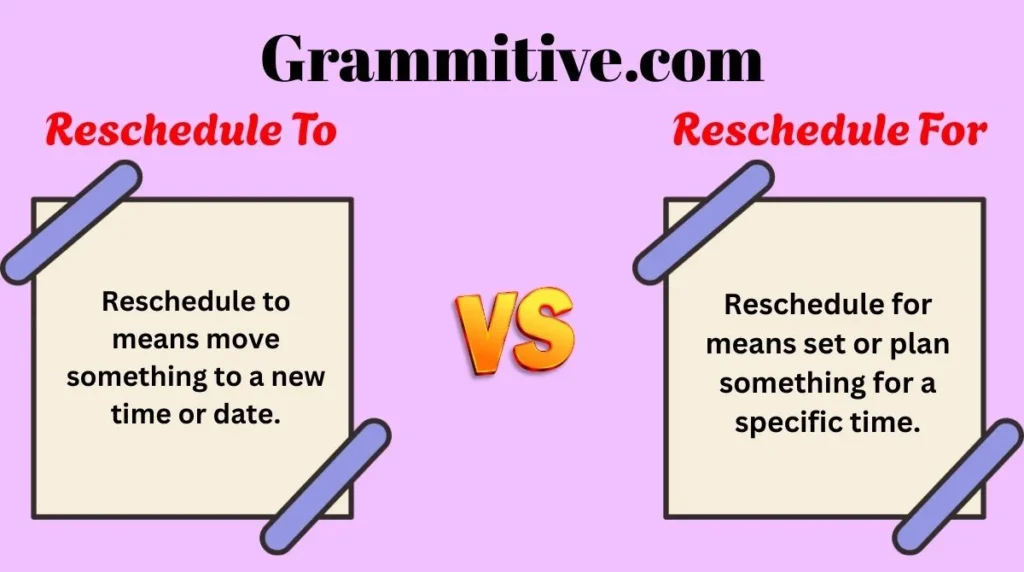
Reschedule to means move something to a new time or date.
You focus on the new time where the event will go.
Think of it like moving a chair.
You move the chair to another place.
Same idea.
You move the meeting to another time.
When to use it
Use reschedule to + specific time/date/day when you want to say:
👉 “Change it and put it at this new time.”
It highlights the destination time.
Grammar rule
Structure:
reschedule + object + to + new time/date
Examples:
- reschedule the meeting to Monday
- reschedule the class to 3 PM
- reschedule the interview to next week
Example sentences
- We rescheduled the meeting to Tuesday.
- Can you reschedule my appointment to 4 PM?
- They rescheduled the exam to next month.
- Let’s reschedule the call to tomorrow morning.
- The doctor rescheduled my visit to Friday.
- She rescheduled her flight to the evening.
- They rescheduled the party to Saturday night.
- We had to reschedule the lesson to another day.
Common learner confusion
Many students think to means “toward movement,” so they avoid it with time.
But English often treats time like a place.
For example:
- move to Monday
- push to next week
- postpone to later
So to feels very natural with time changes.
Still, native speakers don’t always choose to. That’s where for comes in.
What Does “Reschedule For” Mean?
Simple definition
Reschedule for means set or plan something for a specific time.
Here, the focus is on the scheduled time itself, not the movement.
It sounds more like booking or planning.
When to use it
Use reschedule for + time/date when you mean:
👉 “Arrange it for this time.”
This is extremely common in daily English, especially in:
- appointments
- business meetings
- phone calls
- formal emails
Grammar rule
Structure:
reschedule + object + for + time/date
Examples:
- reschedule the meeting for Monday
- reschedule the appointment for 2 PM
- reschedule the interview for next week
Example sentences
- I rescheduled the meeting for Thursday.
- Can we reschedule the call for tomorrow?
- They rescheduled the exam for June 10th.
- She rescheduled her dentist visit for the afternoon.
- Let’s reschedule the class for next week.
- He rescheduled the interview for Monday morning.
- The manager rescheduled the discussion for later.
- We rescheduled dinner for tonight.
Common learner confusion
Students often ask:
“Why use for? Doesn’t for mean ‘purpose’ or ‘benefit’?”
Yes, sometimes.
But for also means scheduled at a time.
Examples:
- The meeting is for 3 PM
- My flight is for Monday
- The appointment is for tomorrow
So reschedule for follows this same pattern.
That’s why it often sounds more natural than to.
Difference Between Reschedule To and Reschedule For (Detailed)
Both are grammatically correct.
But their feeling is slightly different.
Comparison table
| Feature | Reschedule To | Reschedule For |
|---|---|---|
| Focus | moving to a new time | planning/setting a time |
| Feeling | movement | scheduling |
| Common in speech | medium | very common |
| Business English | okay | preferred |
| Sounds natural | yes | very natural |
Usage difference
Reschedule to → emphasizes change
Reschedule for → emphasizes arrangement
Small difference. Same result.
Grammar logic
Think like this:
- to = direction (move to)
- for = planned time (book for)
Both are logical.
But English speakers often prefer for because appointments feel like “plans,” not “movement.”
Sentence structure difference
Both structures look the same:
- reschedule + object + to + time
- reschedule + object + for + time
So grammar is not the problem.
It’s more about natural usage.
Meaning comparison
Compare:
👉 We rescheduled the meeting to Friday.
= We moved it to Friday.
👉 We rescheduled the meeting for Friday.
= We arranged it for Friday.
Almost the same meaning.
But the second sounds smoother in everyday English.
Grammar Rules You Must Remember
Rule #1 — Both are correct
You will not be wrong using either.
✔ We rescheduled the class to Monday
✔ We rescheduled the class for Monday
Rule #2 — “For” is more common for appointments
Use for with:
- meetings
- interviews
- doctor visits
- calls
- bookings
Example:
✔ I rescheduled my appointment for 10 AM
Rule #3 — Use “to” when you think about movement
If you feel the idea of “moving,” use to.
Example:
✔ They moved the deadline to next week
Rule #4 — Never use both together
❌ reschedule to for Monday
❌ reschedule for to Monday
Choose one only.
Common Mistakes Students Make
Mistake 1 — Using wrong prepositions
❌ reschedule at Monday
✔ reschedule for Monday
Tip: only to or for
Mistake 2 — Forgetting the object
❌ I rescheduled to Monday
✔ I rescheduled the meeting to Monday
Always say what you reschedule.
Mistake 3 — Overthinking
Students sometimes stop speaking because they’re unsure.
Remember: both are fine. Fluency is more important than perfection.
Mistake 4 — Using “on”
❌ reschedule on Monday
“On” is for events that already happen, not rescheduling.
Easy Trick to Remember the Difference
Here’s a simple memory trick.
Think:
👉 FOR = FOR an appointment
Appointments are planned for a time.
So if it’s a meeting or booking, use for.
Very easy.
If you imagine physically moving something, use to.
But honestly? Use for most of the time and you’ll sound natural.
Daily Life Examples (Very Important)
These are how native speakers really talk.
- Can we reschedule the meeting for tomorrow?
- I rescheduled my dentist visit for next week.
- Let’s reschedule to Friday if that’s okay.
- The teacher rescheduled the test for Monday.
- They rescheduled the flight to the evening.
- Sorry, can we reschedule for later today?
- He rescheduled the interview for 9 AM.
- We had to reschedule to another day.
- The doctor rescheduled me for next month.
- Can we reschedule this call for after lunch?
Notice something?
You see for more often. That’s natural English.
Practice Section
Choose to or for.
- We rescheduled the meeting ___ Tuesday.
- She rescheduled her appointment ___ 3 PM.
- They rescheduled the exam ___ next month.
- Can you reschedule the call ___ tomorrow morning?
- We rescheduled the party ___ Saturday night.
Answers
- for
- for
- to or for (both ok)
- for
- to or for
FAQs
What is the difference between reschedule to and reschedule for?
Both mean changing the time. “To” focuses on moving to a new time. “For” focuses on planning or booking that time. “For” sounds more natural in daily English.
Which one is more common?
“Reschedule for” is more common, especially for appointments and meetings. Native speakers use it a lot in emails and conversations.
Can we use them in questions?
Yes. Both work.
Examples:
- Can we reschedule to Friday?
- Can we reschedule for Friday?
Both sound correct.
Is reschedule for more formal?
It’s slightly more professional and common in business English. That’s why you often see it in emails and work messages.
Can I use “on” instead?
No. “On” is not used with reschedule. Use only “to” or “for.”
Incorrect: reschedule on Monday
Correct: reschedule for Monday
Do native speakers notice the difference?
Usually no. Both sound fine. They care more about clarity than the preposition. Don’t stress too much.
Final Conclusion
Small grammar words can feel big and scary. But this one is actually simple.
Both reschedule to and reschedule for are correct and widely used. The difference is just about feeling. “To” shows movement. “For” shows planning. That’s it.
If you ever feel unsure, choose for. It works in most situations and sounds very natural for meetings, appointments, and calls.
The best way to learn is through practice. Say the sentences out loud. Write short messages. Use them in real conversations. Soon, you won’t even think about it.
English becomes easier when you focus on patterns, not perfection.
Keep practicing a little every day. Your confidence will grow faster than you expect.

I am Lucas Bennett, a digital content creator passionate about social media trends and online growth strategies.
I share practical insights and guides to help users better understand and navigate the digital world.