
Many English learners say sentences like “Please reply me soon” or “He didn’t reply me.”
It sounds natural, right? The sentence feels short and clear.
But here’s the problem — native English speakers almost never say it that way.
Instead, they say:
👉 “Please reply to me.”
That tiny word “to” causes a lot of confusion.
Students often ask:
- Why do we need to?
- Is “reply me” wrong?
- I hear people say it sometimes — is it okay?
- Which one is correct for exams and formal writing?
This small grammar point is very important in daily English. You use reply in emails, texts, work messages, and conversations all the time.
If you say it the wrong way, it can sound unnatural or grammatically incorrect.
The good news? The rule is actually simple once you understand how the verb reply works.
By the end of this guide, you’ll clearly understand:
- the meaning of both forms
- which one is correct
- grammar rules
- common mistakes
- real-life examples
- and an easy memory trick
After that, you’ll never hesitate again when writing or speaking.
Let’s break it down step by step in very simple English.
What Does “Reply Me” Mean?
Simple definition
“Reply me” means:
👉 Give me an answer
But here’s the key point:
❌ This structure is NOT grammatically correct in standard English.
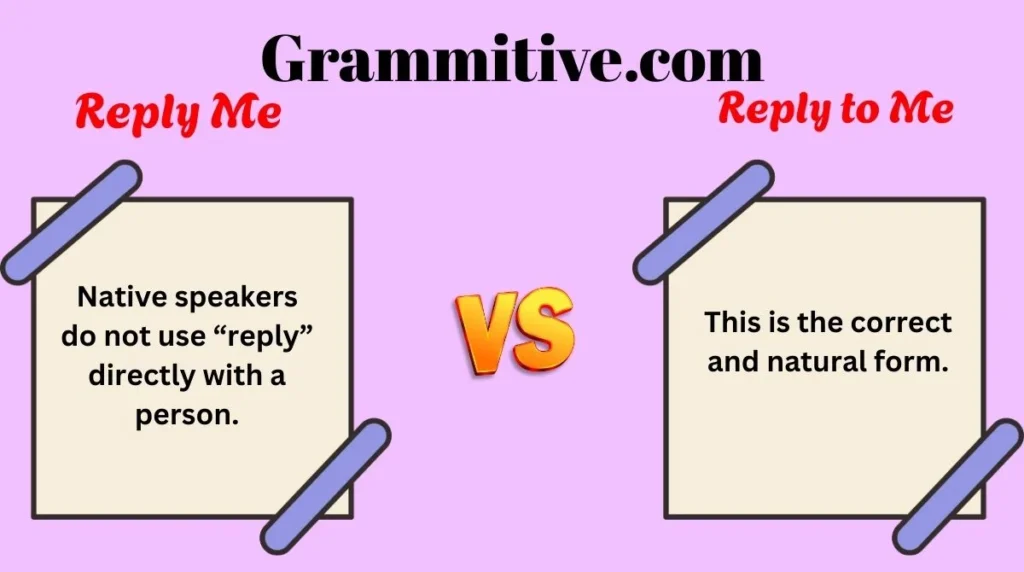
Native speakers do not use “reply” directly with a person.
Grammar rule
The verb reply is an intransitive verb.
That means:
👉 it cannot take a direct object
So you cannot say:
❌ reply me
❌ reply him
❌ reply her
Because “me / him / her” are direct objects.
The verb needs a preposition (to) first.
When learners use “reply me”
Many learners say “reply me” because:
- their native language uses direct objects
- they translate word-for-word
- verbs like “call me” or “tell me” don’t use prepositions
So they think “reply me” should be similar.
But English doesn’t work like that.
Examples students often say (incorrect)
These sentences are wrong, but very common:
❌ Reply me soon.
❌ He didn’t reply me yesterday.
❌ Please reply me quickly.
❌ She replied me after two hours.
❌ Why didn’t you reply me?
❌ Reply me when you reach home.
❌ Can you reply me now?
❌ They never reply me.
All of these need to.
Common learner confusion
Students think:
“Call me” is correct.
“Message me” is correct.
So “reply me” must be correct too.
But verbs are different.
Each verb has its own grammar pattern.
Sadly, English doesn’t follow one simple rule for everything.
You just need to learn how reply behaves.
What Does “Reply to Me” Mean?
Simple definition
“Reply to me” means:
👉 Answer me / give me a response
This is the correct and natural form.
Native speakers use this every day.
Grammar rule
Reply + to + person
Structure:
reply to + someone
Because reply is intransitive, it needs the preposition to before the person.
When to use it
Use “reply to me” when:
- answering messages
- responding to emails
- replying in conversation
- giving answers
It works in both spoken and written English.
Correct examples
✅ Please reply to me soon.
✅ He didn’t reply to me yesterday.
✅ She replied to me politely.
✅ Why didn’t you reply to me?
✅ Reply to me when you are free.
✅ They replied to me by email.
✅ I always reply to my boss quickly.
✅ Did you reply to her message?
These sound natural and correct.
Common learner confusion
Some students think adding to sounds longer or unnecessary.
But in English, the preposition is required.
Without it, the sentence sounds broken to native ears.
Think of it like this:
👉 “reply” needs a small bridge (to) to reach the person.
Difference Between Reply Me and Reply to Me (Detailed)
Here’s a clear comparison:
| Feature | Reply me | Reply to me |
|---|---|---|
| Grammar | ❌ Incorrect | ✅ Correct |
| Verb type | Direct object (wrong) | Preposition used |
| Natural sound | No | Yes |
| Used by natives | Rarely/never | Always |
| Suitable for exams | No | Yes |
| Formal writing | No | Yes |
Usage difference
“Reply me” breaks grammar rules.
“Reply to me” follows standard English patterns.
So in professional or academic English, only the second is acceptable.
Grammar logic
- Reply = intransitive
- Intransitive verbs cannot take objects
- So we add “to”
Similar verbs:
- talk to me
- listen to me
- speak to me
- respond to me
Notice the pattern?
All use to.
Sentence structure difference
Wrong:
❌ reply + me
Correct:
✅ reply + to + me
That small “to” makes everything correct.
Meaning comparison
Both express the same idea:
👉 give an answer
But only one is grammatically right.
So meaning doesn’t change — correctness does.
Grammar Rules You Must Remember
Rule #1 — Reply is intransitive
It cannot take a direct object.
✅ She replied to me.
❌ She replied me.
Rule #2 — Use “to” before a person
Always add “to” when mentioning someone.
✅ Reply to him.
✅ Reply to her.
✅ Reply to them.
Rule #3 — You can drop the person
If no person is mentioned, “to” is not needed.
✅ She replied quickly.
✅ He replied politely.
No object = no problem.
Rule #4 — Use “reply with” for content
When talking about the message itself:
✅ He replied with a smile.
✅ She replied with “yes.”
Different prepositions, different meanings.
Common Mistakes Students Make
Why mistakes happen
Mostly because:
- direct translation
- copying friends
- texting shortcuts
- lack of grammar knowledge
Wrong vs Correct examples
❌ Reply me soon
✅ Reply to me soon
❌ He didn’t reply me
✅ He didn’t reply to me
❌ Please reply me back
✅ Please reply to me
Easy correction tips
Whenever you say “reply someone”…
Stop.
Add to.
It becomes correct instantly.
Easy Trick to Remember the Difference
Here’s a simple memory trick students love:
Think:
👉 Reply travels TO someone
Your message moves from you → to another person.
So you need to.
Like sending a letter:
You send it to someone.
Same logic.
Reply = send answer → to person.
If you remember this movement idea, you’ll never forget again.
Daily Life Examples (Very Important)
These sound like real conversations.
Notice how natural they feel.
✅ “Hey, did you reply to me last night?”
✅ “Please reply to my email today.”
✅ “She never replies to my texts.”
✅ “Why didn’t you reply to the teacher?”
✅ “I’ll reply to you after lunch.”
✅ “He replied to everyone in the group.”
✅ “Can you reply to the customer quickly?”
✅ “They replied to our message this morning.”
✅ “Thanks for replying to me so fast!”
✅ “I forgot to reply to her, sorry.”
You’ll hear these every day in offices, schools, and homes.
Practice Section
Choose the correct option:
1
Please reply ___ me soon.
a) to
b) —
2
She didn’t reply ___ my message.
a) to
b) with
3
He replied ___ a smile.
a) to
b) with
4
Why didn’t you reply ___ him?
a) to
b) —
5
I will reply ___ you tomorrow.
a) to
b) at
Answers
1 → a
2 → a
3 → b
4 → a
5 → a
FAQs
What is the difference between reply me and reply to me?
“Reply me” is grammatically wrong. “Reply to me” is correct because reply needs the preposition “to.” Always use “to” before a person.
Can we use reply me in informal English?
Some learners use it casually, but native speakers don’t. Even in texting or chatting, “reply to me” sounds more natural and correct.
Is reply to me formal or informal?
It works in both. You can use it in emails, work, school, and daily conversations. It’s safe everywhere.
Why does reply need “to”?
Because it’s an intransitive verb. It cannot take a direct object. The preposition connects the verb to the person.
Can I say reply back to me?
Yes, but “back” is often unnecessary. “Reply to me” already means answering back. Adding “back” is extra but still common in speech.
What verbs are similar to reply?
Talk to, speak to, listen to, respond to, explain to. These verbs also use “to” before a person.
Final Conclusion
Small grammar points often cause the biggest headaches. “Reply me vs reply to me” is one of those tiny differences that can change how natural your English sounds.
The rule is simple when you look closely. The verb reply cannot take a direct object, so it always needs to before a person.
That’s why “reply me” feels wrong and “reply to me” sounds smooth and correct.
If you remember just one thing, remember this:
Reply travels TO someone.
Practice using it in daily conversations, emails, and messages. Read examples out loud. The more you use it, the more natural it becomes.
Soon, you won’t even think about the rule. You’ll just say it correctly without effort — like native speakers do.
Keep practicing. Small improvements like this make your English much stronger every day.

I am Lucas Bennett, a digital content creator passionate about social media trends and online growth strategies.
I share practical insights and guides to help users better understand and navigate the digital world.