

English has many small phrases that look simple but cause big confusion. One pair that often troubles learners is “relate to” and “relate with.”
At first, both seem almost the same. They use the same verb — relate. Only the preposition changes. So many students think they mean the same thing. But when they try to speak or write, something feels wrong.
You may have asked yourself:
- Should I say I relate to him or I relate with him?
- Why does one sound natural and the other strange?
- Do native speakers really use both?
These questions are very common, even among intermediate learners.
This topic matters because we use relate often in daily life. We talk about feelings, connections, stories, people, and experiences.
If you use the wrong preposition, your sentence may sound unnatural or even incorrect.
After reading this guide, you will clearly understand:
- What each phrase really means
- When to use each one
- Which one native speakers prefer
- The grammar rules behind them
- Easy memory tricks
- Many real-life examples
By the end, choosing the right phrase will feel simple and natural.
What Does “Relate To” Mean?
Simple definition
Relate to means:
👉 to feel a connection with someone or something
👉 to understand someone’s feelings or experiences
👉 to be connected or linked to something
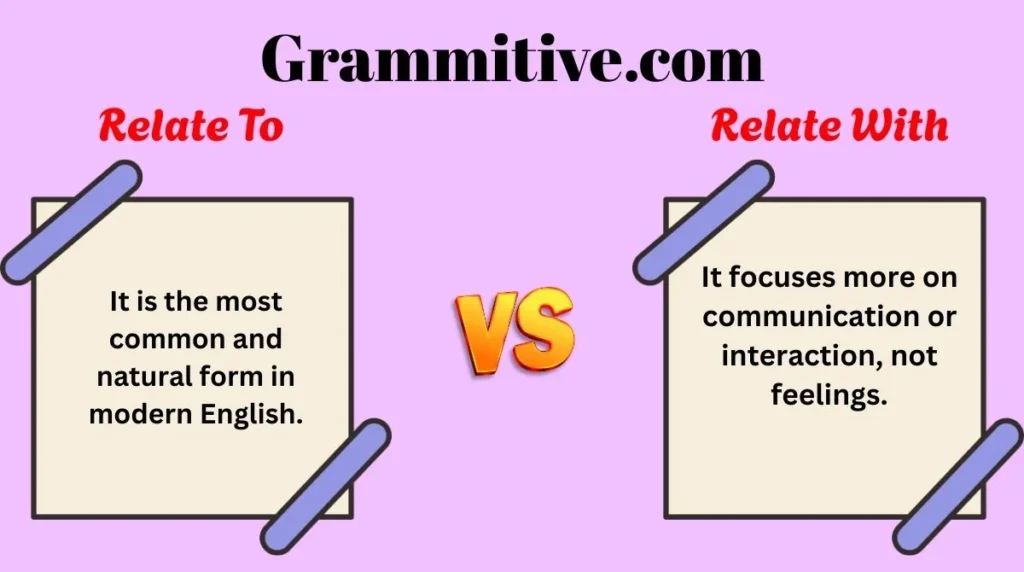
It is the most common and natural form in modern English.
Native speakers use relate to almost every day.
When to use it
Use relate to when:
- you understand someone emotionally
- you feel similar to someone
- something is connected to a topic
- something refers to something else
Grammar rule
Structure:
relate to + noun / pronoun / gerund
Examples:
- relate to him
- relate to her
- relate to the problem
- relate to studying abroad
Example sentences
- I can relate to your story.
- She relates to children very well.
- Many people relate to this movie.
- His advice relates to our project.
- I can’t relate to rich people’s problems.
- This lesson relates to grammar rules.
- Teens relate to songs about friendship.
- I really relate to what you said.
Common learner confusion
Many students think relate to only means “talk about.”
But it also means feel emotionally connected.
For example:
❌ This movie relates to my life. (sounds technical)
✔ I relate to this movie. (means I feel connected)
Notice the feeling difference.
What Does “Relate With” Mean?
Simple definition
Relate with means:
👉 to build a relationship or interact successfully with someone
It focuses more on communication or interaction, not feelings.
However, here’s something important:
⚠️ It is much less common in modern English.
Many native speakers rarely use it.
In many situations, relate to sounds more natural.
When to use it
Use relate with when:
- you talk about working together
- you describe communicating with someone
- you mean interacting professionally
It often appears in formal, business, or psychological contexts.
Grammar rule
Structure:
relate with + person
It is usually used for people, not ideas or things.
Example sentences
- A good teacher knows how to relate with students.
- The manager relates well with his team.
- She struggles to relate with her coworkers.
- Therapists must relate with clients carefully.
- Parents should relate with their children.
- Leaders must relate with different personalities.
- He relates better with older people.
- She finds it hard to relate with strangers.
Common learner confusion
Some learners use relate with everywhere:
❌ I relate with this movie.
❌ I relate with your problem.
These sound unnatural.
For feelings or connections, relate to is correct.
Difference Between Relate To and Relate With (Detailed)
The difference becomes clearer when we compare them side by side.
Quick comparison table
| Feature | Relate To | Relate With |
|---|---|---|
| Meaning | Feel connected / understand | Interact or communicate |
| Usage | Very common | Less common |
| Used with | People, ideas, problems, stories | Mostly people |
| Tone | Natural, everyday | Slightly formal/professional |
| Emotion | Yes | Not always |
| Native preference | Strongly preferred | Rare |
Usage difference
Relate to = emotional connection
You understand someone’s feelings or experiences.
Example:
I relate to her struggles.
(I feel the same struggles)
Relate with = interaction
You communicate or deal with someone.
Example:
I relate well with clients.
(I communicate well)
Grammar logic
Think of the prepositions:
to → direction or connection
with → together or interaction
So:
- connect TO something
- work WITH someone
This small difference explains everything.
Sentence structure difference
Relate to:
- relates to the issue
- relates to her story
- relates to the topic
Relate with:
- relates with customers
- relates with employees
You usually don’t use with for ideas or objects.
Meaning comparison
Compare these:
- I relate to him.
→ I understand him emotionally. - I relate with him.
→ I interact or communicate with him.
The first talks about feelings.
The second talks about behavior or communication.
Grammar Rules You Must Remember
Rule #1 – Use “relate to” for feelings
✔ I relate to your pain.
✔ She relates to lonely people.
If emotions are involved, choose to.
Rule #2 – Use “relate with” for interaction (rare cases)
✔ He relates well with customers.
Focus on communication or working together.
Rule #3 – Use “relate to” for topics or ideas
✔ This chapter relates to history.
✔ His comment relates to the problem.
Never use with here.
❌ relates with the problem
Rule #4 – When unsure, choose “relate to”
Because it is:
- more common
- more natural
- more flexible
Using relate to is safer in most situations.
Common Mistakes Students Make
Why mistakes happen
There are three main reasons:
- Translation from native language
- Thinking both mean the same
- Overusing “with” because it feels friendly
But English doesn’t follow that logic.
Wrong vs correct examples
❌ I relate with your story.
✔ I relate to your story.
❌ This article relates with grammar.
✔ This article relates to grammar.
❌ I can’t relate with rich people.
✔ I can’t relate to rich people.
❌ She relates to her team well. (interaction meaning)
✔ She relates with her team well.
Easy correction tips
Ask yourself:
👉 “Is this about feelings or understanding?” → use to
👉 “Is this about communicating or working with someone?” → maybe with
Simple and clear.
Easy Trick to Remember the Difference
Here’s a very easy memory trick students love.
Think like this:
TO = connection goes TO your heart
WITH = working WITH someone
So:
- Feelings → TO
- Working → WITH
Example:
You cry during a movie → relate TO it
You work with your team → relate WITH them
Your brain remembers stories better than rules. This trick helps a lot.

Daily Life Examples (Very Important)
These are the kinds of sentences native speakers say every day.
- I really relate to this song.
- She relates to shy people easily.
- I can’t relate to horror movies.
- This advice relates to your future.
- He doesn’t relate to kids very well.
- Teachers should relate with students respectfully.
- I relate to her because we grew up poor.
- That story doesn’t relate to our topic.
- Good leaders relate with different personalities.
- I relate to everything you’re saying.
Notice how relate to appears much more often.
That’s how real English sounds.
Practice Section
Choose the correct option: to or with
- I can’t relate ___ his experience.
- This lesson relates ___ grammar basics.
- She relates well ___ young children.
- Many people relate ___ this book.
- Managers must relate ___ employees effectively.
Answers
- to
- to
- with
- to
- with
FAQs
1. What is the difference between relate to and relate with?
Relate to means feeling connected or understanding someone emotionally. Relate with means interacting or communicating with someone. “Relate to” is much more common in daily English.
2. Which one is more natural in modern English?
Relate to is far more natural and widely used. Native speakers prefer it in most situations. Relate with sounds formal or less common.
3. Can we use relate with for things or ideas?
No. Relate with is usually for people only. For topics, problems, or ideas, always use relate to.
4. Is relate with wrong?
Not exactly wrong, but limited. It’s correct in some contexts, especially professional communication. Still, it is not common in everyday speech.
5. Can I say “I relate with you”?
You can, but “I relate to you” sounds more natural and emotional. Native speakers almost always choose “relate to.”
6. Is relate to formal or informal?
It works in both. You can use it in casual talk and formal writing. That’s why it’s very flexible and useful.
Final Conclusion
Small grammar differences often create big problems for learners. “Relate to” and “relate with” look similar, but their uses are not the same. One focuses on feelings and connections. The other focuses on interaction and communication.
In real life, relate to is your best friend. It sounds natural, friendly, and correct in most sentences. Use it for emotions, stories, ideas, and understanding people.
Use relate with only when talking about working or communicating closely with someone.
Don’t worry about memorizing long rules. Practice with real examples. Listen to movies, songs, and conversations. You’ll notice how often “relate to” appears.
With a little practice, this choice becomes automatic. Soon, you won’t even think about it. You’ll just say what feels right — like a true English speaker.

I am Lucas Bennett, a digital content creator passionate about social media trends and online growth strategies.
I share practical insights and guides to help users better understand and navigate the digital world.