
English has many small word pairs that look simple but confuse learners a lot. One such tricky group is reflect, reflection on, and reflection of.
They all come from the same root word. They all talk about thinking or showing something. But they do not mean the same thing. And they do not follow the same grammar rules.
Because they look similar, students often mix them up.
You might hear sentences like:
❌ This photo reflects of my childhood.
❌ I made a reflection about my life.
❌ This is reflection my culture.
These sound strange to native speakers.
The problem is not vocabulary. It is usage and structure.
These forms appear everywhere in daily English — in school essays, conversations, books, news articles, and even job interviews. So understanding them clearly helps you sound natural and confident.
By the time you finish reading, you will know:
- what reflect means
- what reflection means
- when to use reflection on
- when to use reflection of
- the grammar rules
- common mistakes
- easy memory tricks
- real-life examples
Everything will be explained in very simple English, step by step, just like a teacher in a classroom.
What Does “Reflect” Mean?
Simple definition
Reflect is a verb.
It has two main meanings:
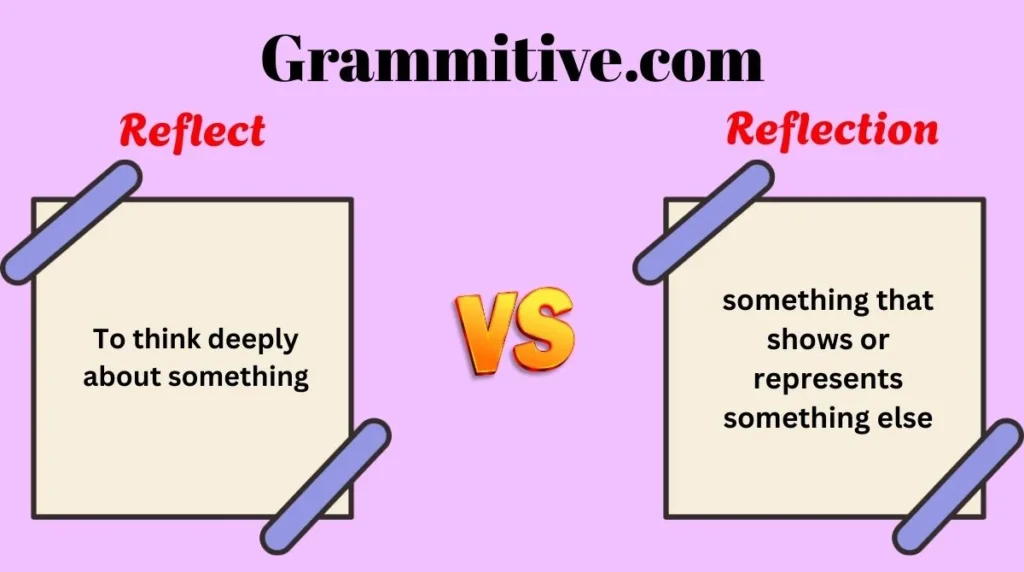
- To think deeply about something
- To show or represent something
It can also mean “to throw back light,” like a mirror, but in grammar lessons we usually focus on thinking or showing meaning.
When to use it
Use reflect when you talk about:
- thinking about your life or past
- considering something carefully
- showing someone’s personality or qualities
Grammar rule
Reflect + on + noun/idea
or
Reflect + something (direct object)
Examples:
- reflect on your mistake
- reflect on the past
- reflect your feelings
- reflect the culture
Example sentences
- I need time to reflect on my decision.
- She sat quietly and reflected on her childhood.
- His actions reflect his true character.
- This book reflects modern society.
- The movie reflects real life problems.
- Teachers often ask students to reflect on their learning.
- He paused to reflect on what happened.
- Good art reflects human emotions.
Common learner confusion
Many students say:
❌ reflect about
❌ reflect of
But remember:
✔ reflect on
✔ reflect something (no preposition)
Never use about or of with reflect.
What Does “Reflection” Mean?
Simple definition
Reflection is a noun.
It is the thing or result of reflecting.
It means:
- deep thought
- careful thinking
- an image (like in a mirror)
- something that shows or represents something else
When to use it
Use reflection when you talk about:
- thoughts or ideas after thinking
- written thinking (school essays)
- something that represents something
- a mirror image
Grammar rule
We usually say:
- reflection on something → thinking
- reflection of something → showing or representing
So the preposition changes the meaning.
Example sentences
- After some reflection, she changed her mind.
- This essay is a reflection on my school year.
- His speech was a reflection of his beliefs.
- The lake showed the reflection of the mountains.
- Teachers want students to write a reflection on their project.
- Her writing is a reflection of her personality.
- Quiet time helps with self-reflection.
- That painting is a reflection of rural life.
Common learner confusion
Students often mix the prepositions:
❌ reflection about
❌ reflection for
Only use:
✔ reflection on (thinking)
✔ reflection of (showing)
Difference Between Reflect and Reflection (Detailed)
Now let’s compare them clearly.
Quick comparison table
| Feature | Reflect | Reflection |
|---|---|---|
| Part of speech | Verb | Noun |
| Meaning | to think or show | the thought/result/image |
| Structure | reflect on / reflect something | reflection on / reflection of |
| Example | I reflect on my past | My reflection on the past |
Usage difference
- Reflect = action
- Reflection = thing or result
Think like this:
- You reflect
- You write a reflection
Grammar logic
Verb → needs subject + action
Noun → needs articles/determiners (a, the, my)
Compare:
- I reflect on my mistakes.
- My reflection on my mistakes was honest.
Sentence structure difference
Verb form
Subject + reflect + on + noun
Noun form
a/the/my + reflection + on/of + noun
Meaning comparison
- reflect = process
- reflection = product
Like:
- think → thought
- decide → decision
- reflect → reflection
Grammar Rules You Must Remember
Rule #1: Reflect is always a verb
✔ I reflect every night.
❌ I made a reflect.
Rule #2: Use “on” after reflect when thinking
✔ reflect on your life
❌ reflect about your life
Rule #3: Reflection on = thinking about
✔ reflection on history
✔ reflection on my mistakes
Rule #4: Reflection of = showing or representing
✔ reflection of society
✔ reflection of her personality
If something shows something else, use of.
Common Mistakes Students Make
These mistakes happen because many languages use only one word or one structure.
English is more specific.
Mistake 1
❌ I did a reflection about my life.
✔ I did a reflection on my life.
Tip: Thinking → ON
Mistake 2
❌ This movie reflects of society.
✔ This movie reflects society.
Tip: No preposition needed here.
Mistake 3
❌ I reflection on my mistake.
✔ I reflected on my mistake.
✔ I wrote a reflection on my mistake.
Tip: Check verb vs noun.
Mistake 4
❌ Her smile is reflection on happiness.
✔ Her smile is a reflection of happiness.
Tip: Showing → OF
Easy correction method
Ask yourself:
- Is it an action? → reflect
- Is it a thing or result? → reflection
- Thinking? → on
- Showing? → of
Easy Trick to Remember the Difference
Here is a simple memory trick students love.
Think:
ON = thinking ON your brain
When you think, ideas sit on your head.
So:
- reflect on
- reflection on
Both mean thinking.
Think:
OF = part OF something
If something belongs to something or shows it, use of.
Example:
- reflection of culture
- reflection of personality
These belong together.
One sentence memory
Think ON, show OF.
Very short. Very easy.
Daily Life Examples (Very Important)
Here are natural spoken English examples. These sound exactly like real conversations.
- I need a few minutes to reflect on what you said.
- This report is a reflection on our team’s progress.
- His behavior reflects his values.
- The photo is a reflection of our family history.
- She wrote a reflection on her internship.
- Your attitude reflects your mindset.
- The lake showed a beautiful reflection of the sky.
- After some reflection, I decided to quit my job.
- That movie is a reflection of modern problems.
- Teachers often ask for a reflection on the lesson.
Notice how natural these sound. No strange grammar.
Practice Section
Choose the correct answer.
Questions
- I need to reflect ___ my mistakes.
a) about
b) on
c) of - This painting is a reflection ___ nature.
a) of
b) on
c) about - She wrote a reflection ___ her trip.
a) on
b) of
c) about - His words reflect ___ his personality.
a) on
b) — (no preposition)
c) of - After some ___, I changed my plan.
a) reflect
b) reflection
c) reflecting
Answers
- b
- a
- a
- b
- b
FAQs
1. What is the difference between reflect and reflection?
Reflect is a verb. It shows action. Reflection is a noun. It is the result or the thought itself. You reflect, and then you have a reflection.
2. What is the difference between reflection on and reflection of?
Reflection on means thinking deeply about something. Reflection of means showing or representing something. “On” is for thought. “Of” is for representation.
3. Can we use reflect in questions?
Yes. It works like any verb.
Examples: “Did you reflect on your mistake?” or “How does this reflect your goals?”
4. Is reflection formal or informal?
Reflection is common in both. It is often used in school writing, reports, and essays. In casual speech, people may simply say “think about.”
5. Can we say reflect about something?
No. This is incorrect. Always use reflect on or no preposition. “About” sounds unnatural.
6. Why do students confuse reflection on and reflection of?
Because both look similar and use the same noun. But the preposition changes the meaning. Remember: thinking → on, showing → of.
Final Conclusion
Reflect, reflection on, and reflection of may look like small grammar points, but they make a big difference in how natural your English sounds.
One word is a verb. One is a noun. And the small prepositions change the meaning completely.
When you want to talk about thinking, use on.
When something shows or represents something else, use of.
And when you need an action, use the verb reflect.
Try to notice these forms when you read books, watch movies, or listen to English conversations. The more you see them, the easier they become.
Practice writing your own sentences every day. Write a short reflection on your day. Think about what your actions reflect. Soon, using these words will feel simple and natural.
Small grammar steps like this build strong English. Keep going.

I am Lucas Bennett, a digital content creator passionate about social media trends and online growth strategies.
I share practical insights and guides to help users better understand and navigate the digital world.