
English learners often get stuck on small words that seem simple but cause big confusion. One of the most common mix-ups is between “putted” and “put.”
Many students wonder, “Is it correct to say ‘I putted the book on the table?’” or “Should it be ‘I put the book on the table?’”
These questions are very normal. Even advanced learners sometimes hesitate because English verbs can be tricky, especially irregular ones.
Understanding the difference between putted and put is important because it affects how natural your English sounds.
Using the wrong form can make you sound like a beginner, even if your vocabulary and grammar are otherwise strong.
In daily life, speaking about actions, placing things, or talking about past events often requires the right form of this verb.
By the end of this article, you will clearly understand why “put” is correct and why “putted” is almost never used in standard English.
You’ll learn grammar rules, common mistakes, simple tricks to remember the difference, and real-life examples to make your English fluent and natural.
Even if you are a beginner, you will feel confident using this verb in conversation, writing, and exams.
What Does “Putted” Mean?
At first glance, “putted” might seem like the past tense of put. Some learners make this mistake because they follow the regular verb pattern: add -ed for past tense. For example, “walk → walked” or “jump → jumped.”
Definition:
- “Putted” is only correct in golf terminology. In golf, putting is the action of hitting the ball lightly into the hole using a putter.
- Outside of golf, “putted” is not considered correct English.
When to use it:
- Only when talking about golf.
- Example: “He putted the ball carefully onto the green.”
Grammar rule:
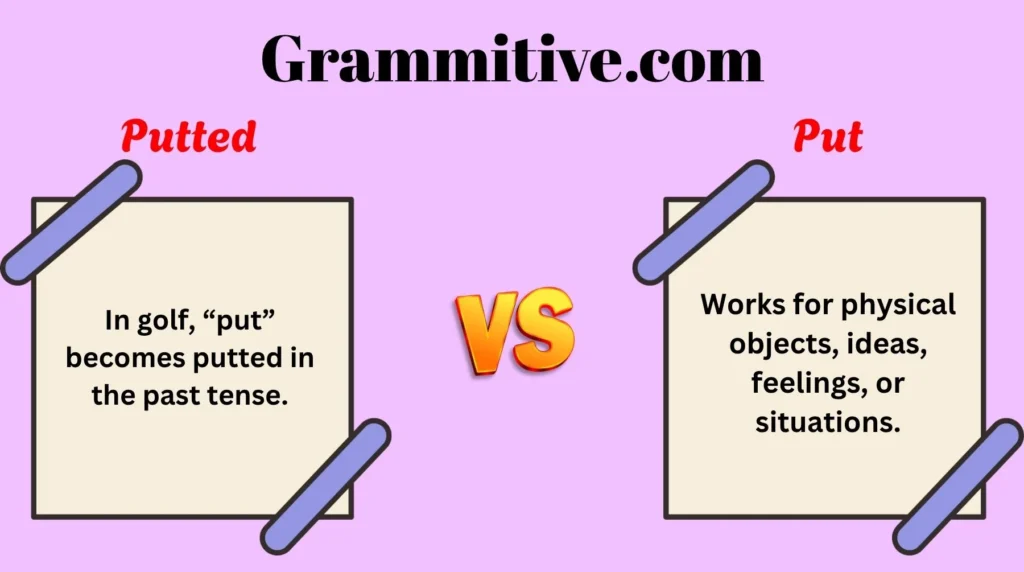
- In golf, “put” becomes putted in the past tense.
- Outside golf, do not add -ed; the verb put stays the same in all tenses.
Example sentences in golf:
- She putted the ball into the hole in one try.
- Yesterday, he putted three balls very well.
- The coach said he putted too hard.
- In the last round, I putted poorly.
- My friend putted all the balls onto the green.
- He putted slowly to avoid mistakes.
Common learner confusion:
- Many students try to use “putted” in normal sentences, e.g., “I putted my keys on the table,” which is incorrect.
- The correct form outside golf is always put, whether past, present, or future.
What Does “Put” Mean?
Definition:
- Put is an irregular verb that means to place something somewhere.
- It is one of the few verbs in English that does not change form in the past, present, or past participle.
When to use it:
- Anytime you want to say that something is placed, set, or positioned.
- Works for physical objects, ideas, feelings, or situations.
Grammar rule:
- Put = base form, past simple, past participle.
- Structure: Subject + put + object + place
- Example: “I put the book on the shelf.”
Example sentences:
- I put my bag on the chair.
- She put the milk in the fridge yesterday.
- They put their phones on the table.
- He put his trust in her.
- We put our plans on hold.
- She put her jacket over the chair.
- I put my ideas into practice.
- He put the keys in his pocket.
Common learner confusion:
- Students often want to say “putted” because most verbs add -ed for past tense.
- English is irregular, so “put” stays the same: “I put,” “You put,” “He put,” all correct.
Difference Between Putted and Put
Here is a clear comparison to help learners understand.
| Feature | Putted | Put |
|---|---|---|
| Meaning | Golf action: hitting the ball lightly | Placing, positioning, or setting something |
| Usage | Only in golf context | Everyday English, writing, speaking |
| Verb form | Regular in golf: add -ed | Irregular: same in past and present |
| Correct example | He putted the ball in golf. | I put my bag on the table. |
| Incorrect example | I putted my keys on the desk. | She putted the milk in the fridge. |
| Grammar logic | Past tense of “put” in golf | “Put” is past, present, and past participle |
Sentence structure difference:
- Putted (golf): Subject + putted + object + onto/into + place
- Example: “He putted the ball onto the green.”
- Put (general): Subject + put + object + preposition + place
- Example: “She put her phone in her bag.”
Meaning comparison:
- “Putted” is very specific and only applies to golf.
- “Put” is universal and can describe almost anything being placed.
Grammar Rules You Must Remember
Rule #1 – “Put” never changes
- Base, past simple, and past participle are all the same.
- ✅ Correct: I put my coat on the chair yesterday.
- ❌ Wrong: I putted my coat on the chair.
Rule #2 – Do not add -ed to irregular verbs
- English irregular verbs often do not follow the “-ed” rule.
- Examples: put → put, cut → cut, let → let
- ✅ Correct: She cut the paper.
- ❌ Wrong: She cutted the paper.
Rule #3 – “Putted” is only for golf
- Use only when describing putting in golf.
- ✅ Correct: He putted the golf ball into the hole.
- ❌ Wrong: I putted my homework on the desk.
Rule #4 – Use prepositions correctly with put
- Common prepositions: in, on, at, onto, into
- ✅ Examples:
- She put the book on the table.
- He put the letter into the envelope.
- They put the food in the fridge.
Common Mistakes Students Make
Many learners mix up put and putted because they try to follow a pattern they know.
Mistake #1 – Adding -ed
- ❌ Wrong: I putted my bag on the floor.
- ✅ Correct: I put my bag on the floor.
- Tip: Remember, “put” is the same for past tense.
Mistake #2 – Using putted in non-golf sentences
- ❌ Wrong: She putted the milk in the fridge.
- ✅ Correct: She put the milk in the fridge.
- Tip: Only golf actions can use “putted.”
Mistake #3 – Forgetting the verb “put” in past tense
- ❌ Wrong: Yesterday I putted the keys here.
- ✅ Correct: Yesterday I put the keys here.
- Tip: Visualize yourself placing the object, then use put.
Easy correction tips:
- Ask yourself: “Am I talking about golf?”
- If no → use put.
- If yes → “putted” is fine.
Easy Trick to Remember the Difference
Think of this simple memory trick:
- Put = universal, everyday English → You can put anything anywhere.
- Putted = only golf → You only put the golf ball gently.
Logic:
- Imagine a golf course: You swing lightly → putted.
- Imagine your house or office → you just put things, no -ed needed.
Student-friendly tip: “If you’re not on a golf course, don’t say putted.”
Daily Life Examples
Here are easy, natural sentences you can use every day:
- I put my keys in the drawer this morning.
- She put the flowers on the table.
- We put our jackets in the closet.
- He put the plate into the dishwasher.
- They put their bags in the car before leaving.
- I put my phone on silent during class.
- She put her ideas into action.
- He put his trust in his friend.
- I put my shoes outside the door.
- We put extra chairs in the living room.
Notice how none of these sentences use putted. That’s because daily life English always uses put.
Practice Section
Choose the correct option for each sentence:
- I ___ my bag on the chair yesterday.
- a) put
- b) putted
- She ___ the milk in the fridge.
- a) put
- b) putted
- He ___ the ball into the hole (golf).
- a) put
- b) putted
- We ___ extra chairs in the room.
- a) put
- b) putted
- They ___ their books on the shelf.
- a) put
- b) putted
Answers: 1-a, 2-a, 3-b, 4-a, 5-a
FAQs
1. What is the difference between putted and put?
- “Putted” is used only in golf. “Put” is used for all other placing actions.
2. Can we use putted in questions?
- Only in golf contexts: “Did he putted the ball well?” Outside golf, use “put.”
3. Is putted formal or informal?
- It’s neutral in golf but incorrect outside. Always use “put” for daily English.
4. Why do students say putted instead of put?
- They follow the regular verb pattern (-ed). Remember: put is irregular.
5. Can put be used for abstract ideas?
- Yes. Example: “I put my trust in her,” or “He put his thoughts into words.”
6. Is putted ever wrong in golf?
- No, in golf past tense, putted is correct.
Final Conclusion
Understanding put and putted is simple once you know the rule: “put” is always correct except in golf, where “putted” is fine.”
This knowledge will make your English sound natural and confident. Remembering the small trick about golf vs. daily life can save you from common mistakes.
Practice using put in your daily conversations, writing, and even while speaking with friends. Soon, it will become automatic.
With consistent use, you’ll never confuse put and putted again. Your English will feel fluent, simple, and clear to anyone listening.

I am Lucas Bennett, a digital content creator passionate about social media trends and online growth strategies.
I share practical insights and guides to help users better understand and navigate the digital world.