
Many English learners feel confused when they hear sentences like:
- “We made progress in English.”
- “We made progress on the project.”
- “The progress of the patient is slow.”
All of them use the same word — progress — but the small preposition changes. And suddenly the meaning changes too.
This is where students stop and think, “Why in? Why on? Why of? They all sound similar!”
Prepositions are tiny words, but they carry big meaning. Native speakers choose them naturally. Learners often guess. And guessing usually leads to mistakes.
The problem is not grammar rules alone. It’s understanding how English thinks.
When we talk about improvement inside a skill, we use one preposition.
When we talk about work on a task, we use another.
When we talk about something belonging to someone or something, we use a different one.
These small ideas help everything become clear.
By the end of this guide, you will:
- know exactly when to use progress in
- clearly understand progress on
- confidently use progress of
- avoid common mistakes
- speak more natural, everyday English
Everything will be explained in simple words, like a classroom lesson — not like a heavy grammar book.
What Does “Progress in” Mean?
Simple meaning
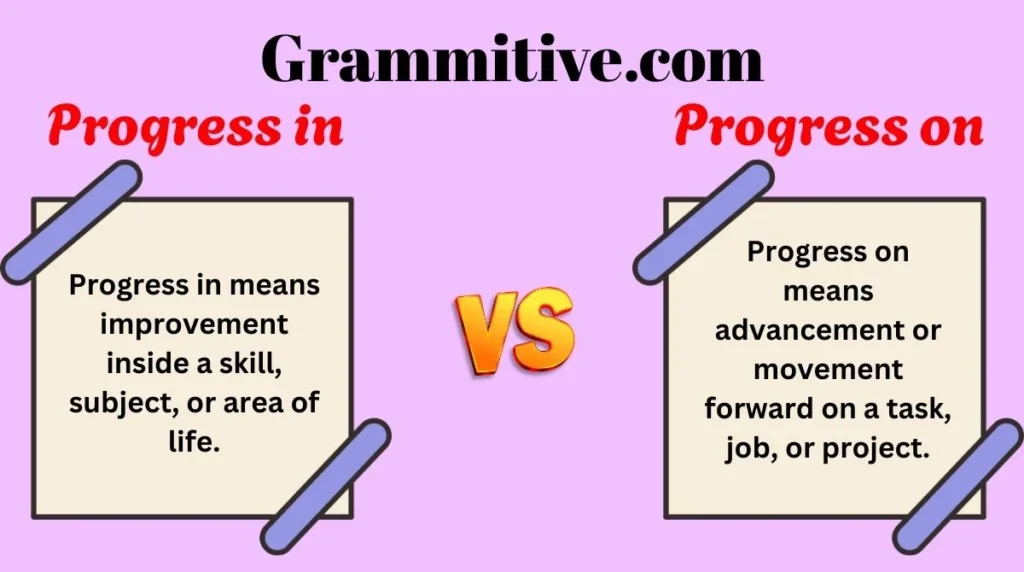
Progress in means improvement inside a skill, subject, or area of life.
Think of it like growth happening inside something.
You are getting better in something.
When to use it
Use progress in for:
- subjects (math, English, science)
- skills (speaking, writing, cooking)
- areas of life (health, career, fitness)
- abilities
If it’s something you develop or learn, “in” usually fits.
Grammar rule
progress in + noun (skill/area/field)
Structure:
make/made/making progress in + subject/skill
Examples
- She made great progress in English this year.
- I’m seeing progress in my fitness.
- The children showed progress in reading.
- He improved a lot in speaking skills.
- We noticed progress in the project management course.
- She made slow progress in math.
- The team showed progress in teamwork.
- They are making progress in their careers.
Why “in”?
Because the improvement happens inside that area.
Imagine being inside a box called English. You move forward inside it. That’s progress in.
Common learner confusion
❌ progress on English
❌ progress of English
These sound unnatural because English is not a task or an owner. It’s a skill area. So we use in.
What Does “Progress on” Mean?
Simple meaning
Progress on means advancement or movement forward on a task, job, or project.
It focuses on work being done.
Think of something lying in front of you. You work on it.
When to use it
Use progress on for:
- homework
- assignments
- reports
- projects
- construction
- tasks
- plans
If it’s something you work on physically or mentally, use on.
Grammar rule
progress on + task/project/work
Structure:
make/made/making progress on + task
Examples
- We made good progress on the report.
- She is making progress on her homework.
- The workers made progress on the building.
- Any progress on the website design?
- He worked all night and made progress on the assignment.
- We need more progress on this problem.
- They showed progress on the new app.
- I haven’t made much progress on my book yet.
Why “on”?
Because you work on top of something, like:
- working on a table
- writing on paper
- building on land
So we say progress on.
Common learner confusion
❌ progress in the report
❌ progress of the report
These sound strange because the report is not a skill or ownership. It’s a task.
What Does “Progress of” Mean?
Simple meaning
Progress of means the development or condition belonging to someone or something.
It often shows possession or description.
When to use it
Use progress of when:
- describing someone’s development
- talking formally
- reporting results
- discussing medical or scientific changes
This form is more formal than the other two.
Grammar rule
progress of + person/thing
Structure:
the progress of + noun
Examples
- The progress of the patient is good.
- We checked the progress of the students.
- The teacher monitored the progress of the class.
- The progress of the disease was slow.
- They studied the progress of the experiment.
- The manager reviewed the progress of the team.
- The progress of the child’s speech improved.
- Doctors observed the progress of recovery.
Why “of”?
Because it shows belonging.
The progress belongs to the patient.
The progress belongs to the team.
Just like:
- color of the car
- name of the student
So we say progress of.
Common learner confusion
Students sometimes say:
❌ progress of my homework
But homework is a task, not ownership. So we use on my homework.
Difference Between Progress in and Progress on (Detailed)
Many learners mix these two. Here’s a clear comparison.
Comparison Table
| Feature | Progress in | Progress on |
|---|---|---|
| Meaning | improvement in skill/area | advancement on task/work |
| Focus | learning/growth | doing/completing |
| Type | ability/subject | project/job |
| Example | progress in English | progress on homework |
| Feeling | inside development | surface work |
Usage difference
- in → improvement
- on → work completion
If you are getting better, use in.
If you are doing work, use on.
Grammar logic
- skills = in
- tasks = on
English thinks of skills as containers and tasks as surfaces.
Sentence structure difference
- progress in + subject
- progress on + task
Example:
✔ progress in writing
✔ progress on the essay
Meaning comparison
“I made progress in writing”
→ my writing skill improved
“I made progress on the essay”
→ I finished part of the essay
Different meanings!
Grammar Rules You Must Remember
Rule #1
Use in for skills and learning.
✔ She made progress in cooking.
Rule #2
Use on for tasks and projects.
✔ We made progress on the presentation.
Rule #3
Use of to show ownership or description.
✔ The progress of the child is slow.
Rule #4
After “progress of,” usually use the + noun.
✔ progress of the team
❌ progress of team
Common Mistakes Students Make
Why mistakes happen
Learners translate from their first language. Many languages don’t change prepositions this way. So they guess.
English doesn’t like guessing. It wants patterns.
Mistake 1
❌ I made progress on English.
✔ I made progress in English.
Tip: English is a subject → use in.
Mistake 2
❌ Progress in my homework is slow.
✔ Progress on my homework is slow.
Tip: Homework is a task → use on.
Mistake 3
❌ Teacher checked progress in students.
✔ Teacher checked progress of the students.
Tip: belongs to students → use of.
Easy correction tip
Ask yourself:
- Is it a skill? → in
- Is it work? → on
- Does it belong to someone? → of
Easy Trick to Remember the Difference
A simple memory trick helps a lot.
Think:
IN = INSIDE learning
ON = ON the task
OF = OWNERSHIP
Picture it:
- you sit in a classroom learning
- you work on a desk
- something belongs of someone
It sounds silly, but students remember it fast.
Daily Life Examples (Very Important)
Here are natural sentences people really say.
- I’m making progress in my driving lessons.
- Any progress on the house repairs?
- The progress of the baby looks healthy.
- She made progress in speaking confidently.
- We worked late and made progress on the design.
- The manager discussed the progress of the team today.
- I haven’t made progress on my taxes yet.
- He’s making good progress in guitar practice.
- Doctors are happy with the progress of recovery.
- We need more progress on this plan.
These are exactly how native speakers talk.
Practice Section
Choose the correct preposition: in / on / of
- She made progress ___ math.
- Any progress ___ the project?
- The progress ___ the patient is good.
- I’m making progress ___ my writing skills.
- We worked hard and made progress ___ the report.
Answers
- in
- on
- of
- in
- on
FAQs
What is the difference between progress in and progress on?
“Progress in” is used for skills and improvement. “Progress on” is used for tasks and projects. One shows growth, the other shows work completion.
Can we use progress in questions?
Yes. Very common.
Example: “Are you making progress in English?” It sounds natural and friendly.
Is progress of formal or informal?
It is slightly more formal. You often hear it in reports, schools, hospitals, and professional settings.
Can I say progress for without a preposition?
Usually no. We need a preposition after “progress.” English grammar needs it to show the relationship.
Which is correct: progress in work or progress on work?
Normally progress on work because work is a task. But if you mean improvement in job skills, then progress in work skills is fine.
Why are prepositions so tricky in English?
Because they follow meaning, not strict rules. Native speakers learn them naturally. Learners must notice patterns and practice.
Final Conclusion
These three small prepositions may look tiny, but they change meaning a lot.
When talking about improvement inside a skill or subject, use progress in.
When talking about working forward on a task or project, use progress on.
When describing development that belongs to someone or something, use progress of.
Once you see the logic — inside, on top, belonging — everything feels simple.
The best way to remember is daily practice. Listen to native speakers. Make your own sentences. Correct yourself gently. Small habits build strong grammar.
Soon, choosing the right preposition will feel natural, not stressful.
Language grows step by step — just like progress itself.

I am Lucas Bennett, a digital content creator passionate about social media trends and online growth strategies.
I share practical insights and guides to help users better understand and navigate the digital world.