
English has many word pairs that look almost the same but make learners stop and think.
You read a sentence, pause, and wonder, “Is this correct… or not?” One such pair is preventive and preventative.
Both words seem right. Both appear in books, websites, hospitals, and even government documents. Some teachers say one is correct.
Others say both are fine. Spell check sometimes accepts both. That can feel confusing, especially if English is not your first language.
And this isn’t a small issue. These words are common in daily life. You hear them in health advice, safety rules, insurance policies, and school guidelines.
For example: preventive care, preventive measures, preventative steps, preventative medicine. So knowing which one to use helps you sound more natural and confident.
The good news? The difference is actually simple once you understand the history and usage.
By the end, you’ll clearly know:
- what each word means
- when to use each one
- which is more common
- which sounds more natural
- and an easy trick to remember
Everything will be explained in plain, everyday English — just like a teacher talking to you in class.
What Does “Preventive” Mean?
Simple definition
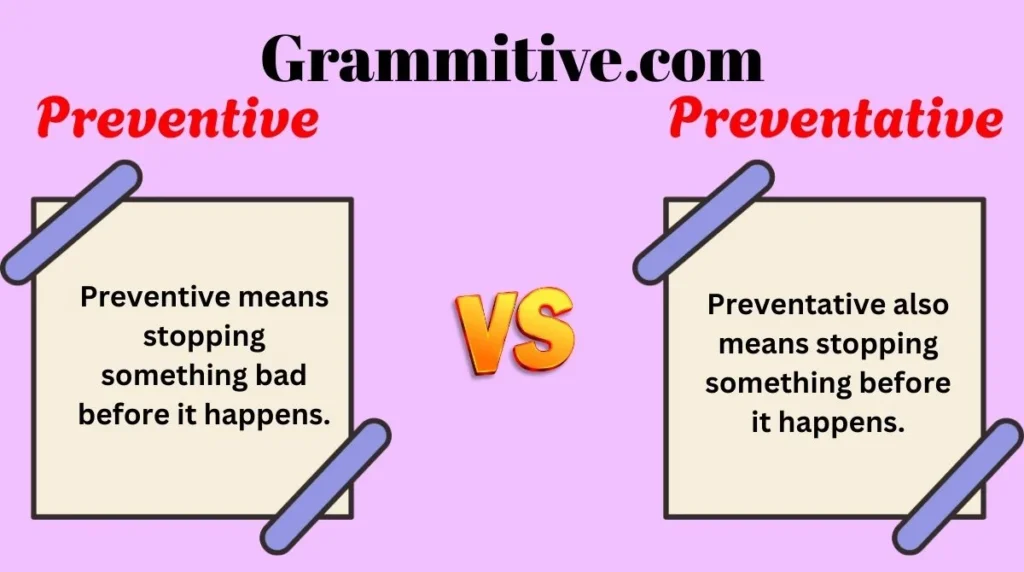
Preventive means stopping something bad before it happens.
It describes an action, step, or method that protects you from future problems.
Think of it as:
👉 done early to avoid trouble later
When to use it
Use preventive when talking about:
- health care
- safety rules
- maintenance
- protection
- actions taken in advance
It is very common in formal and professional English, especially American English.
Grammar rule
Preventive is an adjective.
It describes a noun.
Structure:
preventive + noun
Examples:
- preventive care
- preventive action
- preventive measures
Example sentences
- Regular exercise is a preventive step against heart disease.
- The doctor recommended preventive care for children.
- Wearing a helmet is a preventive safety measure.
- We installed software as a preventive action.
- Schools teach preventive health habits.
- The company uses preventive maintenance for machines.
- Vaccines are preventive medicine.
- Good sleep is preventive for stress problems.
Common learner confusion
Many students think preventive sounds shorter or incomplete, so they avoid it. But actually, it is:
- older
- more traditional
- more widely used
- often preferred in formal writing
In fact, in medical and academic contexts, preventive is usually the first choice.
What Does “Preventative” Mean?
Simple definition
Preventative also means stopping something before it happens.
Yes — the meaning is exactly the same.
There is no difference in meaning between preventive and preventative.
When to use it
You may see preventative in:
- casual speech
- British English
- everyday writing
- general conversations
Some people simply like the sound of it.
Grammar rule
Just like preventive, preventative is an adjective.
Structure:
preventative + noun
Example sentences
- The dentist talked about preventative care.
- They took preventative steps to stop the fire.
- This cream has preventative benefits for the skin.
- The school follows preventative health rules.
- Police use preventative measures to reduce crime.
- We added preventative checks to the system.
- Preventative medicine saves money long term.
- Good habits are preventative tools.
Common learner confusion
Students often wonder:
“Is preventative wrong?”
No — it is not wrong.
But it is:
- slightly longer
- less common in formal writing
- sometimes considered unnecessary by style guides
Some teachers prefer preventive because it is shorter and simpler.
Difference Between Preventive and Preventative (Detailed)
Here’s the key idea:
👉 They mean the same thing. The difference is mainly style and usage.
Quick comparison table
| Feature | Preventive | Preventative |
|---|---|---|
| Meaning | Stop problems early | Stop problems early |
| Part of speech | Adjective | Adjective |
| Length | Shorter | Longer |
| Formal writing | More common | Less common |
| American English | Very common | Less common |
| British English | Common | Also common |
| Medical terms | Preferred | Sometimes used |
Usage difference
In real life:
- Doctors often say preventive care
- Textbooks usually say preventive measures
- Casual speakers may say preventative steps
So preventive sounds more professional.
Grammar logic
Both words come from the verb prevent.
The suffix -ive already makes an adjective.
Adding -ative adds extra sound but no extra meaning.
So:
prevent + ive → preventive (complete)
prevent + ative → preventative (extra syllable)
That extra “at” isn’t necessary, but English sometimes keeps longer forms because of habit or pronunciation comfort.
Sentence structure difference
There is no structural difference.
Both fit the same place in a sentence:
- preventive action
- preventative action
Both are correct.
Meaning comparison
Meaning = 100% identical.
No change in time, tone, or intensity.
The only difference is preference.
Grammar Rules You Must Remember
Rule #1 – Both are adjectives
They describe nouns, not actions.
✅ preventive care
❌ preventive carefully
Rule #2 – Preventive is more standard
In formal writing, reports, essays, and exams, choose preventive.
Example:
✔ The hospital provides preventive services.
Rule #3 – Do not mix forms in one document
Stay consistent.
❌ preventive care and preventative steps
✔ preventive care and preventive steps
Rule #4 – Shorter words are often preferred
English often prefers shorter forms.
Example:
- informative (not informatory)
- preventive (more natural)
Short = clearer.
Common Mistakes Students Make
Why mistakes happen
There are three main reasons:
- The words look almost the same
- Both are correct
- Different books use different forms
So learners feel unsure.
Wrong vs correct examples
❌ This is a prevent care program.
✔ This is a preventive care program.
❌ We need prevent measures.
✔ We need preventive measures.
❌ The doctor gave prevent advice.
✔ The doctor gave preventive advice.
Easy correction tips
- Remember: add -ive
- If unsure → choose preventive
- Check consistency
That solves most problems.
Easy Trick to Remember the Difference
Here’s a simple memory trick students love.
Think:
Preventive = Prevent + Give protection
“Give” sounds like -ive.
So preventive → gives protection.
Also:
Short problems need short solutions.
Preventive is shorter. So it’s the safe choice.
If your brain is tired during an exam, just choose preventive. You’ll almost always be correct.
Daily Life Examples (Very Important)
These sentences sound like real conversations.
- I go for preventive health checkups every year.
- We installed smoke alarms as a preventive step.
- The dentist explained preventive care for kids.
- Schools teach preventive hygiene habits.
- The company uses preventive maintenance on machines.
- Wearing sunscreen is preventive skin care.
- Police added preventive patrols at night.
- Doctors focus on preventive medicine these days.
- Good sleep is a preventive habit.
- We took preventive action before the storm arrived.
Notice how natural preventive sounds in everyday English.
Practice Section
Choose the correct option.
1
The hospital offers ______ care.
a) preventive
b) prevent
2
We took ______ measures to stop the infection.
a) preventative
b) prevent
3
Regular exercise is ______ medicine.
a) preventive
b) preventing
4
The company uses ______ maintenance.
a) prevent
b) preventive
5
Both words are ______.
a) adjectives
b) verbs
Answers
1 – preventive
2 – preventative (or preventive)
3 – preventive
4 – preventive
5 – adjectives
FAQs
What is the difference between preventive and preventative?
There is no difference in meaning. Both mean stopping a problem before it happens. Preventive is shorter and more common in formal English.
Which one is more correct?
Both are correct. However, preventive is preferred in professional, academic, and medical writing.
Can we use preventative in exams?
Yes, but preventive is safer and more widely accepted. Many teachers prefer it.
Is preventive American or British English?
It is used in both. Americans strongly prefer preventive. British English uses both forms.
Why are there two forms?
English sometimes creates longer versions with extra syllables. Over time, both forms stay in the language even if one is simpler.
Which sounds more natural in daily speech?
Most native speakers say preventive, especially in health and safety topics.
Final Conclusion
English can feel tricky when two words look different but mean the same thing. Preventive and preventative are a perfect example.
Many learners worry about choosing the “wrong” one, but the truth is simple: both are correct.
Still, smart language choices make your English sound smoother and more natural. Preventive is shorter, clearer, and more common in formal writing, textbooks, and professional settings.
That makes it the best everyday option.
If you ever feel unsure, just pick preventive and move on with confidence.
Language learning isn’t about memorizing hundreds of small rules. It’s about noticing patterns and building habits. Once you practice using preventive in real sentences, it will start to feel automatic.
Keep reading, keep listening, and keep using new words in daily life. Small steps today create strong English tomorrow.

I am Lucas Bennett, a digital content creator passionate about social media trends and online growth strategies.
I share practical insights and guides to help users better understand and navigate the digital world.