

Many English learners often get confused when choosing between “please advise” and “please advice.”
At first glance, they look almost identical, and both are commonly seen in emails, messages, and even school assignments.
But using the wrong one can make your English sound unnatural or even incorrect.
For beginners, this confusion is understandable because English has many words that sound similar but serve completely different functions.
Understanding the difference between these two phrases is crucial in daily English. If you use “please advice” instead of “please advise,” native speakers might notice the mistake immediately.
On the other hand, knowing when to use “please advise” can make your emails, letters, and conversations sound polite, professional, and fluent.
After reading this article, you will clearly understand:
- The exact meaning of advise and advice.
- How to use them correctly in sentences.
- Common mistakes to avoid.
- Simple tricks to remember the difference forever.
By the end, you will feel confident using these words correctly in emails, conversations, and exams.
You will also see real-life examples that make the grammar easy to remember.
What Does “Please Advise” Mean?
Advise is a verb. This is the most important point to remember. Verbs are action words, which means “advise” refers to the action of giving guidance or recommendations.
- Definition: To give suggestions, recommendations, or guidance to someone.
- When to Use: Use advise when you want someone to tell you what to do.
- Grammar Rule: Since it’s a verb, it often follows helping verbs like can, should, will, or please in polite requests.
Examples:
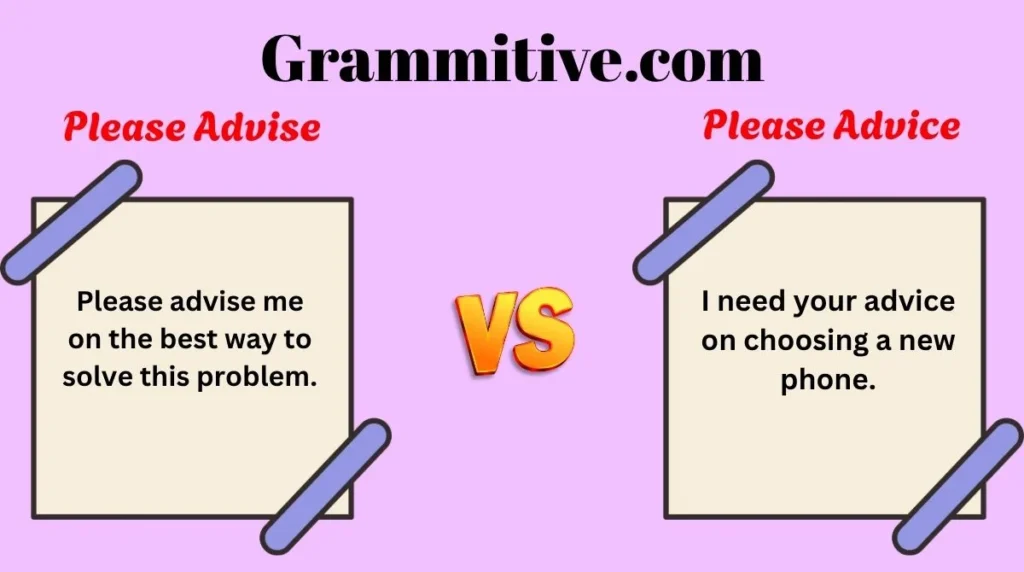
- Please advise me on the best way to solve this problem.
- Can you advise me about my career options?
- The teacher advised the students to revise their notes.
- Please advise if you will attend the meeting tomorrow.
- I would advise you to check your answers before submitting.
- Could you advise me on which laptop to buy?
- The doctor advised him to rest for a few days.
- Please advise on the next steps we should take.
Common Confusion:
Many learners make the mistake of using “advice” in these situations. For example:
❌ Please advice me on the project.
✅ Please advise me on the project.
Remember, advise is something you do (verb), not something you have (noun).
What Does “Please Advice” Mean?
Advice is a noun. Nouns are words for things, people, or ideas. This means “advice” refers to the guidance or suggestions themselves, not the action of giving them.
- Definition: Guidance, suggestions, or recommendations given to someone.
- When to Use: Use advice when talking about the information or suggestions someone gives.
- Grammar Rule: Because it’s a noun, advice usually comes after words like give, need, receive, ask for, or follow.
Examples:
- I need your advice on choosing a new phone.
- Her advice helped me make a better decision.
- Can you give me some advice about studying for exams?
- The lawyer’s advice was very helpful.
- Thank you for your advice on the project.
- He ignored my advice and made a mistake.
- Following her advice, I improved my English skills.
- I always ask my teacher for advice before starting a new task.
Common Confusion:
Beginners often say:
❌ I need you to advice me.
✅ I need your advice.
Notice the difference: if you’re asking for the action, you use advise. If you’re asking for the suggestions themselves, you use advice.
Difference Between “Advise” and “Advice” (Detailed)
Here is a clear comparison to avoid confusion:
| Feature | Advise | Advice |
|---|---|---|
| Part of Speech | Verb | Noun |
| Meaning | To give suggestions or guidance | Suggestions or recommendations |
| Grammar Example | Please advise me. | I need your advice. |
| Common Confusion | Using it as a noun | Using it as a verb |
| Sentence Structure | Subject + advise + object | Subject + need/give/receive + advice |
| Politeness/Formality | Polite in requests (emails) | Polite or neutral |
Usage Difference:
- Advise: Focus on the action. “I advise you to study.”
- Advice: Focus on the suggestion itself. “I need your advice on studying.”
Grammar Logic:
Think of it this way:
- Verbs are doers, nouns are things.
- Advise = doing (action) → “Please advise me.”
- Advice = thing (object) → “Please give me your advice.”
Grammar Rules You Must Remember
Rule #1: Advise is always a verb
✅ Correct: I advise you to rest.
❌ Wrong: I advice you to rest.
Rule #2: Advice is always a noun
✅ Correct: She gave me good advice.
❌ Wrong: She gave me good advise.
Rule #3: Polite requests use “please advise”
✅ Correct: Please advise on the payment schedule.
❌ Wrong: Please advice on the payment schedule.
Rule #4: “Advice” often follows verbs like give, take, or need
✅ Correct: I need your advice.
❌ Wrong: I need you to advice. (unless you are using advise)
Common Mistakes Students Make
Many English learners mix these two because they sound similar. Here’s why mistakes happen:
- Sound confusion: In spoken English, advise and advice are pronounced almost the same.
- Translation errors: Some languages don’t separate verb and noun in the same way.
- Email shortcuts: People see “Please advise” in emails and copy it without understanding.
Wrong vs Correct Examples:
- ❌ Please advice me on this matter.
✅ Please advise me on this matter. - ❌ I need your advise on buying a laptop.
✅ I need your advice on buying a laptop.
Easy Tip: Always check if you are asking for the action (advise) or the information (advice).
Easy Trick to Remember the Difference
Here’s a student-friendly trick:
- Advise with an “s” = action (verb) → s reminds you of speak or suggest.
- Advice with a “c” = thing (noun) → c reminds you of counsel or caution, which are things you give or receive.
Real-life logic: You advise someone to do something. The advice is what you give them.

Daily Life Examples
Here are some sentences used in real conversations:
- Can you please advise me about the meeting time?
- I asked my teacher for advice on my homework.
- Please advise if the documents are ready for submission.
- I really need your advice before I buy this car.
- Could you advise on how to improve my English skills?
- Her advice helped me pass the test.
- Please advise me about the best route to the airport.
- I always follow my parents’ advice.
- Please advise on any changes in the schedule.
- The doctor advised him to exercise daily.
Notice how advise is always the action, while advice is always the object.
Practice Section
Choose the correct word in each sentence:
- Please ___ me on this matter. (advise/advice)
- I need your ___ about my project. (advise/advice)
- Could you ___ me about the test? (advise/advice)
- Her ___ helped me choose the right career. (advise/advice)
- Please ___ on the next steps. (advise/advice)
Answers:
- advise
- advice
- advise
- advice
- advise
FAQs
Q1: What is the difference between advise and advice?
- Advise is a verb (action), and advice is a noun (thing). Use advise to ask for action and advice to refer to suggestions.
Q2: Can we use advise in questions?
- Yes, for example: “Could you advise me on this issue?” It’s polite and formal.
Q3: Is advice formal or informal?
- Advice can be used in both formal and informal situations, like emails or daily conversations.
Q4: Can I say “please advice me”?
- No, that is incorrect. You should say “please advise me.”
Q5: Can advice be plural?
- No, “advice” is uncountable. You can say “a piece of advice” for one suggestion.
Q6: Why do people confuse advise and advice?
- They sound similar, and many learners copy email phrases without checking grammar. Remember: verb = advise, noun = advice.
Final Conclusion
Understanding the difference between please advise and please advice is simple once you know the rules. Remember:
advise is the action, advice is the suggestion. This small difference can make your emails, letters, and conversations sound professional and natural.
Practice using these words in your daily English. Pay attention when reading emails or articles, and notice how native speakers use them.
With a little attention and practice, you will never confuse them again. Start with small sentences, then use them in real conversations.
Your English will feel more confident, polite, and correct.
Keep practicing, and soon, the difference between advise and advice will feel completely natural.

I am Lucas Bennett, a digital content creator passionate about social media trends and online growth strategies.
I share practical insights and guides to help users better understand and navigate the digital world.