
English learners often get confused between “plan to do” and “plan on doing.” These two phrases sound very similar, but they are used in slightly different ways.
Mixing them up can make your English sound unnatural or even a little confusing.
Why is this important? Because both expressions are common in daily conversations, emails, and even exams.
Using the wrong one can make it hard for others to understand your intentions.
For example, saying “I plan on visit my friend” instead of “I plan to visit my friend” might catch the listener off guard.
By understanding the difference, you will speak more confidently and correctly. You will also know how to use each phrase in the right situation.
After reading this guide, you will be able to:
- Understand what each phrase means
- Use them naturally in sentences
- Avoid common mistakes students make
- Sound more like a native speaker in daily English
Even if you are a beginner, this guide will make everything clear.
No complicated grammar rules, no confusing jargon—just simple explanations, real-life examples, and easy tricks to remember the difference.
What Does “Plan to Do” Mean?
Definition:
“Plan to do” is used to talk about a future intention. It shows that someone wants or intends to do something.
When to use it:
- To express a decision you made
- To talk about something you will do in the future
- Often used in formal and informal English
Grammar rule:
- Structure: plan + to + base verb
- Example: plan to + do something
Examples:
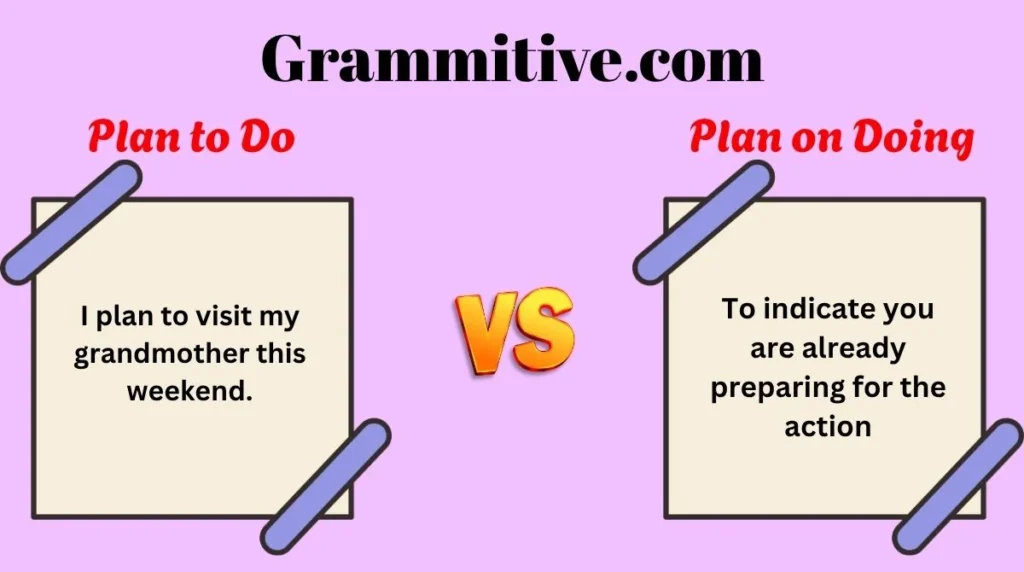
- I plan to visit my grandmother this weekend.
- She plans to study abroad next year.
- We plan to start a new project in March.
- He plans to learn Spanish this summer.
- They plan to buy a new house soon.
- I plan to call my friend tonight.
- She plans to attend the meeting tomorrow.
- We plan to travel after exams.
Common learner confusion:
Some students mix “plan to do” with “plan on doing.” They might say, “I plan on visit my friend,” which is incorrect. Another mistake is thinking “plan to” means “plan on,” but “plan to” is more about intention or decision, not preparation or expectation.
What Does “Plan on Doing” Mean?
Definition:
“Plan on doing” is used when you expect or anticipate that something will happen. It emphasizes that the action is likely or prepared for, rather than just intended.
When to use it:
- To express expectation
- To indicate you are already preparing for the action
- Often used in informal English
Grammar rule:
- Structure: plan on + verb-ing
- Example: plan on + doing something
Examples:
- I plan on going to the party tonight.
- She plans on taking the bus to work.
- We plan on meeting them at 7 PM.
- He plans on staying at his cousin’s house.
- They plan on watching the movie tomorrow.
- I plan on cooking dinner after work.
- She plans on joining the yoga class.
- We plan on visiting the museum this weekend.
Common learner confusion:
Beginners often replace “plan to do” with “plan on doing” incorrectly. For example: “I plan on to call my friend” is wrong. Also, “plan on” is more casual than “plan to,” so in formal writing, “plan to do” is preferred.
Difference Between “Plan to Do” and “Plan on Doing”
Understanding the difference is easier when we compare them side by side.
| Feature | Plan to Do | Plan on Doing |
|---|---|---|
| Meaning | Intention or decision | Expectation or preparation |
| Structure | plan + to + verb | plan on + verb-ing |
| Formality | More formal | Informal / conversational |
| Focus | What you want to do | What you are prepared to do |
| Example | I plan to visit Paris next year. | I plan on visiting Paris next year. |
Usage difference:
- Use plan to do when you are deciding on a future action.
- Use plan on doing when you are readying yourself or expecting to do it.
Grammar logic:
- “To do” uses the base verb after “to”
- “On doing” uses the -ing form
Sentence structure difference:
- Correct: I plan to read this book.
- Correct: I plan on reading this book.
- Wrong: I plan to reading this book.
Meaning comparison:
- Plan to do = “I have decided.”
- Plan on doing = “I expect this to happen; I am ready.”
Grammar Rules You Must Remember
Rule #1: Base verb after “plan to”
- Always use the base verb: plan to + verb
- Example: I plan to start a blog.
Rule #2: -ing form after “plan on”
- Always use the -ing form: plan on + verb-ing
- Example: I plan on starting a blog.
Rule #3: Use “plan to” for formal English
- Writing emails, reports, or formal letters often prefer plan to do.
- Example: We plan to complete the project by Friday.
Rule #4: Use “plan on” for everyday conversation
- Talking with friends, family, or in informal situations: plan on doing works best.
- Example: I plan on watching the new movie tonight.
Common Mistakes Students Make
Mistake #1: Mixing the structures
- Wrong: I plan on to visit my friend.
- Correct: I plan to visit my friend.
Mistake #2: Using “plan to” when expectation is implied
- Wrong: I plan to going shopping later.
- Correct: I plan on going shopping later.
Mistake #3: Forgetting the verb form
- Wrong: She plans on join the meeting.
- Correct: She plans on joining the meeting.
Why mistakes happen:
- English learners translate from their native language literally.
- “To do” and “on doing” look similar in meaning.
- Confusion between formal and informal usage.
Easy correction tips:
- Remember: to do = decision, on doing = expectation
- Check the verb form: base verb after “to,” -ing after “on.”
- Ask yourself: Is this formal or casual?
Easy Trick to Remember the Difference
Memory trick:
- Think of “plan to do” = I decide”
- Think of **“plan on doing” = I expect / prepare”
Real-life logic:
- Plan to do = You make a plan in your mind.
- Plan on doing = You already take steps or anticipate it.
Student-friendly explanation:
- Imagine telling a teacher: “I plan to finish homework by Monday.” (Decision)
- Imagine telling a friend: “I plan on finishing homework after dinner.” (Expectation, more casual)
Daily Life Examples
Here are real-life examples for both expressions in spoken English:
- I plan to visit my aunt this weekend.
- She plans on meeting her friends at the mall.
- We plan to start a new exercise routine.
- He plans on going to the gym after work.
- I plan to call my parents tonight.
- They plan on traveling to Italy this summer.
- She plans to learn French next year.
- We plan on cooking dinner together.
- I plan to finish this book by tomorrow.
- He plans on watching the football match tonight.
Notice how “plan to do” sounds more like a decision, and “plan on doing” feels more like preparing or expecting to do it.
Practice Section
Choose the correct option:
- I _______ (plan to / plan on) start a new hobby next month.
- She _______ (plans to / plans on) going to the market later.
- We _______ (plan to / plan on) visit our grandparents this weekend.
- He _______ (plans to / plans on) finish his homework after lunch.
- They _______ (plan to / plan on) move to a new city soon.
Answers:
- plan to
- plans on
- plan to
- plans on
- plan to
FAQs
1. What is the difference between plan to do and plan on doing?
- Plan to do = intention or decision.
- Plan on doing = expectation or preparation.
2. Can we use plan on doing in questions?
- Yes, for example: Do you plan on attending the party?
3. Is plan to do formal or informal?
- More formal; often used in writing, emails, or professional conversations.
4. Is plan on doing informal or formal?
- More casual; often used in daily conversation with friends or family.
5. Can plan to do and plan on doing be used interchangeably?
- Sometimes yes, but meaning slightly changes. Plan to emphasizes decision; plan on emphasizes expectation.
6. Why do learners get confused between these two?
- Both express future actions.
- Similar pronunciation.
- Different verb forms (-ing vs base verb) are easy to forget.
Final Conclusion
Mastering the difference between plan to do and plan on doing is key to sounding confident in English.
Remember, “plan to” shows your decision, while “plan on” shows your expectation or preparation.
Practice with real-life sentences every day. Try using them in emails, conversations, or even talking to yourself.
The more you use them, the easier it becomes to choose the right one naturally. Soon, your English will sound smooth and professional, even in casual chats.
Keep practicing, and these small differences will feel second nature.
With a little attention, you can easily avoid common mistakes and use both expressions correctly.
Understanding these phrases is a small step that makes a big difference in speaking clear and natural English.

I am Lucas Bennett, a digital content creator passionate about social media trends and online growth strategies.
I share practical insights and guides to help users better understand and navigate the digital world.