

English learners often stumble when it comes to small, simple words like pet and petted. These two words look almost the same, but they are used differently in sentences.
Many students confuse them, sometimes thinking they are interchangeable. This can make speaking or writing feel tricky, even if the meaning is clear in their mind.
Understanding the difference between pet and petted is important for daily English.
Whether you are talking about your dog, writing an email, or chatting with friends, using the correct form shows that your English is natural and accurate.
For instance, saying “I petted my dog yesterday” is correct, but saying “I petted my dog yesterday” is wrong. Small mistakes like this can confuse listeners or readers.
By the end of this guide, you will clearly know:
- The exact meaning of pet and petted.
- When to use each word correctly.
- Common mistakes and how to avoid them.
- Easy tricks to remember the difference.
This article is written in simple English with lots of examples. Even beginners can read and understand it.
You will also get real-life sentences that native speakers use, so you can sound natural in conversations.
What Does “Pet” Mean?
The word pet can be both a noun and a verb, but here we focus on the verb meaning because that is where confusion happens most.
Definition
As a verb, pet means:
“To touch or stroke an animal, usually in a gentle and loving way.”
It is the base form of the verb, which means it is used for present tense, infinitive forms, or with auxiliary verbs.
When to Use It
- When talking about actions happening now or regularly.
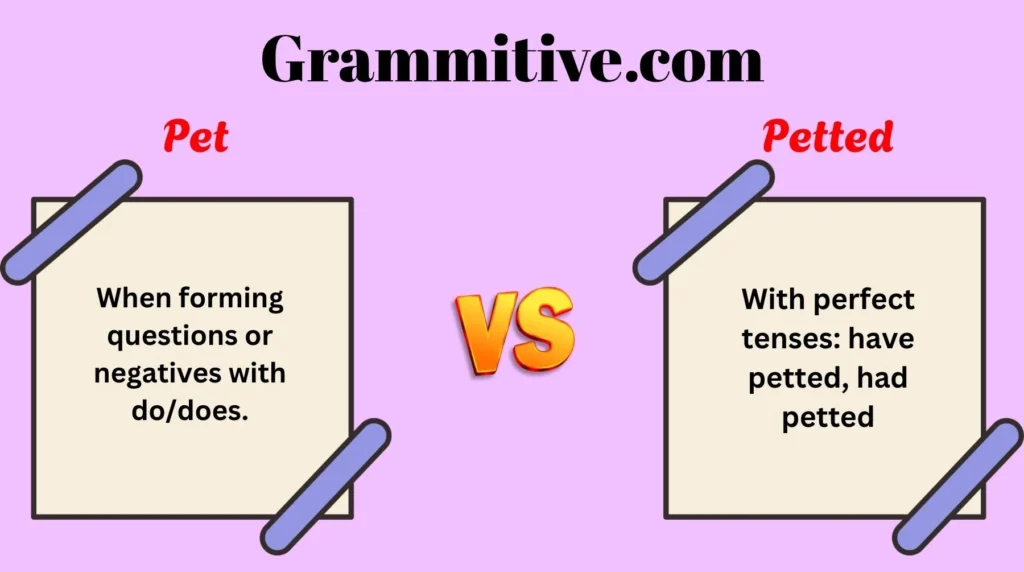
- When forming questions or negatives with do/does.
- To express general actions with animals.
Grammar Rule
- Base form: pet
- Past tense: petted
- Present participle: petting
- Past participle: petted
Example Sentences
- I pet my cat every morning.
- Do you pet your dog when it’s happy?
- She loves to pet rabbits at the farm.
- They pet the horses carefully before riding.
- We pet our neighbors’ dog when we visit.
- I usually pet my parrot on the head.
- Can I pet your puppy for a while?
- He doesn’t like to pet cats.
Common Learner Confusion
Many learners mix pet with petted because they sound similar. A common mistake is using pet for past actions, e.g., “Yesterday, I pet my dog” is correct in American English but not preferred in formal writing. Most teachers suggest using petted for clarity in past tense.
What Does “Petted” Mean?
Definition
Petted is the past tense and past participle of pet. It shows that the action already happened.
“Petted” is used when you talk about something you did in the past.
When to Use It
- For past actions: yesterday, last week, when I was a child
- With perfect tenses: have petted, had petted
- To show completed actions in a story
Grammar Rule
- Past tense: petted → shows completed action
- Past participle: petted → used with have/has/had
Example Sentences
- I petted my dog after work yesterday.
- She has petted many cats in her life.
- They had petted the horse before feeding it.
- We petted the dog while waiting for the vet.
- He petted the rabbit gently on its ears.
- Did you pet or petted the cat? (Correct: pet)
- My brother has petted every dog in the park.
- I petted the stray dog carefully so it wouldn’t run away.
Common Learner Confusion
Learners often forget to use petted for past actions, especially because Americans sometimes use pet in the past tense conversationally. Writing requires petted for clarity. Another mistake is saying “I petted my dog today”—double t’s are correct, but only one “t” in pet is sometimes seen in informal writing.
Difference Between Pet and Petted
Understanding the difference is easier when you see it in a table.
| Feature | Pet | Petted |
|---|---|---|
| Form | Base form / verb | Past tense / past participle |
| Meaning | To touch or stroke an animal (present action) | To touch or stroke an animal (past action) |
| Tense | Present | Past |
| Example | I pet my cat every day. | Yesterday, I petted my cat. |
| Usage | Present, infinitive, questions with do/does | Simple past, perfect tenses with have/has/had |
| Confusion | Mistaken for past tense | Sometimes used instead of base form in informal speech |
Usage Difference
- Pet → now, generally, habitual
- Petted → past, completed actions
Grammar Logic
- Pet is the action itself.
- Petted tells us the action already happened.
Sentence Structure Difference
- Present: I pet my dog every morning.
- Past: I petted my dog yesterday.
Grammar Rules You Must Remember
Rule #1: Use “pet” for present tense
Example: I pet my cat every day.
Rule #2: Use “petted” for past actions
Example: Last night, I petted the dog before sleep.
Rule #3: Use “petted” with perfect tenses
Example: She has petted many dogs in her life.
Rule #4: Forming questions
- Present: Do you pet your dog?
- Past: Did you pet or petted your dog yesterday? (Correct: pet)
Common Mistakes Students Make
Why Mistakes Happen
- Learners often assume words ending with “ed” are always past tense.
- Confusion arises because pet can sound like past tense in American English speech.
- Writing requires clarity, and many students overgeneralize rules.
Wrong vs Correct Examples
- Wrong: Yesterday, I pet my cat.
Correct: Yesterday, I petted my cat. - Wrong: She have petted the dog yesterday.
Correct: She petted the dog yesterday. - Wrong: Do you petted the cat?
Correct: Do you pet the cat?
Easy Correction Tips
- Check if the action happened in the past → use petted
- Check if the action is now or general → use pet
- Remember the rule: Base = pet, Past = petted
Easy Trick to Remember the Difference
Think of pet as “touch now”. The letter t in pet reminds you of the present.
Think of petted as “touched yesterday”. The extra -ed always shows past tense.
Real-life logic:
- You pet your dog every day (habit, present)
- You petted your dog yesterday (completed, past)
This simple mental picture can help students quickly choose the right word.
Daily Life Examples
- I pet my dog when I wake up.
- She petted her cat before leaving for school.
- We always pet our rabbit gently.
- He petted the puppy after it came homev.
- Do you pet your dog often?
- They petted the horse at the farm yesterday.
- I like to pet the birds in the park.
- My sister has petted every cat in our neighborhood.
- Did you pet the dog at your friend’s house?
- We petted the little kitten before it ran away.
Practice Section
Choose the correct word for each sentence:
- Yesterday, I ___ my cat. (pet / petted)
- She usually ___ the dog in the morning. (pet / petted)
- Have you ever ___ a rabbit? (pet / petted)
- We ___ the stray puppy last week. (pet / petted)
- Do you ___ your parrot gently? (pet / petted)
Answers: 1) petted, 2) pet, 3) petted, 4) petted, 5) pet
FAQs
1. What is the difference between pet and petted?
Pet is present or base form; petted is past tense or past participle.
2. Can we use pet in questions?
Yes. Example: Do you pet your cat every day?
3. Is petted formal or informal?
It is neutral; both formal and informal English use petted for past actions.
4. Can I say “I pet my dog yesterday”?
In American English, yes in speech. For writing, use petted.
5. Do all verbs follow this simple rule?
Not all. Irregular verbs like go → went are different. Pet → petted is regular.
6. Why do learners confuse these words?
Because pet sounds like past tense when spoken. Writing requires petted for clarity.
Final Conclusion
Understanding the difference between pet and petted is simple if you focus on time. Use pet for present actions or general habits. Use petted for past events or completed actions. Always remember: pet = now, petted = past.
Practice daily with your pets or in sentences. Speak, write, and notice native speakers’ usage. Soon, choosing between pet and petted will become automatic. Accurate grammar makes your English sound natural and confident.
Keep practicing, and don’t worry about small mistakes—they disappear with regular use. Your pets—and your English—will thank you!

I am Lucas Bennett, a digital content creator passionate about social media trends and online growth strategies.
I share practical insights and guides to help users better understand and navigate the digital world.