

English has many small grammar points that look tiny but cause big headaches.
One of the most confusing pairs is “people who” and “people whom.”
Both words look almost the same. They sound similar. Many native speakers even mix them up. So it’s no surprise that English learners feel unsure.
You might stop in the middle of a sentence and think:
- “Should I say people who called me?”
- Or “people whom I called?”
- Or maybe “who” is always fine?
That small doubt can slow your speaking and writing.
This topic matters more than you think. You hear these words every day — at school, at work, in emails, in movies, and in formal writing.
Using the wrong one can make a sentence sound awkward or too formal. Using the right one makes your English smooth and natural.
By the end of this guide, you will clearly understand:
- what who means
- what whom means
- when each one is correct
- simple grammar rules
- easy tricks to remember
- lots of real-life examples
No hard grammar terms. No complicated explanations. Just clear English, like a friendly teacher talking to you in class.
What Does “Who” Mean?
Simple definition
Who is used for people.
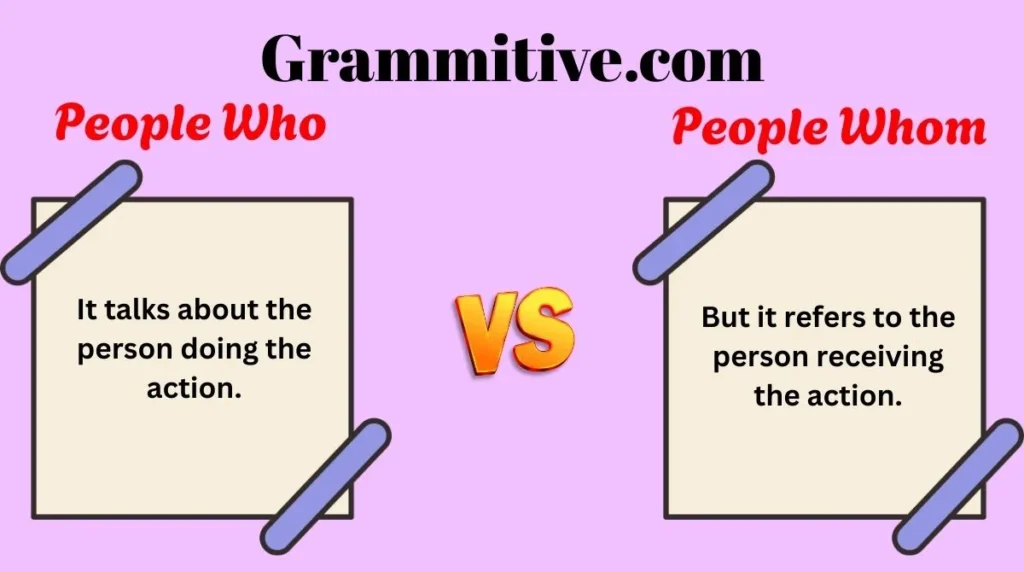
It talks about the person doing the action.
Think of who = subject.
If the person performs the action, we use who.
When to use it
Use who when:
- the person is the subject of the verb
- the person does something
- you could replace it with he / she / they
Grammar rule (easy version)
If you can say:
- he
- she
- they
then who is correct.
Examples
- The people who live next door are very kind.
- I like students who ask questions.
- She met a teacher who helped her a lot.
- The man who called you is outside.
- These are the people who built this house.
- I know children who love reading.
- The girl who won the prize is my cousin.
- We need workers who can speak English.
What’s happening here?
In every sentence:
- people live
- students ask
- teacher helped
- man called
They are doing the action.
So we use who.
Common learner confusion
Many students think:
“Who is only for questions.”
That’s not true.
Yes, we use who in questions like:
- Who is that?
But we also use who in sentences that describe people.
So remember: who is not just for questions.
What Does “Whom” Mean?
Simple definition
Whom also talks about people.
But it refers to the person receiving the action.
Think of whom = object.
The action happens to that person.
When to use it
Use whom when:
- the person is the object
- someone does something to them
- you could replace it with him / her / them
Grammar rule (easy version)
If you can say:
- him
- her
- them
then whom is correct.
Examples
- The people whom you invited arrived early.
- She is the woman whom I met yesterday.
- That is the teacher whom we respect.
- The students whom the principal praised felt proud.
- I remember the man whom you helped.
- The guests whom they called didn’t answer.
- The child whom the doctor treated is fine now.
- He spoke to the people whom he trusted.
What’s happening here?
Look closely:
- you invited them
- I met her
- we respect him
They are receiving the action.
So we use whom.
Common learner confusion
Here’s the tricky part:
In modern spoken English, many native speakers don’t use “whom” often.
They just say who.
So you may hear:
- The people who you invited
This sounds natural in conversation. But in formal writing, “whom” is still correct.
Difference Between Who and Whom (Detailed)
This is where everything becomes clear.
Quick comparison table
| Feature | Who | Whom |
|---|---|---|
| Grammar role | Subject | Object |
| Does the action? | Yes | No |
| Action happens to them? | No | Yes |
| Replace with | he/she/they | him/her/them |
| Common in speech | Very common | Less common |
| Formal writing | Yes | Yes |
Usage difference
Who → the doer
Whom → the receiver
Example:
- The people who called me (they called)
- The people whom I called (I called them)
See the difference? The action changes direction.
Grammar logic
Sentence structure helps you decide.
If the word comes before the verb, it’s usually who.
If the word comes after a verb or preposition, it’s often whom.
Example:
- who helped you
- you helped whom
Meaning comparison
Let’s compare two sentences:
- The people who love you
- The people whom you love
Sentence 1 → they love you
Sentence 2 → you love them
Same words. Different meaning. Big difference.
That’s why choosing correctly matters.
Grammar Rules You Must Remember
Rule #1 – Subject = Who
If the person does the action → use who
Example:
The students who study hard pass the test.
Students study. So → who.
Rule #2 – Object = Whom
If the person receives the action → use whom
Example:
The students whom the teacher praised smiled.
Teacher praised them. So → whom.
Rule #3 – After prepositions, use Whom
After words like:
- to
- for
- with
- about
- from
use whom.
Example:
- The person to whom I spoke
- The friend with whom I traveled
(These sound formal but correct.)
Rule #4 – In everyday speech, Who is often OK
In normal conversation, people often say:
- The person who I met
- The friend who I called
Grammatically, “whom” is correct. But “who” is common and natural.
Use whom mainly in formal writing or exams.
Common Mistakes Students Make
Why mistakes happen
- who and whom look similar
- grammar terms feel confusing
- native speakers don’t always follow rules
- learners overthink
Mistake 1
❌ The people whom live here are friendly.
✅ The people who live here are friendly.
They live → subject → who.
Mistake 2
❌ The woman who I met was kind. (formal writing)
✅ The woman whom I met was kind.
I met her → object → whom.
Mistake 3
Using “whom” everywhere because it sounds smart.
❌ The boy whom runs fast
✅ The boy who runs fast
“Whom” is not more correct. It must fit the grammar.
Easy correction tips
- Find the verb
- Ask: who does the action?
- Replace with he/him trick
Simple thinking saves time.
Easy Trick to Remember the Difference
Here’s a very easy memory trick students love.
The HE/HIM test
Try replacing the word with:
- he → who
- him → whom
Example:
The people ___ called me.
Try:
- he called me (correct)
- him called me (wrong)
So use who.
Another:
The people ___ I called.
Try:
- I called him (correct)
- I called he (wrong)
So use whom.
That’s it. No complicated grammar. Just he/him.
Daily Life Examples (Very Important)
These are sentences you might actually hear.
- She’s the friend who always helps me.
- That’s the guy who fixed my bike.
- The people who work here are nice.
- He’s the teacher who explains everything slowly.
- The customer whom I spoke to was angry.
- The manager whom you emailed replied today.
- Those are the guests whom we invited last week.
- I like people who listen carefully.
- She met someone whom she really trusts.
- We need workers who arrive on time.
Notice something?
In casual speech, “who” appears more often. That’s normal.
Practice Section
Choose who or whom.
- The people ___ called you are outside.
- The girl ___ I helped thanked me.
- Students ___ work hard succeed.
- The man ___ she invited didn’t come.
- Friends ___ support you are special.
Answers
- who
- whom
- who
- whom
- who
FAQs
What is the difference between who and whom?
Who is the subject (does the action).
Whom is the object (receives the action).
Think he → who, him → whom.
Can we use whom in questions?
Yes, but it sounds formal.
Example: Whom did you call?
Most people simply say “Who did you call?” in daily speech.
Is whom formal or informal?
Whom is more formal.
It appears in academic writing, business emails, and exams.
In casual talk, people usually say “who.”
Is it wrong to use who instead of whom?
In everyday conversation, it’s fine.
In formal grammar or tests, it may be marked wrong.
So follow the situation.
After prepositions, should we use whom?
Yes, formally.
Examples: to whom, with whom, for whom.
But many people still use “who” in speaking.
Do native speakers really use whom?
Some do, but not often.
Mostly in writing or careful speech.
That’s why many learners rarely hear it.
Final Conclusion
Small grammar points often feel scarier than big ones. “Who” and “whom” is a perfect example. Two tiny words, but they can stop you mid-sentence.
The good news is that the rule is actually simple.
If the person does the action, use who.
If the action happens to the person, use whom.
And when you feel unsure, use the he/him trick. It works almost every time.
Don’t worry too much about being perfect in conversation. Even native speakers mix these up.
Focus on understanding the difference first. Then practice with real sentences. Slowly, it will feel natural.
Grammar becomes easy when you see patterns. Once you master this pair, your English will sound more confident and polished.
Keep practicing a little each day. That’s how fluency grows.

I am Lucas Bennett, a digital content creator passionate about social media trends and online growth strategies.
I share practical insights and guides to help users better understand and navigate the digital world.