

Many English learners get confused between “passion for” and “passion in.” At first glance, these two phrases seem very similar, and it’s easy to mix them up.
After all, both are used when talking about something you love or feel strongly about. But using the wrong one can make a sentence sound awkward, unnatural, or even incorrect.
Understanding the difference is more than just a grammar exercise. In everyday English, speaking naturally requires knowing which preposition to use.
For instance, saying “I have a passion in cooking” might sound slightly off to native speakers.
On the other hand, “I have a passion for cooking” is clear, correct, and commonly used.
After reading this guide, you will be able to confidently choose between passion for and passion in in different situations.
You will learn the rules, see examples, understand why learners make mistakes, and even get tricks to remember the difference easily.
Whether you are writing an essay, speaking with friends, or crafting a CV, mastering this small grammar point will make your English more fluent and natural.
By the end, not only will you avoid confusion, but you will also be able to use both expressions correctly in real-life conversations.
Let’s explore these expressions carefully so that you never mix them up again.
What Does “Passion For” Mean?
Simple Definition
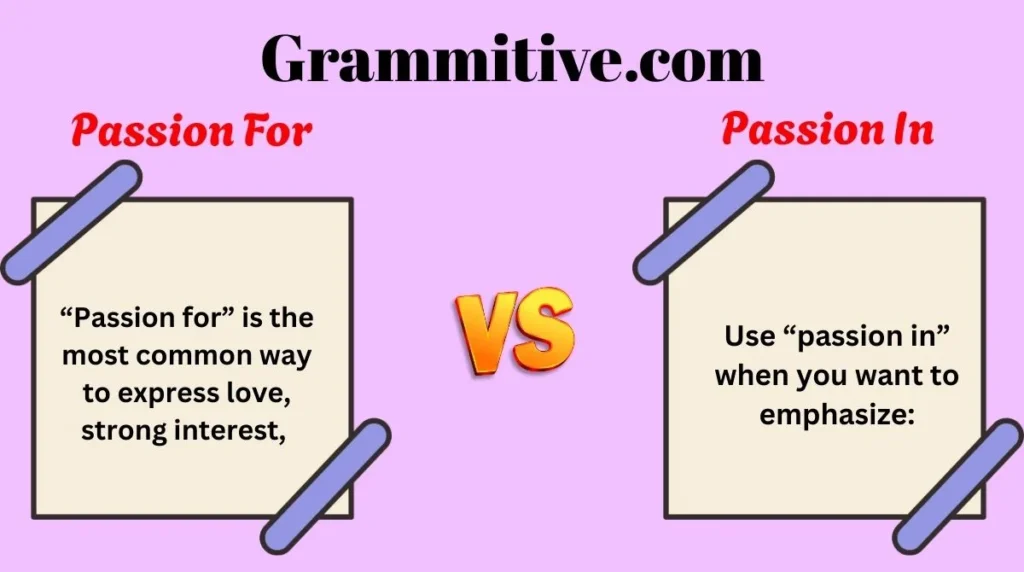
“Passion for” is the most common way to express love, strong interest, or enthusiasm for something. It usually talks about an activity, a subject, or a person you deeply care about.
When to Use It
Use “passion for” when you want to talk about:
- Hobbies or activities you enjoy
- Career interests
- Personal goals
- Things you feel strongly about
It shows your emotional connection or strong liking toward something.
Grammar Rule
- Structure:
have/feel/show + passion for + noun/gerund (-ing form) - Examples:
- I have a passion for painting.
- She shows a passion for learning new languages.
- They expressed a passion for helping others.
Notice that after “passion for”, we usually use a noun or a verb in -ing form.
Example Sentences
- He has a passion for music and spends hours playing the guitar.
- My sister has always had a passion for animals.
- We share a passion for cooking Italian dishes.
- She discovered her passion for teaching when she volunteered at school.
- They show a real passion for protecting the environment.
- John’s passion for photography is obvious from his amazing pictures.
- I feel a strong passion for writing stories.
- Students with a passion for science often do well in experiments.
Common Learner Confusion
Some students wrongly say:
- ❌ I have a passion in painting.
- ❌ She has a passion in reading.
These sentences are mostly not correct in standard English. Using “in” here sounds unnatural because “passion for” is the standard collocation.
What Does “Passion In” Mean?
Simple Definition
“Passion in” is less common. It is used to talk about excellence, skill, or deep involvement in a particular field or activity rather than just liking it. It often focuses on your performance or professional dedication.
When to Use It
Use “passion in” when you want to emphasize:
- The area or field where someone is active
- Professional or academic expertise
- Deep involvement or commitment to something
Grammar Rule
- Structure:
have/show/express + passion in + noun/field
Here, the preposition “in” usually comes with a field of work, study, or activity, not just hobbies.
Example Sentences
- She has a passion in the field of neuroscience.
- He shows great passion in his role as a teacher.
- I have always had a passion in mathematics.
- They demonstrated their passion in community service.
- John has a unique passion in software development.
- Her passion in research is inspiring for young scientists.
- We found our passion in volunteer work abroad.
- Mark shows passion in leadership and mentoring.
Common Learner Confusion
Many learners mistakenly use “passion in” like “passion for”:
- ❌ I have a passion in music. (sounds less natural)
- ❌ She has a passion in cooking.
“Passion in” is generally more formal and often reserved for fields, careers, or professional contexts. It is less flexible than “passion for.”
Difference Between Passion For and Passion In
Let’s make this crystal clear with a comparison table:
| Feature | Passion For | Passion In |
|---|---|---|
| Meaning | Love, strong interest, enjoyment | Commitment, involvement, or excellence in a field |
| Common Usage | Hobbies, interests, personal likes | Professional, academic, or skill-based fields |
| Preposition | For | In |
| Structure | passion for + noun/verb-ing | passion in + field/noun |
| Example | I have a passion for painting. | She has a passion in graphic design. |
| Tone | Casual / everyday English | Formal / professional English |
Usage Difference
- Casual interests → passion for
- Professional dedication or specialized fields → passion in
Sentence Structure Difference
- Passion for: subject + have/feel/show + passion for + activity/noun
- Passion in: subject + have/show/express + passion in + field/profession
Meaning Comparison
- Passion for expresses emotional love.
- Passion in expresses active involvement or skill.
Grammar Rules You Must Remember
Rule #1: Use the Correct Preposition
- ✅ passion for hobbies, likes, personal interests
- ✅ passion in fields, careers, formal domains
Example:
- Correct: I have a passion for writing.
- Correct: She has a passion in law and human rights.
Rule #2: Follow With Noun or Gerund
- ✅ “passion for” → usually noun or -ing verb
- ✅ “passion in” → usually noun (field/profession)
Example:
- I have a passion for painting.
- He has a passion in architecture.
Rule #3: Avoid Mixing Prepositions
- ❌ I have a passion in football. (wrong in casual English)
- ❌ She has a passion for engineering. (acceptable in some contexts, but “in” is better for professional tone)
Rule #4: Use Tone to Decide
- Everyday conversation → use for
- Formal or professional context → use in
Example:
- Casual: I have a passion for movies.
- Professional: She shows great passion in film production.
Common Mistakes Students Make
- Using “in” for hobbies
- ❌ I have a passion in painting.
- ✅ I have a passion for painting.
- Using “for” in professional fields
- ❌ He has a passion for law. (acceptable but less formal)
- ✅ He has a passion in law.
- Confusing structure
- ❌ Passion for in teaching.
- ✅ Passion for teaching / Passion in teaching
Tips to Correct Mistakes
- Remember: for = love / interest
- in = field / expertise
- Ask yourself: “Am I talking about my liking or my professional involvement?”
Easy Trick to Remember the Difference
Think of “for” = feelings and “in” = involvement.
- Passion for → “I love it” (emotion)
- Passion in → “I work in it / I’m active in it” (action/field)
Another trick:
- Ask: “Do I enjoy it casually or do I do it professionally?”
- Casual → for
- Professional → in
This mental shortcut helps students pick the right phrase instantly.

Daily Life Examples
- I have a passion for chocolate. (casual liking)
- My brother has a passion for football.
- She has a passion for painting landscapes.
- I show my passion for reading by visiting libraries.
- He has a passion in medicine. (professional involvement)
- She demonstrates her passion in law by volunteering in legal aid.
- We discovered our passion in teaching children.
- John’s passion for photography started when he was ten.
- They share a passion for traveling the world.
- My friend has a passion in computer science.
Practice Section
Choose the correct option:
- I have a passion ___ dancing.
- a) for
- b) in
- She has a passion ___ artificial intelligence.
- a) for
- b) in
- They show a passion ___ helping the below .
- a) for
- b) in
- He discovered his passion ___ music.
- a) for
- b) in
- We have a passion ___ sports management.
- a) for
- b) in
Answers: 1-a, 2-b, 3-a, 4-a, 5-b
FAQs
1. What is the difference between passion for and passion in?
“Passion for” shows strong interest or love. “Passion in” shows professional involvement or field dedication.
2. Can we use passion for in questions?
Yes. Example: Do you have a passion for painting?
3. Can we use passion in for hobbies?
It’s less common. “Passion for” is more natural for hobbies.
4. Is passion in formal or informal?
“Passion in” is formal and professional, often used in work or academic contexts.
5. Why do learners confuse them?
Because both talk about liking something, but one is casual (for) and the other professional (in).
6. Can I say “I have a passion in music”?
It is grammatically correct but sounds formal. For casual English, “passion for music” is preferred.
Conclusion
Understanding passion for and passion in makes your English sound natural and confident. Remember:
for = love or interest, in = professional or field involvement. By practicing with real-life sentences and noticing the context, you can quickly master the difference.
Using these correctly improves your writing, speaking, and even your CV or job interviews. Start noticing these phrases in books, movies, and conversations.
The more you practice, the easier it will become. Soon, choosing passion for or passion in will feel completely natural. Keep practicing, stay curious, and enjoy using English every day!

I am Lucas Bennett, a digital content creator passionate about social media trends and online growth strategies.
I share practical insights and guides to help users better understand and navigate the digital world.