
English has many words that look or sound almost the same. These small differences can confuse even smart learners. Three words that often cause trouble are pass time, past time, and pastime.
They sound nearly identical when spoken. If you say them fast, they feel exactly the same. But their meanings are very different. And using the wrong one can change your sentence completely.
Imagine telling a friend, “Reading is my past time.”
It sounds strange, right? You probably meant “pastime.”
Or writing, “We talked about pass time.”
That doesn’t sound natural either.
These tiny spelling changes matter a lot in English. Native speakers notice them immediately.
These words appear in daily life. You hear them in conversations, books, movies, and exams. So understanding them clearly will make your English smoother and more natural.
By the end, you will:
- know what each word means
- understand the grammar rules
- see many easy examples
- learn memory tricks
- stop mixing them up forever
Everything is explained in simple, friendly language — just like in a real classroom.
What Does “Pass Time” Mean?
Simple definition
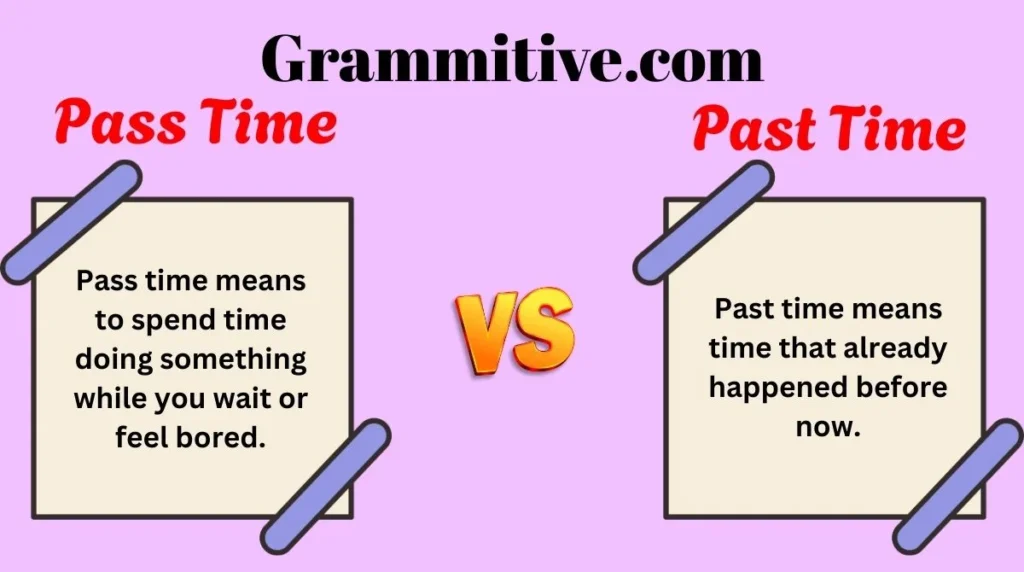
Pass time means to spend time doing something while you wait or feel bored.
It is a verb phrase, not a noun.
Think of it like this:
You are not busy, so you do something to make time move faster.
When to use it
Use pass time when:
- you are waiting
- you feel bored
- you want time to go faster
Grammar rule
pass time = verb + noun
- pass = verb
- time = noun
You can change the verb tense:
- pass time
- passed time
- passing time
Examples
- I read a book to pass time at the airport.
- She plays games to pass time on the bus.
- We chatted to pass time while waiting.
- He watched TV to pass time at night.
- They told jokes to pass time.
- I scroll my phone to pass time in long lines.
- Kids draw pictures to pass time.
- We listened to music to pass time during the trip.
Common learner confusion
Many students think pass time is a hobby. It is not.
Wrong idea:
❌ Reading is my pass time.
Correct:
✅ I read to pass time.
Notice the difference. One is an action. Not a thing.
What Does “Past Time” Mean?
Simple definition
Past time means time that already happened before now.
It talks about the past, not the present.
It is usually used in phrases like:
- past times
- past time memories
- stories of past time
This phrase is less common in daily speech but appears in writing and storytelling.
When to use it
Use past time when talking about:
- history
- old days
- earlier life
- memories
Grammar rule
past = adjective
time = noun
So it describes time that is finished.
Examples
- I miss the past time of my childhood.
- She often thinks about past time memories.
- Life was simple in past times.
- We talked about past time traditions.
- He collects photos from past times.
- Past time stories teach us lessons.
- The village looked different in past times.
- My grandparents share past time experiences.
Common learner confusion
Students sometimes use past time when they mean hobby.
Wrong:
❌ Swimming is my past time.
Correct:
✅ Swimming is my pastime.
Remember: past time = earlier time, not an activity.
What Does “Pastime” Mean?
Simple definition
Pastime means a hobby or fun activity that you do in your free time.
It is a noun.
This is the most common and useful word among the three.
When to use it
Use pastime when talking about:
- hobbies
- free-time activities
- relaxing things you enjoy
Grammar rule
pastime = one word noun
Do not separate it.
Correct:
✅ pastime
Wrong:
❌ past time (if you mean hobby)
Examples
- Reading is my favorite pastime.
- Gardening is a relaxing pastime.
- Chess is a popular pastime.
- Cooking became her new pastime.
- Fishing is his weekend pastime.
- Drawing is a cheap pastime.
- Watching movies is our family pastime.
- Photography is a creative pastime.
Common learner confusion
Students often write it as two words.
Wrong:
❌ past time
❌ pass time
Correct:
✅ pastime
If it means hobby, always one word.
Difference Between Pass Time and Pastime (Detailed)
These two are confused the most because they sound the same.
Quick comparison table
| Feature | Pass Time | Pastime |
|---|---|---|
| Type | Verb phrase | Noun |
| Meaning | spend time | hobby |
| Grammar | action | thing |
| Form | two words | one word |
| Example | I read to pass time | Reading is my pastime |
Usage difference
Pass time = something you do
Pastime = the activity itself
Example:
- I play chess to pass time. (action)
- Chess is my favorite pastime. (noun)
Grammar logic
If you can replace the word with “hobby”, use pastime.
If you can replace it with “spend time”, use pass time.
Sentence structure difference
Verb structure:
- subject + verb + to pass time
Noun structure:
- subject + be + pastime
Meaning comparison
One is temporary.
One is regular.
Pass time = short moment
Pastime = repeated hobby
Grammar Rules You Must Remember
Rule #1: “Pastime” is always one word
Correct: Painting is my pastime.
Wrong: Painting is my past time.
Rule #2: “Pass time” needs a verb
Correct: I watch videos to pass time.
Wrong: Watching videos is my pass time.
Rule #3: “Past time” means earlier time only
Correct: Stories from past times are interesting.
Wrong: Football is my past time.
Rule #4: Check meaning first
Ask: hobby or spending time?
Hobby → pastime
Spending time → pass time
Example:
I read to pass time, but reading is my pastime.
Common Mistakes Students Make
Why mistakes happen
- Same pronunciation
- Very similar spelling
- Fast typing
- No grammar check
Mistake 1
❌ Music is my pass time.
✅ Music is my pastime.
Tip: hobbies = one word
Mistake 2
❌ I play games as a pastime time.
✅ I play games to pass time.
Tip: use “to” with pass time
Mistake 3
❌ Cricket was my pass time when I was young.
✅ Cricket was my pastime when I was young.
Mistake 4
❌ We talked about pass times.
✅ We talked about past times.
Tip: history = past
Easy correction tips
- Say it slowly while writing
- Check if it is a noun or verb
- Remember: hobby = one word
Easy Trick to Remember the Difference
Here is a simple memory trick.
Trick 1: The “S” rule
Pass time → two S letters → two words
pass + time
Trick 2: Hobby hugs together
A hobby sticks together.
So pastime stays together as one word.
Trick 3: Past means history
If you see past, think “before now.”
So it talks about old days.
These small tricks help your brain choose faster.
Daily Life Examples (Very Important)
These sound like real conversations.
- “I’m bored. Let’s play cards to pass time.”
- “Drawing is my favorite pastime.”
- “Grandpa loves telling stories about past times.”
- “We watched funny videos to pass time at the hospital.”
- “Reading novels became her new pastime.”
- “People had simple lives in past times.”
- “I listen to music to pass time on the train.”
- “Knitting is a relaxing pastime for my mom.”
- “They shared memories from past times.”
- “We chatted and laughed to pass time.”
These are natural, everyday sentences.
Practice Section
Choose the correct option.
Questions
- Reading is my ______. (pass time / pastime)
- We played games to ______. (pass time / pastime)
- Stories from ______ are interesting. (past time / pastime)
- Chess is a fun ______. (pastime / pass time)
- I scroll my phone to ______ in long lines. (pass time / pastime)
Answers
- pastime
- pass time
- past time
- pastime
- pass time
FAQs
What is the difference between pass time and pastime?
Pass time is a verb phrase that means spending time. Pastime is a noun that means hobby. One shows action, the other names an activity.
Can we use pastime in questions?
Yes. It works like any noun.
Example: What is your favorite pastime?
Is pass time formal or informal?
It is neutral. You can use it in both speaking and writing. It sounds natural in daily English.
Why do these words sound the same?
English pronunciation often drops small sounds. Pass time, past time, and pastime blend together when spoken. That’s why spelling matters.
Is past time common in daily speech?
Not very common. People usually say “in the past” or “long ago.” But you may see past time in books or history writing.
How can I stop confusing them?
Focus on meaning first. Ask yourself: hobby, spending time, or history? Then choose the correct word. Practice helps a lot.
Final Conclusion
Small words can create big confusion in English. Pass time, past time, and pastime look almost the same, but their meanings are very different.
Pass time is an action you do when you are bored or waiting.
Pastime is a hobby you enjoy often.
Past time talks about earlier days or history.
Once you understand this logic, the choice becomes easy. Think about grammar. Check if it is a verb or a noun. Use the memory tricks. And read many examples out loud.
The more you practice, the more natural it feels. Soon, you will write these words correctly without even thinking.
Keep noticing them in books and conversations. Every small step makes your English stronger and clearer.

I am Lucas Bennett, a digital content creator passionate about social media trends and online growth strategies.
I share practical insights and guides to help users better understand and navigate the digital world.