
English looks simple at first. Then small phrases start causing big problems.
One tiny example is “open to” and “open for.”
Many learners mix them up every day.
You may hear:
❌ The shop is open to business.
❌ I am open for new ideas.
These sound close… but they are not correct.
Prepositions like to and for change the meaning of a sentence. Just one small word can make your English sound natural or strange. That’s why this topic matters so much in daily speaking and writing.
You will hear these phrases everywhere:
- open to suggestions
- open for business
- open to the public
- open for lunch
They appear in conversations, emails, signs, ads, and workplaces.
So if you choose the wrong one, people may still understand you… but it won’t sound right.
After reading this guide, you will clearly understand:
- what open to means
- what open for means
- the grammar rules
- the difference in meaning
- how native speakers use them
- and how to avoid common mistakes
By the end, you’ll feel confident using both naturally — without stopping to think.
What Does “Open to” Mean?
Simple meaning
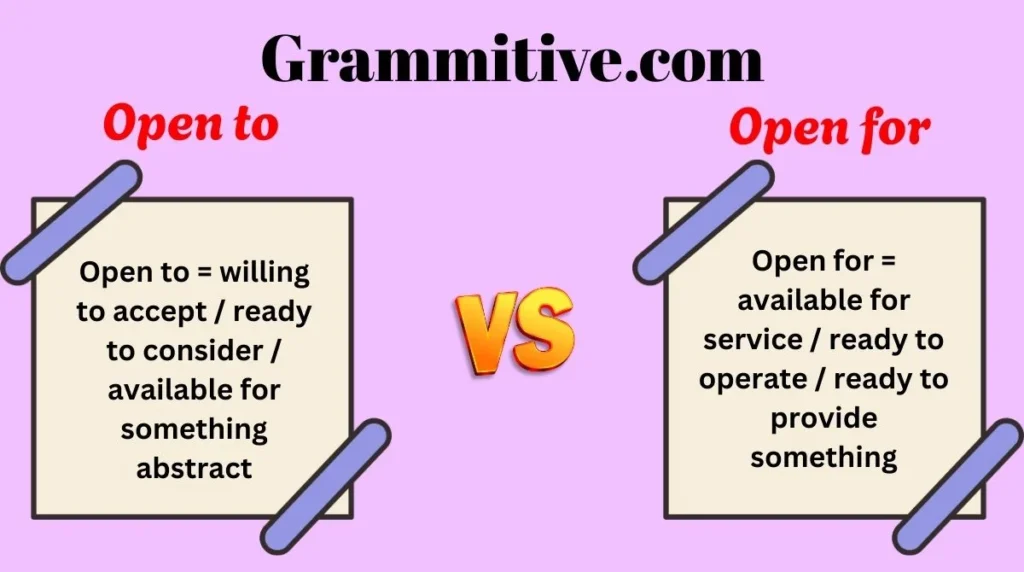
Open to = willing to accept / ready to consider / available for something abstract
It often talks about:
- ideas
- opinions
- possibilities
- people
- access
It usually shows mental or emotional openness, not business hours.
Think of it like this:
👉 Your mind or access is open.
When to use it
Use open to when someone:
- is willing to listen
- accepts suggestions
- allows people to enter
- is ready for change
It often describes attitude or permission, not schedules.
Grammar rule
Open to + noun / pronoun / -ing verb
Structure:
- open to + idea
- open to + suggestion
- open to + visitors
- open to + trying
Examples
- I’m open to new ideas.
- She is open to feedback.
- The park is open to everyone.
- He’s open to learning new skills.
- We are open to suggestions.
- The museum is open to the public.
- They are open to change.
- I’m open to discussing this later.
Common learner confusion
Students often think open to means “available for business.”
So they say:
❌ The shop is open to customers.
This sounds unnatural.
Native speakers usually say:
✅ The shop is open for customers.
or
✅ The shop is open for business.
Because here we talk about service, not willingness.
That’s the key difference.
What Does “Open for” Mean?
Simple meaning
Open for = available for service / ready to operate / ready to provide something
It usually talks about:
- business
- activities
- events
- services
- periods of time
Think of it like this:
👉 The door is open for action or service.
When to use it
Use open for when something:
- starts serving customers
- begins operating
- is ready to receive something
- is available for a purpose
It focuses on function or service, not feelings.
Grammar rule
Open for + noun (purpose/activity)
Structure:
- open for business
- open for lunch
- open for visitors
- open for registration
Examples
- The restaurant is open for lunch.
- The store opens for business at 9 a.m.
- Registration is open for students.
- The hall is open for meetings.
- The café is open for takeaway orders.
- The bank is open for customers.
- The hotel is open for bookings.
- The gym is open for members.
Common learner confusion
Students often say:
❌ I am open for new ideas.
This sounds strange.
Because people don’t usually use “open for” for feelings.
Correct:
✅ I am open to new ideas.
Remember:
Feelings → to
Services → for
Difference Between Open to and Open for (Detailed)
These two phrases look similar, but their meanings are quite different.
Here’s a clear comparison.
Comparison Table
| Feature | Open to | Open for |
|---|---|---|
| Main meaning | willing / accepting | available / operating |
| Type | attitude or access | service or activity |
| Used with | ideas, people, suggestions | business, lunch, registration |
| Focus | mental/emotional | functional/practical |
| Example | open to feedback | open for business |
Usage difference
Open to → mind or permission
Open for → service or action
If you can replace it with “willing to accept”, use to.
If you can replace it with “available for service”, use for.
Grammar logic
Prepositions often show direction or purpose.
To → direction or connection
- open to ideas
- open to change
Your mind moves toward something.
For → purpose or function
- open for lunch
- open for business
The place exists for that purpose.
Sentence structure difference
Open to + abstract nouns
- ideas
- change
- suggestions
- people
Open for + activities/events
- lunch
- business
- registration
- bookings
Meaning comparison
Compare these:
👉 The museum is open to the public.
Meaning: People are allowed to enter.
👉 The museum is open for tours.
Meaning: Tours are available.
Small difference. Big meaning change.
Grammar Rules You Must Remember
These four rules will save you from most mistakes.
Rule #1 – Use “open to” for opinions or ideas
✅ She is open to advice.
❌ She is open for advice.
Advice is an idea, not a service.
Rule #2 – Use “open for” for business or services
✅ The shop is open for business.
❌ The shop is open to business.
Business is an activity.
Rule #3 – Use “open to” with people when talking about access
✅ The event is open to everyone.
❌ The event is open for everyone.
This means permission to enter.
Rule #4 – Use “open for” with time periods or operations
✅ The café is open for dinner.
❌ The café is open to dinner.
Dinner is a service time.
Common Mistakes Students Make
Why mistakes happen
There are two big reasons:
- Both use the word “open”
- Many languages don’t change prepositions like English does
So learners guess. And guessing causes errors.
Wrong vs Correct Examples
❌ I’m open for your idea.
✅ I’m open to your idea.
❌ The bank is open to business.
✅ The bank is open for business.
❌ Registration is open to applications.
✅ Registration is open for applications.
❌ The club is open for everyone.
✅ The club is open to everyone.
Easy correction tips
Ask yourself:
👉 Is this about feelings or service?
- feelings → to
- service → for
This small check works almost every time.
Easy Trick to Remember the Difference
Here’s a simple memory trick students love.
Think of this:
TO = toward your mind
FOR = for a purpose
Picture your brain opening.
If ideas go toward your brain → use to
If something exists for a purpose → use for
Examples:
- ideas go to your head → open to ideas
- shops work for business → open for business
It’s simple and very logical.
Daily Life Examples (Spoken English Style)
These are sentences you might hear every day.
- I’m open to trying new food.
- The café is open for breakfast now.
- She’s open to your suggestion.
- The office is open for appointments.
- Are you open to working late today?
- The library is open for students only.
- He’s open to change.
- The shop opens for customers at 10.
- We’re open to meeting next week.
- The website is open for registration.
These sound very natural in conversation.
Practice Section
Choose to or for.
- The store is open ___ business.
- I’m open ___ new experiences.
- The park is open ___ visitors.
- Registration is open ___ new members.
- She’s open ___ feedback.
Answers
- for
- to
- to
- for
- to
FAQs
What is the difference between open to and open for?
Open to shows willingness or permission. Open for shows service or operation. One is about attitude, the other is about function.
Can we use open to for people?
Yes. It means people are allowed to enter or join. Example: The event is open to everyone.
Can we use open for ideas?
No. Ideas are not services. Use open to ideas.
Is open for business formal or informal?
It works in both. You’ll see it on signs, websites, and in normal speech. Very common phrase.
Can both be correct in some sentences?
Sometimes, yes, but the meaning changes. “Open to visitors” means allowed to enter. “Open for visitors” means ready to serve visitors.
Which one is more common in daily English?
Both are common, but used in different situations. You’ll hear open to in conversations and open for in shops and services.
Final Conclusion
Small grammar points like this can feel annoying at first. One little word changes everything. But once you see the pattern, it becomes easy.
Remember the heart of it:
Open to → mind, ideas, permission
Open for → service, activity, business
If you think about meaning instead of memorizing rules, the correct preposition often feels natural.
Listen to native speakers. Notice signs in shops. Read menus and websites. You’ll see these phrases everywhere. Practice using them in your own sentences each day.
Soon you won’t even need to think. The right one will just come out automatically.
That’s when you know you truly understand English.

I am Lucas Bennett, a digital content creator passionate about social media trends and online growth strategies.
I share practical insights and guides to help users better understand and navigate the digital world.