

Many English learners feel confused when they hear phrases like “My house is on the market” and “We are in the market for a new car.”
Both sentences talk about buying or selling. Both use the word market. Both sound similar. So naturally, students mix them up.
You might ask yourself:
- Why do we say on the market for products?
- Why do we say in the market for when we want to buy something?
- Why can’t we use them the same way?
These small word changes can feel strange. English prepositions often cause headaches. One tiny word can change the whole meaning of a sentence.
But here’s the good news — this topic is actually very logical once you see the pattern. It’s not about memorizing. It’s about understanding the idea behind each phrase.
After reading this guide, you will clearly know:
- when to use on the market
- when to use in the market
- how native speakers use them in daily life
- common mistakes to avoid
- easy tricks to remember forever
By the end, these two phrases will feel natural, not confusing.
What Does “On the Market” Mean?
Simple meaning
On the market means:
👉 available for sale
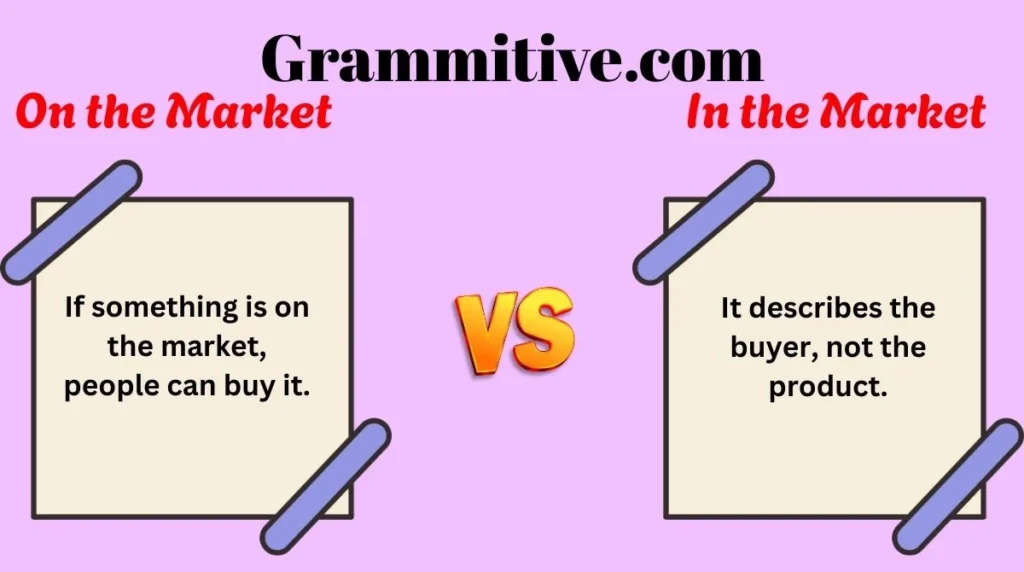
If something is on the market, people can buy it.
It is being offered to customers.
Think of a product sitting on a store shelf or listed for sale online.
When to use it
Use on the market when:
- something is for sale
- a product has been released
- a house or property is being sold
- a company is selling something
It talks about the seller’s side, not the buyer’s side.
Grammar rule
Structure:
- be + on the market
- put + something + on the market
Examples:
- The house is on the market.
- They put the phone on the market last year.
Example sentences (6–8)
- Our house is on the market right now.
- That new laptop will be on the market next month.
- Their company put a cheaper version on the market.
- The car has been on the market for three weeks.
- Fresh mangoes are finally on the market.
- This medicine was on the market for many years.
- The apartment went on the market yesterday.
- The product is not yet on the market.
Common learner confusion
Many students say:
❌ I am on the market for a new phone.
This sounds wrong.
Why?
Because on the market describes the item being sold, not the person buying.
You are not a product for sale (unless you are joking!).
So this phrase usually talks about things, not people.
What Does “In the Market” Mean?
Simple meaning
In the market (for something) means:
👉 wanting or planning to buy something
It describes the buyer, not the product.
It means you are shopping or looking for something.
When to use it
Use in the market for when:
- you want to buy something
- you are searching for something
- you are planning to purchase soon
- you are comparing options
It focuses on intention to buy.
Grammar rule
Structure:
- be + in the market + for + noun
Examples:
- I am in the market for a car.
- They are in the market for a new house.
Always remember the word for after it.
Example sentences (6–8)
- I’m in the market for a new phone.
- We are in the market for a bigger apartment.
- She’s in the market for a job.
- They’re in the market for a used car.
- My parents are in the market for a sofa.
- He is in the market for better headphones.
- Are you in the market for a laptop?
- We’re not in the market for anything expensive right now.
Common learner confusion
Students often say:
❌ A new phone is in the market.
This sounds strange.
Because products are not “shopping.”
Only buyers are in the market.
Difference Between On the Market and In the Market (Detailed)
This is where everything becomes clear.
Quick idea
- On the market → selling
- In the market → buying
Comparison Table
| Feature | On the Market | In the Market |
|---|---|---|
| Focus | Product | Buyer |
| Meaning | For sale | Looking to buy |
| Who? | Seller/item | Customer/person |
| Structure | be on the market | be in the market for |
| Example | The house is on the market | We are in the market for a house |
Usage difference
If you talk about something available, use on.
If you talk about someone shopping, use in.
Grammar logic
Think about the meaning of prepositions:
- on → something placed or displayed
- in → inside an activity or situation
So:
- A product is placed on the market
- A person is involved in the market
This is why English uses different prepositions.
Sentence structure difference
On the market
- Subject = thing
- The car is on the market.
In the market
- Subject = person
- I am in the market for a car.

Meaning comparison
- The house is on the market. → People can buy it
- We are in the market for a house. → We want to buy one
One is supply.
One is demand.
Grammar Rules You Must Remember
Rule #1 – Use “on” for products or items
✔ The laptop is on the market.
Never use it for buyers.
Rule #2 – Use “in the market for” for buyers
✔ I’m in the market for new shoes.
Always add for.
Rule #3 – Don’t remove “for”
❌ I’m in the market a car
✔ I’m in the market for a car
Without for, the sentence is wrong.
Rule #4 – Time expressions are common with “on the market”
✔ The house has been on the market for two months.
This phrase often talks about how long something is available.
Common Mistakes Students Make
Why mistakes happen
The words look similar.
Both use market.
Both talk about buying and selling.
So learners switch them accidentally.
Wrong vs Correct
❌ I am on the market for a job.
✔ I am in the market for a job.
❌ The phone is in the market.
✔ The phone is on the market.
❌ We’re in the market a car.
✔ We’re in the market for a car.
Easy correction tips
Ask yourself:
- Am I talking about the item? → use on
- Am I talking about the buyer? → use in
This question fixes 90% of mistakes.
Easy Trick to Remember the Difference
Here’s a simple memory trick my students love.
Picture this:
Imagine a supermarket.
- Products sit on shelves
- Shoppers walk in the store
So:
- Products → on the market
- Shoppers → in the market
On = shelf
In = store
Easy and logical.
Daily Life Examples (Very Important)
These sound very natural in spoken English.
- Our house is on the market if you know anyone interested.
- I’m in the market for a cheap laptop.
- That model isn’t on the market anymore.
- We’re in the market for a wedding dress.
- Their car has been on the market for months.
- Are you in the market for a new phone or just browsing?
- The company put a new tablet on the market last week.
- I’m not in the market for anything expensive right now.
- Fresh strawberries are finally on the market.
- My brother is in the market for his first apartment.
These are exactly how native speakers talk.
Practice Section
Choose the correct phrase:
- The house is ___
- I’m ___ a new job
- This phone isn’t ___ yet
- We’re ___ a bigger TV
- Their product has been ___ for years
Answers
- on the market
- in the market for
- on the market
- in the market for
- on the market
FAQs
What is the difference between on the market and in the market?
On the market means something is available for sale. In the market means someone wants to buy something. One talks about products, the other talks about buyers.
Can we use “in the market” without “for”?
No. You almost always need “for.” Say “in the market for a car.” Without “for,” the sentence sounds incomplete.
Is “on the market” formal or informal?
It works in both. You can use it in everyday speech and in business English. It’s very common and natural.
Can people be “on the market”?
Only jokingly. For example, “I’m on the market again” means single and ready to date. But for buying and selling, we use it for products.
Can we use these phrases for jobs?
Yes. You can say “I’m in the market for a new job.” But we don’t usually say a job is “on the market.”
Which phrase is more common in daily English?
Both are common. You hear “on the market” with houses and products, and “in the market for” when people plan to buy something.
Final Conclusion
Small English phrases often create big confusion, and these two expressions are a perfect example. They look almost the same, but their meanings move in opposite directions.
Just remember the simple idea:
Products are on the market.
Buyers are in the market.
When you focus on who or what you’re talking about, the choice becomes easy. No guessing. No stress.
Try using these phrases in your daily life. Talk about your phone, your house, your shopping plans. The more you practice, the more natural they will sound.
Soon, you won’t even think about the rule. You’ll just say it correctly, like native speakers do.
And that’s the real goal of learning English.

I am Lucas Bennett, a digital content creator passionate about social media trends and online growth strategies.
I share practical insights and guides to help users better understand and navigate the digital world.