
Small English phrases can cause big confusion.
“On the left” and “to the left” look almost the same. They both talk about direction or position. So many learners think they mean exactly the same thing.
But they are not the same.
Sometimes you must use on.
Sometimes you must use to.
And sometimes using the wrong one sounds strange or even incorrect.
Imagine giving directions to someone in a new city. If you say the wrong phrase, they might walk the wrong way.
Or picture describing a photo in an exam. A tiny mistake could lower your score. These little grammar points really matter in daily English.
Students often ask:
- Which one shows position?
- Which one shows movement?
- Can I use both?
- Why do native speakers choose different words?
All good questions.
By the time you finish reading, you’ll clearly understand:
- the meaning of each phrase
- when to use each one
- the grammar rules
- common mistakes
- and an easy trick to remember forever
Everything is explained in simple, friendly English — just like a teacher talking to you in class.
What Does “On the Left” Mean?
Simple meaning
“On the left” shows position.
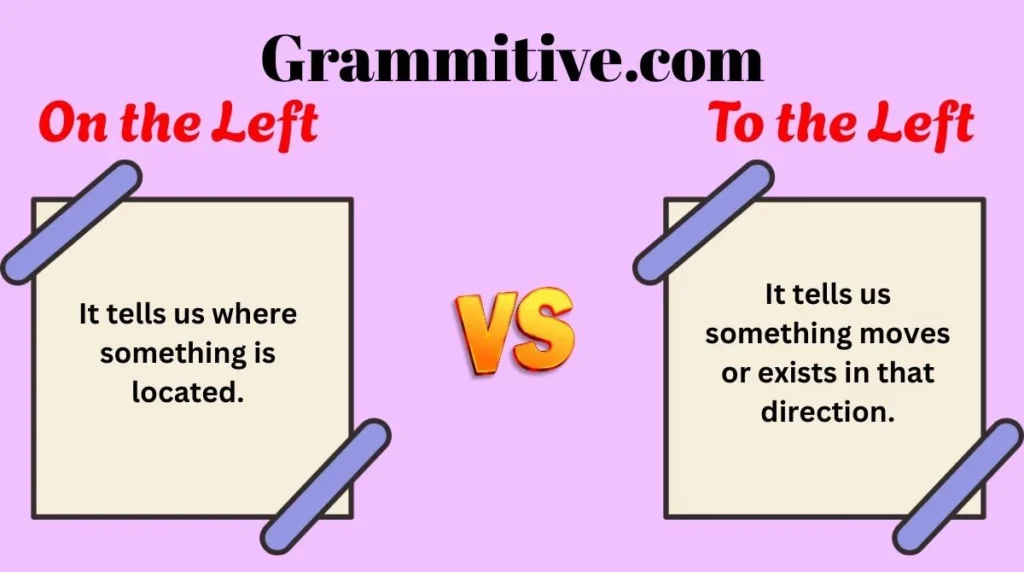
It tells us where something is located.
It means something is already there, not moving.
Think of it like this:
👉 It answers the question: “Where is it?”
When to use it
Use on the left when:
- describing places
- talking about location
- explaining where something is fixed
- describing pictures, maps, rooms, or objects
Grammar rule
Structure:
be + on the left
Examples:
- is on the left
- was on the left
- sits on the left
It usually follows a verb of position like:
- is
- are
- was
- stands
- sits
- lies
Examples
- The bank is on the left.
- My house is on the left side of the street.
- There’s a small park on the left.
- Your name is on the left column.
- The red car is on the left.
- She sat on the left side of the classroom.
- The bathroom is on the left of the stairs.
- His picture appears on the left of the page.
Common learner confusion
Many students use to the left in these sentences:
❌ The bank is to the left.
This sounds incomplete unless we compare it to something.
Remember:
- on the left = fixed position
- to the left = direction or relation
If something is simply located somewhere, “on” is safer.
What Does “To the Left” Mean?
Simple meaning
“To the left” shows direction or movement.
It tells us something moves or exists in that direction.
It often compares one thing to another.
Think:
👉 It answers the question: “Which direction?”
When to use it
Use to the left when:
- giving directions
- talking about movement
- turning or walking
- comparing positions
Grammar rule
Structure:
Often used with movement verbs:
move/go/turn/look + to the left
Examples:
- turn to the left
- move to the left
- shift to the left
Examples
- Turn to the left at the traffic light.
- Move your chair to the left.
- The cat ran to the left.
- Slide the box to the left.
- Look to the left before crossing.
- The arrow points to the left.
- Step two meters to the left.
- He leaned slightly to the left.
Common learner confusion
Students sometimes say:
❌ The store is to the left.
This sounds like we are comparing:
“To the left of what?”
Without a reference point, it feels unfinished.
Better:
✅ The store is on the left.
✅ The store is to the left of the bank.
Difference Between “On the Left” and “To the Left” (Detailed)
The difference becomes very clear when you compare them side by side.
Quick comparison table
| Feature | On the Left | To the Left |
|---|---|---|
| Meaning | position | direction |
| Shows | location | movement or relation |
| Common verbs | is, sits, stands | go, turn, move |
| Question answered | where? | which way? |
| Example | The shop is on the left | Turn to the left |
Usage difference
On the left
= something already there
To the left
= something moves or is compared
Grammar logic
- “On” often describes surfaces or positions
- “To” shows movement or direction toward something
English uses prepositions very carefully.
“On” feels stable.
“To” feels active.
Sentence structure difference
Position:
The café is on the left.
Movement:
Walk to the left.
Comparison:
The café is to the left of the bank.
Meaning comparison
- On the left → picture description
- To the left → instruction or direction
If you imagine a map:
- the building sits on the left
- you walk to the left
Grammar Rules You Must Remember
Rule #1 — Use “on the left” for location
The museum is on the left.
(No movement. Just position.)
Rule #2 — Use “to the left” with movement verbs
Turn to the left.
(Action or motion.)
Rule #3 — Use “to the left of” for comparison
The pharmacy is to the left of the supermarket.
(Shows relation between two things.)
Rule #4 — Don’t mix them randomly
❌ Sit to the left side
✅ Sit on the left side
Choose the correct preposition for the meaning.
Common Mistakes Students Make
Why mistakes happen
Both phrases look similar.
Many languages use just one word for both ideas.
So learners translate directly.
That causes errors.
Wrong vs Correct examples
❌ The hospital is to the left.
✅ The hospital is on the left.
❌ Turn on the left.
✅ Turn to the left.
❌ Move on the left.
✅ Move to the left.
❌ The car went on the left.
✅ The car went to the left.
Easy correction tips
Ask yourself:
- Is it staying? → on
- Is it moving? → to
This simple question fixes most mistakes.
Easy Trick to Remember the Difference
Here’s a memory trick students love.
Think of this:
ON = sitting ON a place
TO = going TO a place
If something is already sitting somewhere → on
If something goes somewhere → to
Example:
You sit on a chair.
You walk to a chair.
Same idea.
So:
- The chair is on the left
- Walk to the left
Very natural when you think this way.
Daily Life Examples (Very Important)
These sound like real conversation.
- The elevator is on the left.
- Turn to the left after the bridge.
- The kitchen is on the left side.
- Move your bag to the left.
- My office is on the left of the hallway.
- Just step to the left a little.
- The emergency exit is on the left.
- The dog suddenly ran to the left.
- Your photo is on the left of the screen.
- Look to the left before you cross the road.
These are the kinds of sentences you hear every day.
Practice Section
Choose the correct answer.
1
The bookstore is ___ the left.
a) on
b) to
2
Turn ___ the left at the corner.
a) on
b) to
3
My seat is ___ the left side.
a) on
b) to
4
Slide the table ___ the left.
a) on
b) to
5
The restroom is ___ the left of the stairs.
a) on
b) to
Answers
1 → on
2 → to
3 → on
4 → to
5 → on
FAQs
What is the difference between on the left and to the left?
“On the left” shows position. “To the left” shows direction or movement. One describes where something is. The other shows which way to go.
Can we use “to the left” in questions?
Yes. It works well for directions. For example: “Should I turn to the left here?” It sounds natural in spoken English.
Is “on the left” formal or informal?
It’s neutral. You can use it in both casual and formal situations. It appears in daily speech, writing, and exams.
Can both phrases mean the same thing sometimes?
Sometimes they feel similar, but the grammar idea is different. Native speakers still choose based on position or movement.
Do we always need “of” after “to the left”?
Often yes for comparison. Example: “to the left of the bank.” Without “of,” the meaning may feel incomplete.
Which one is more common in daily English?
Both are common. “On the left” appears in descriptions. “To the left” appears in directions and instructions.
Final Conclusion
English prepositions can be small, but they carry big meaning. “On the left” and “to the left” are a perfect example. One tiny word changes everything.
When something stays in one place, use on the left.
When something moves or you give directions, use to the left.
That simple idea solves most problems.
Try noticing these phrases when you watch movies, read signs, or follow directions. You’ll hear them everywhere.
Practice by making your own sentences about your house, school, or town. The more you use them, the more natural they feel.
Don’t worry if you forget sometimes. Everyone makes mistakes while learning. Keep practicing, and soon you’ll choose the correct phrase without even thinking.
Small steps lead to big progress in English.

I am Lucas Bennett, a digital content creator passionate about social media trends and online growth strategies.
I share practical insights and guides to help users better understand and navigate the digital world.