
Many English learners feel confused when they meet two words that look almost the same but behave very differently. Nutriment and nutrition are perfect examples.
At first glance, they seem like twins. Both come from the idea of food and health. Both relate to eating and the body. Both sound formal and scientific. So it’s easy to think they mean the same thing.
But here’s the problem.
Native speakers almost never use nutriment in daily conversation, while nutrition is everywhere — in schools, hospitals, gyms, food labels, and even on TV ads.
Because of this, students often say things like:
❌ “Good nutriment is important for children.”
❌ “I studied nutriment at college.”
These sound strange to native ears.
Understanding the small difference between these two words helps you sound more natural and confident. It also helps you avoid very old-fashioned or incorrect English.
By the end of this guide, you will clearly understand:
- the real meaning of each word
- when to use them
- when NOT to use them
- grammar rules
- everyday examples
- common mistakes
- easy memory tricks
Everything will be explained in simple English, just like a teacher talking in class.
What Does “Nutriment” Mean?
Simple definition
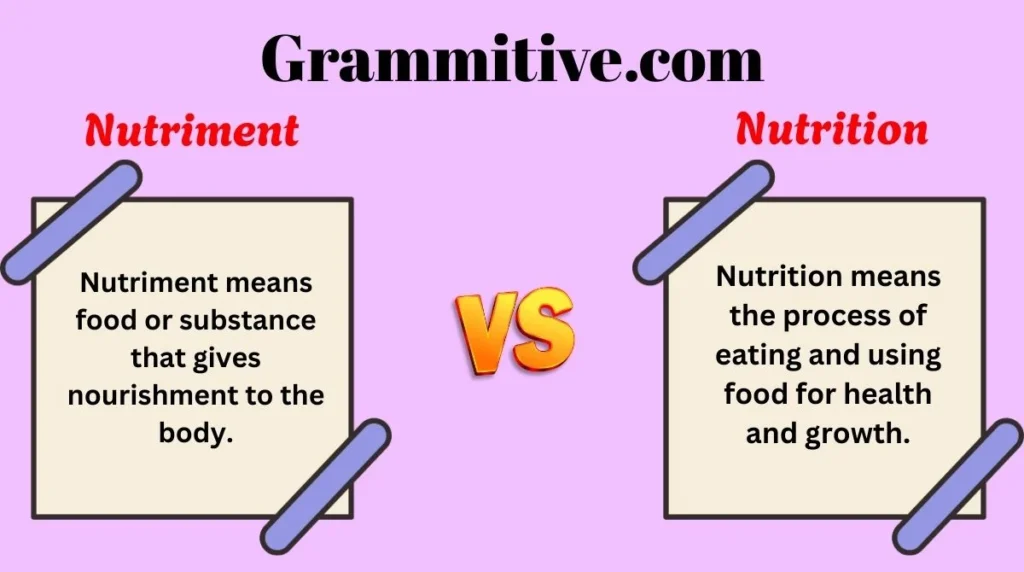
Nutriment means food or substance that gives nourishment to the body.
In very simple words:
👉 something that feeds you or helps you grow.
It refers to the actual material that gives energy or health.
When to use it
Here’s the interesting part.
This word is rare in modern English.
It sounds:
- old-fashioned
- literary
- poetic
- sometimes scientific
You might see it in:
- old books
- formal writing
- historical texts
- poetry
You will almost never hear it in daily speech.
Grammar rule
Nutriment is a noun.
It is usually uncountable, like “food.”
We don’t normally say:
❌ a nutriment
❌ many nutriments
Instead:
✅ nutriment
✅ some nutriment
Example sentences
- Milk provides nutriment for young animals.
- Plants get nutriment from the soil.
- Bread was their only nutriment during winter.
- The baby needed nutriment to grow strong.
- The soup gave warmth and nutriment.
- Roots absorb water and nutriment.
- The body searches for nutriment after long fasting.
Common learner confusion
Many learners think nutriment = nutrition.
But they are not the same.
- nutriment → the food itself
- nutrition → the process or science of nourishment
Also, nutriment sounds very formal and outdated. Using it in normal conversation may sound unnatural.
If you say, “I care about my nutriment,” people may feel confused.
What Does “Nutrition” Mean?
Simple definition
Nutrition means the process of eating and using food for health and growth.
In easier words:
👉 how food affects your body
It focuses on:
- health
- diet
- vitamins
- minerals
- balanced meals
- science of food
When to use it
This word is very common and modern.
People use it every day:
- doctors
- teachers
- parents
- fitness trainers
- students
It’s the normal word you should use 99% of the time.
Grammar rule
Nutrition is an uncountable noun.
We say:
✅ good nutrition
✅ poor nutrition
✅ proper nutrition
We don’t say:
❌ a nutrition
❌ nutritions
Example sentences
- Good nutrition keeps your body strong.
- Children need proper nutrition to grow.
- She studies nutrition at university.
- The doctor talked about healthy nutrition.
- Fast food often lacks nutrition.
- Nutrition plays a big role in immunity.
- This book explains basic nutrition.
- Athletes focus on sports nutrition.
Common learner confusion
Students sometimes say:
❌ “This food gives good nutritionment.”
❌ “Milk is a nutrition.”
These are incorrect.
Remember:
- nutrition = concept/process
- food gives nutrition
- food is NOT nutrition itself
Difference Between Nutriment and Nutrition (Detailed)
This is where things become clear.
Quick comparison table
| Feature | Nutriment | Nutrition |
|---|---|---|
| Meaning | Food substance | Process/science of nourishment |
| Use today | Rare | Very common |
| Style | Old-fashioned/formal | Everyday English |
| Type | Thing/material | Idea/process |
| Common in speech | No | Yes |
| Countable | No | No |
Usage difference
Nutriment talks about the actual substance that feeds you.
Nutrition talks about health and diet in general.
Compare:
- The soup provides nutriment. (the substance)
- The soup provides good nutrition. (health benefit)
Both are correct, but the second sounds natural.
Grammar logic
Think of it like this:
- nutriment → similar to food
- nutrition → similar to health
You don’t say:
❌ I study food (as a science)
You say:
✅ I study nutrition
Sentence structure difference
Nutriment:
- provides nutriment
- gives nutriment
Nutrition:
- improves nutrition
- studies nutrition
- teaches nutrition
Meaning comparison
If you hold an apple:
- The apple = nutriment
- The benefits to your body = nutrition
That’s the simplest way to see it.
Grammar Rules You Must Remember
Rule #1: Both are uncountable
✅ good nutrition
❌ a nutrition
✅ some nutriment
❌ a nutriment
Rule #2: Nutrition is used in modern speech
✅ I care about my nutrition.
❌ I care about my nutriment.
Rule #3: Use nutrition with adjectives about health
✅ balanced nutrition
✅ poor nutrition
✅ sports nutrition
Not:
❌ balanced nutriment
Rule #4: Nutriment appears mostly in formal or old texts
Example:
“The land provided little nutriment for the villagers.”
This sounds literary, not conversational.
Common Mistakes Students Make
Why mistakes happen
Main reasons:
- similar spelling
- same root word
- dictionary confusion
- translation from other languages
Wrong vs correct examples
❌ Vegetables give good nutriment.
✅ Vegetables give good nutrition.
❌ I study nutriment science.
✅ I study nutrition science.
❌ This is healthy nutriment advice.
✅ This is healthy nutrition advice.
Easy correction tips
Ask yourself:
👉 Am I talking about health or diet science?
If yes → use nutrition
In most cases, nutrition is the safe choice.
Easy Trick to Remember the Difference
Here’s a simple classroom trick.
Think about the endings
Nutrition → ends with “-tion”
Words ending in -tion often show:
- action
- process
- condition
Examples:
- education
- digestion
- communication
So:
👉 nutrition = process
Nutriment → ends with “-ment”
Many “-ment” words mean a thing or result:
- equipment
- ingredient
- document
So:
👉 nutriment = thing/material
Process vs thing. Easy.
Daily Life Examples (Very Important)
These are sentences you might actually hear.
- My doctor says I need better nutrition.
- Kids today don’t get enough nutrition.
- She reads books about child nutrition.
- Good nutrition helps you sleep better.
- The school teaches basic nutrition.
- Athletes care a lot about nutrition plans.
- Poor nutrition can make you tired.
- This app tracks your daily nutrition.
- Nutrition is more important than dieting.
- I changed my meals to improve my nutrition.
Notice something?
Nobody uses “nutriment” here. That’s real life English.
Practice Section
Choose the correct word: nutriment or nutrition
- Good ______ is important for babies.
- The soil provides ______ to plants.
- She studies sports ______.
- This meal lacks proper ______.
- Roots absorb water and ______.
Answers
- nutrition
- nutriment
- nutrition
- nutrition
- nutriment
FAQs
1. What is the difference between nutriment and nutrition?
Nutriment means the food or substance itself. Nutrition means the process or science of how food helps the body. Nutrition is much more common in everyday English.
2. Can we use nutriment in daily conversation?
Technically yes, but it sounds old-fashioned. Native speakers rarely use it. It’s better to choose nutrition or simply food.
3. Is nutrition formal or informal?
It works in both. You can use it in daily speech, school, hospitals, and academic writing. It’s a normal modern word.
4. Is nutriment countable?
No. It is uncountable. We don’t say “a nutriment” or “nutriments.”
5. Which word should students use in exams?
Use nutrition unless the question is about old literature or very formal science writing. Nutrition is almost always correct.
6. Are nutriment and nutrient the same?
No. Nutrient means a specific substance like protein or vitamin. Nutriment is a general old word for nourishment. Nutrient is much more common today.
Final Conclusion
English has many pairs of words that look similar but behave differently. Nutriment and nutrition are one of those tricky pairs.
The simple truth makes life easier: nutrition is the word you will use most of the time. It talks about health, diet, and how food helps the body. It sounds natural and modern.
Nutriment, on the other hand, feels old and literary. You might see it in classic books or scientific writing, but rarely in everyday speech.
When you speak or write, choose the word that sounds normal to native speakers. That’s how your English becomes smooth and confident.
Read labels, listen to doctors, watch health videos. You’ll notice one thing again and again — nutrition everywhere.
Practice a few sentences each day, and soon this confusion will completely disappear.

I am Lucas Bennett, a digital content creator passionate about social media trends and online growth strategies.
I share practical insights and guides to help users better understand and navigate the digital world.