

English has many word pairs that look simple but still confuse learners. One common example is “not able” and “unable.”
At first glance, they seem exactly the same. Both talk about something you cannot do. Both describe lack of ability. Both appear in similar sentences. So naturally, many students ask:
“Are they the same?”
“Can I use either one?”
“Which sounds more natural?”
If you have ever stopped in the middle of a sentence thinking, Should I say not able… or unable…?, you are not alone.
Even advanced learners sometimes mix them up because the difference is small but important. One sounds more formal. One sounds more everyday. One fits better in conversation. The other often appears in writing.
These tiny details matter a lot in real English. They affect how polite, natural, or professional you sound.
By the time you finish reading, you will clearly understand:
- The meaning of both expressions
- When to use each one
- Grammar rules
- Real-life examples
- Common mistakes
- An easy trick to remember the difference
Everything will be explained in simple English, step by step, just like a friendly teacher in class.
What Does “Not Able” Mean?
Simple definition
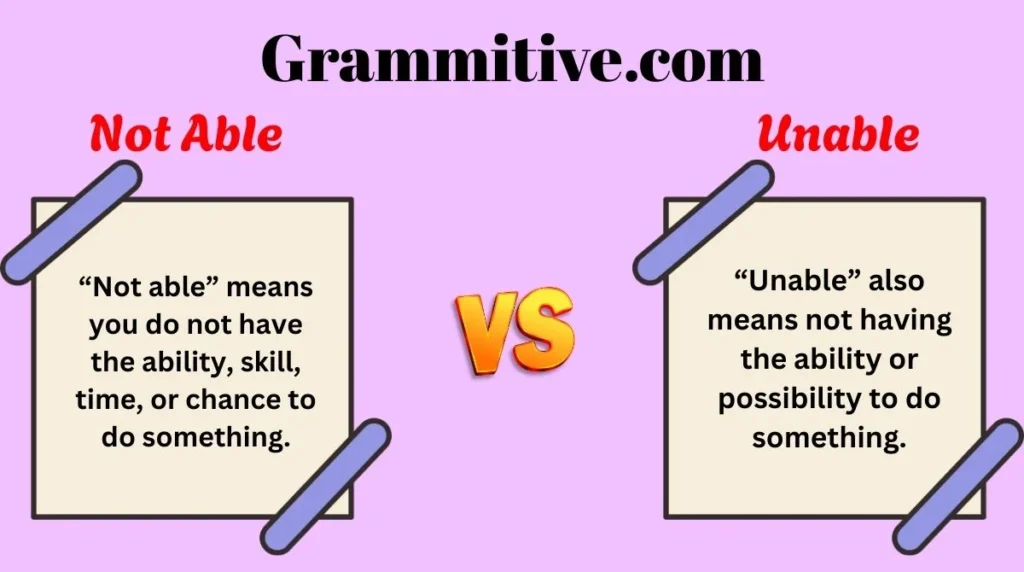
“Not able” means you do not have the ability, skill, time, or chance to do something.
It is simply the negative form of able.
- able = can do
- not able = cannot do
Very straightforward.
When to use it
“Not able” is common in:
- everyday speech
- casual conversations
- simple explanations
- situations that feel temporary
It often sounds more relaxed and natural in spoken English.
Grammar rule
Structure:
Subject + be + not able + to + verb
Examples:
- I am not able to come.
- She is not able to drive.
- They were not able to finish.
Notice that we always use to + base verb.
Example sentences (6–8)
- I am not able to sleep tonight.
- She is not able to answer the phone right now.
- We were not able to find the shop.
- He is not able to lift that box.
- They are not able to join the meeting.
- I’m not able to understand this question.
- The child was not able to tie his shoes.
- Sorry, I’m not able to help today.
Common learner confusion
Many learners think “not able” sounds weak or incorrect. That is not true. It is perfectly correct English.
In fact, native speakers use it a lot in daily life:
- “I’m not able to talk now.”
- “We’re not able to go.”
It sounds friendly and natural.
What Does “Unable” Mean?
Simple definition
“Unable” also means not having the ability or possibility to do something.
It has the same basic meaning as “not able.”
But the feeling and style are different.
When to use it
“Unable” is common in:
- formal writing
- emails
- business English
- announcements
- official situations
It sounds more serious or professional.
Grammar rule
Structure:
Subject + be + unable + to + verb
Same pattern as “not able.”
Examples:
- I am unable to attend.
- She was unable to speak.
Example sentences (6–8)
- I am unable to attend the meeting.
- She was unable to contact her manager.
- We were unable to solve the problem.
- He is unable to walk after the accident.
- They were unable to reach the airport on time.
- The system is unable to process your request.
- I am unable to access my account.
- The doctor was unable to save the patient.
Common learner confusion
Students often use “unable” in everyday talking, like:
❌ “I’m unable to go to the party.”
This is correct grammar, but it sounds too formal or stiff in casual speech.
Native speakers usually say:
✔ “I can’t go.”
✔ “I’m not able to go.”
“Unable” feels more serious or official.
Difference Between Not Able and Unable (Detailed)
Both expressions mean almost the same thing, but their tone and usage are different.
Comparison table
| Feature | Not able | Unable |
|---|---|---|
| Meaning | Cannot do | Cannot do |
| Formality | Casual / everyday | Formal / professional |
| Common in speech | Yes | Less common |
| Common in writing | Sometimes | Very common |
| Tone | Friendly | Serious |
| Feeling | Temporary | Often more serious or final |
Usage difference
Use not able when:
- talking with friends
- everyday situations
- informal speech
Use unable when:
- writing emails
- business settings
- official notices
- formal documents
Grammar logic
“Not able” = negative phrase
“Unable” = one negative adjective
So:
- not + able
- un + able
They mean the same, but “unable” feels more compact and formal.
Sentence structure difference
Both use:
be + (not able / unable) + to + verb
So grammar is the same. Only style changes.
Meaning comparison
Compare:
- I’m not able to come today. (normal, friendly)
- I am unable to attend today. (formal, serious)
Same meaning. Different tone.
Grammar Rules You Must Remember
Rule #1: Always use “to + verb”
✔ I am unable to attend
❌ I am unable attend
✔ She is not able to swim
❌ She is not able swim
Rule #2: Use “not able” more in conversation
✔ I’m not able to call you now.
Sounds natural.
“Unable” may sound too stiff here.
Rule #3: Use “unable” for formal writing
✔ We are unable to process your request.
Perfect for business emails or notices.
Rule #4: Don’t use double negatives
❌ I am not unable to go
This means something different and sounds confusing.
Say:
✔ I am able to go
or
✔ I am not able to go
Common Mistakes Students Make
Why mistakes happen
Because both expressions mean the same, learners think they are always interchangeable. But tone matters.
Mistake 1: Using “unable” in casual chat
❌ I am unable to hang out tonight.
✔ I’m not able to hang out tonight.
Tip: Speak simple in daily life.
Mistake 2: Forgetting “to”
❌ She is unable finish
✔ She is unable to finish
Tip: Always remember to + verb.
Mistake 3: Overusing “not able”
In formal writing:
❌ We are not able to accept your application.
✔ We are unable to accept your application.
Tip: Formal = “unable.”
Mistake 4: Confusing meaning
Some students think:
- unable = impossible forever
- not able = temporary
This is not always true. Both can be temporary or permanent.
Easy Trick to Remember the Difference
Here’s a simple memory trick students love.
Think like this:
“Un = uniform = formal”
The prefix un- appears in many formal words:
- unable
- unavailable
- unacceptable
These often appear in professional English.
So:
👉 If the situation feels official → use “unable”
👉 If talking normally → use “not able”
Another easy idea:
Say the sentence out loud.
If “unable” sounds too serious, switch to “not able.”
Your ears will guide you.
Daily Life Examples (Very Important)
These sentences sound exactly like real conversations.
- Sorry, I’m not able to come today.
- I’m not able to find my keys.
- She’s not able to talk right now.
- We’re not able to meet this weekend.
- I’m unable to attend the interview due to illness.
- The company is unable to deliver your order today.
- He was unable to log in to his account.
- I’m not able to hear you clearly.
- They were unable to solve the technical issue.
- I’m not able to stay late tonight.
Notice how casual ones use “not able,” while serious ones use “unable.”
Practice Section
Choose the correct option.
1
I am ______ to open the file.
a) not able
b) unable
2
Sorry, I’m ______ to talk right now.
a) unable
b) not able
3
The system is ______ to process your payment.
a) not able
b) unable
4
We were ______ to find the address.
a) not able
b) unable
5
I’m ______ to join the party tonight.
a) unable
b) not able
Answers
1 → b
2 → b
3 → b
4 → either (both correct)
5 → b
FAQs
1. What is the difference between not able and unable?
Both mean “cannot do something.” The difference is tone. “Not able” sounds casual and everyday. “Unable” sounds formal or professional.
2. Can we use unable in questions?
Yes. For example:
“Are you unable to access the system?”
But in daily speech, people usually say “Can’t you access it?”
3. Is unable formal or informal?
It is mostly formal. You often see it in emails, reports, and official messages.
4. Which is more common in speaking?
“Not able” or simply “can’t” is much more common in speaking.
5. Are they grammatically interchangeable?
Yes, grammar is the same. But the style and feeling change.
6. Should beginners avoid unable?
Not avoid, but use it mainly for formal writing. For everyday English, “not able” is easier and more natural.
Final Conclusion
Small grammar choices can change how natural your English sounds. “Not able” and “unable” are a perfect example. They share the same meaning, but their tone is different.
Use not able for daily life, friendly talk, and relaxed speech.
Use unable for formal writing, business English, and professional situations.
Once you understand this difference, your sentences will feel smoother and more native-like.
Try listening to how people speak around you. Notice which form they use. Practice both in your own sentences. Soon, you won’t even have to think about it. You’ll choose the right one automatically.
English gets easier when you learn these small details one step at a time.
Keep practicing. You’re doing great.

I am Lucas Bennett, a digital content creator passionate about social media trends and online growth strategies.
I share practical insights and guides to help users better understand and navigate the digital world.