
Small English words often cause big confusion. Words like yes, no, yeah, nope, and nah look simple, but they do not always mean the same thing.
Many English learners think “no” and “nope” are exactly equal, so they use them anywhere. Later, they hear a native speaker say, “Nope!” in a funny or casual way and start wondering, Wait… is that correct English? Is it rude? Is it slang? Can I use it in exams or emails?
This confusion is normal.
Both words express refusal or negation, but they live in different situations and tones. One is standard and neutral.
The other is relaxed and informal. Using the wrong one can make your speech sound too cold, too casual, or even childish in serious situations.
Imagine saying “Nope” in a job interview. Or saying “No” to a close friend when they expect something friendly. It feels a bit strange, right?
Understanding this difference helps you sound more natural, polite, and confident in everyday English. After reading this guide, you will clearly know:
- what each word means
- when to use each one
- grammar rules
- common mistakes
- easy memory tricks
- real-life examples
By the end, choosing between them will feel automatic.
What Does “No” Mean?
Simple definition
“No” means not, negative, or the opposite of yes.
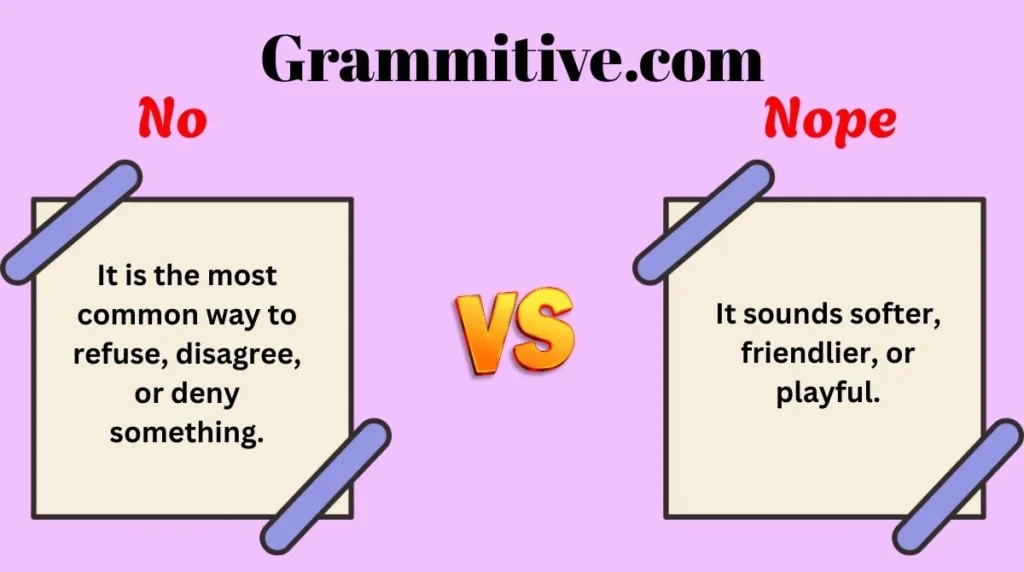
It is the most common way to refuse, disagree, or deny something.
It is a standard English word, used in both speaking and writing.
When to use it
Use no when:
- answering questions
- saying something is not allowed
- refusing politely
- writing formally (emails, exams, business)
- speaking seriously or clearly
It works in all situations — formal, informal, spoken, written.
Grammar rule
“No” can be:
- An answer word
→ “Do you like coffee?” – “No.” - A determiner before a noun
→ “I have no money.” - Part of negative expressions
→ “No problem.” / “No idea.”
Example sentences (6–8)
- No, I don’t understand the question.
- She said no to the job offer.
- There is no milk in the fridge.
- No one called me yesterday.
- No problem, I can help you.
- He has no time today.
- “Are you ready?” – “No, not yet.”
- No dogs are allowed here.
Common learner confusion
Many students think “no” sounds too direct or rude. But actually, it is neutral. Tone matters more than the word itself.
Compare:
- No. ❌ (cold tone)
- No, sorry. ✅ (polite)
- No, thank you. ✅ (friendly)
So the problem is not the word. It is how you say it.
What Does “Nope” Mean?
Simple definition
“Nope” also means no, but it is informal and casual.
It sounds softer, friendlier, or playful.
Think of it as a relaxed version of “no”.
When to use it
Use nope when:
- talking to friends or family
- texting or chatting online
- joking
- casual conversations
- speaking in a light, friendly way
Avoid it in:
- exams
- business emails
- formal presentations
- interviews
- serious situations
Grammar rule
“Nope” is only used as a short spoken answer.
It does NOT work:
- before nouns
- inside formal sentences
- in writing tasks
So you cannot say:
❌ “I have nope money.”
❌ “Nope students came.”
It only works alone or as a reply.
Example sentences (6–8)
- “Are you tired?” – “Nope!”
- “Did you finish?” – “Nope, not yet.”
- “Want pizza?” – “Nope, I’m full.”
- “Is this yours?” – “Nope.”
- “Ready to leave?” – “Nope!”
- “Did he call?” – “Nope, nothing.”
- “Do you like horror movies?” – “Nope, they scare me.”
- “Is the shop open?” – “Nope, it’s closed.”
Common learner confusion
Some learners think “nope” sounds childish or incorrect. But native speakers use it every day. It is just informal.
Think of it like:
- yes → yeah
- no → nope
Same meaning. Different tone.
Difference Between No and Nope (Detailed)
Understanding the difference is mostly about tone, formality, and grammar, not meaning.
Quick comparison table
| Feature | No | Nope |
|---|---|---|
| Meaning | Negative answer | Negative answer |
| Formality | Neutral/formal | Informal/casual |
| Used in writing | Yes | Rarely |
| Used in exams | Yes | No |
| Used before nouns | Yes | No |
| Friendly tone | Neutral | Softer/playful |
| Grammar role | Many | Only short reply |
Usage difference
No works everywhere.
Nope works mainly in relaxed speech.
Example:
Formal:
- No, I cannot attend the meeting.
Casual:
- Nope, can’t come today.
Grammar logic
“No” is a real grammar word. It can change sentence structure:
- no money
- no time
- no people
But “nope” is just a sound-like reply. It does not change grammar.
Sentence structure difference
Correct:
- No cars are allowed.
- No students failed.
Wrong:
- Nope cars are allowed.
- Nope students failed.
“Nope” cannot be used inside the sentence.
Meaning comparison
Both mean the same thing.
But feelings are different.
- No → clear, direct, serious
- Nope → relaxed, friendly, sometimes playful
Imagine a smile when saying “nope”.
Grammar Rules You Must Remember
Rule #1: Use “no” in formal writing
Example:
✔ No, I will not accept the offer.
❌ Nope, I will not accept the offer.
Rule #2: Only “no” can come before nouns
Example:
✔ I have no idea.
❌ I have nope idea.
Rule #3: “Nope” is only a reply
Example:
✔ “Did you call him?” – “Nope.”
❌ Nope, I didn’t called him. (grammar problem)
Rule #4: Tone matters
Example:
“No.” (cold)
“No, thank you.” (polite)
“Nope!” (friendly)
Choose based on situation.
Common Mistakes Students Make
Why mistakes happen
Students often:
- translate directly from their language
- copy movies or YouTube speech
- don’t know formal vs informal differences
So they use “nope” everywhere.
Wrong vs correct examples
❌ Nope sir, I disagree.
✔ No, sir, I disagree.
❌ I have nope money.
✔ I have no money.
❌ Nope students came today.
✔ No students came today.
❌ Teacher: “Did you do homework?” Student: “Nope.” (too casual)
✔ “No, I didn’t.”
Easy correction tips
Ask yourself:
- Is this formal? → use “no”
- Is this friendly chat? → “nope” is fine
That simple question saves many mistakes.
Easy Trick to Remember the Difference
Here’s a simple memory trick.
Think:
“Nope has extra letters, so it’s extra relaxed.”
Short and serious → no
Long and relaxed → nope
Another trick:
Imagine talking to your boss.
Would you say “nope” to your boss?
Probably not.
So remember:
Boss = no
Best friend = nope
Easy and practical.
Daily Life Examples (Very Important)
These examples show how native speakers really talk.
- Friend: “Want some coffee?”
You: “Nope, I’m good.” - Mom: “Did you clean your room?”
Kid: “Nope!” - Teacher: “Is the answer 25?”
Student: “No, it’s 35.” - Coworker: “Are you free at 3 PM?”
You: “No, I have a meeting.” - Friend: “Scared of spiders?”
You: “Nope, not at all.” - Hotel staff: “Smoking allowed?”
Staff: “No, it isn’t.” - Brother: “Did you eat my cake?”
You: “Nope! Not me!” - Interviewer: “Do you have experience?”
You: “No, but I am willing to learn.” - Friend texting: “Coming tonight?”
Reply: “Nope, busy.” - Shopkeeper: “Card or cash?”
You: “No, I’ll pay online.”
Notice how serious situations use “no” and friendly talk uses “nope.”
Practice Section
Choose the correct option: no / nope
- “Do you want tea?” – _____, thanks.
- There is _____ sugar left.
- “Finished your homework?” – _____!
- _____ students were late today.
- “Is this your pen?” – _____.
Answers
- No
- no
- Nope
- No
- Nope
FAQs
1. What is the difference between no and nope?
Both mean the same thing, but “no” is standard and works in all situations. “Nope” is informal and mainly used in casual speech with friends.
2. Can we use nope in questions or sentences?
No. “Nope” is only used as a short reply. It cannot come before nouns or inside normal sentence grammar.
3. Is nope formal or informal?
It is informal. Use it in conversations, texting, or relaxed settings. Avoid it in business or academic writing.
4. Is saying no rude?
Not at all. “No” is neutral. Your tone and extra words like “sorry” or “thank you” make it polite.
5. Do native speakers use nope often?
Yes. Native speakers use it a lot in everyday speech. It sounds natural and friendly among friends and family.
6. Can I use nope in exams?
No. Always use “no” in exams or formal writing tasks. “Nope” may be marked incorrect.
Final Conclusion
Small words carry big meaning in English. “No” and “nope” look almost identical, yet they send slightly different messages. One is clean, clear, and professional.
The other is relaxed, warm, and casual. Knowing when to use each one helps you sound more natural and confident.
If you remember only one thing, remember this: use “no” everywhere, and save “nope” for friendly conversations.
Listen to how native speakers talk. Practice with daily situations. Try using “nope” with friends and “no” in formal places. Soon, the difference will feel natural, not confusing.
Language is not only grammar. It is also feeling and tone. Once you learn that, your English becomes alive.
Keep practicing. Small changes like this make a big difference.

I am Lucas Bennett, a digital content creator passionate about social media trends and online growth strategies.
I share practical insights and guides to help users better understand and navigate the digital world.