
Small grammar mistakes can change how professional or natural your English sounds. One tiny word can make a sentence feel wrong, even if the meaning is clear. A common example is choosing between “no longer exist” and “no longer exists.”
Many English learners pause here.
Should you add -s or not?
Why does one sound correct and the other sound strange?
The confusion usually comes from subject–verb agreement. English verbs change depending on the subject. But when phrases like “no longer” appear, learners often forget to check the subject carefully.
This topic matters more than you may think. You will hear and read it everywhere:
- This shop no longer exists.
- Dinosaurs no longer exist.
- My old email account no longer exists.
If you choose the wrong form, your sentence still makes sense, but it sounds unnatural to native speakers.
By the end of this guide, you will clearly understand:
- When to use exist
- When to use exists
- How grammar rules control both forms
- Easy tricks to remember the difference
- Real-life examples you can use every day
Everything is explained in simple, friendly English—just like a classroom lesson.
What Does “No Longer Exist” Mean?
Simple meaning
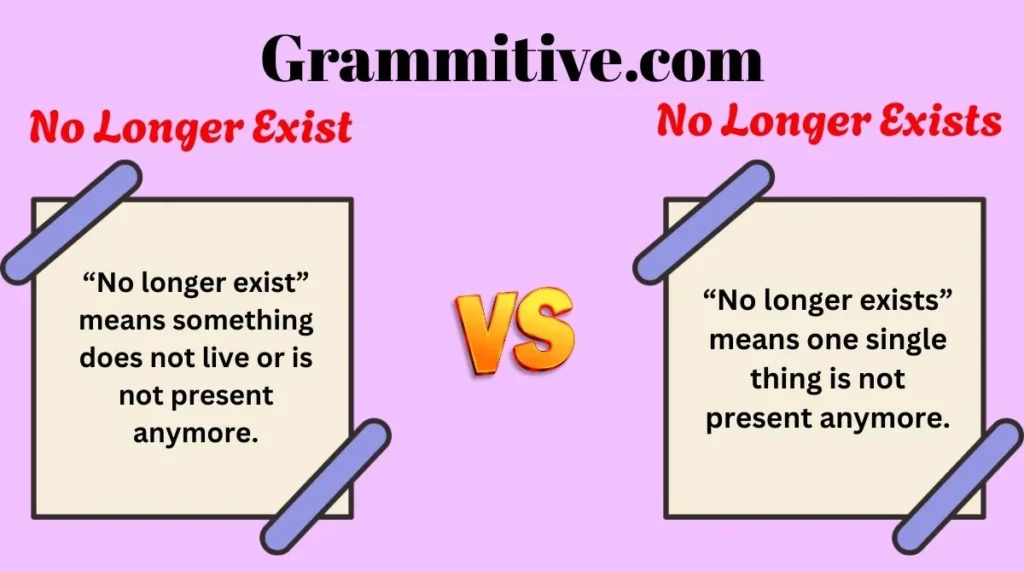
“No longer exist” means something does not live or is not present anymore.
It talks about things that used to be real or available, but are gone now.
When do we use it?
We use exist (without -s) when:
- The subject is plural (two or more things)
- The subject is I, you, we, they
Grammar rule
Use exist with:
- plural nouns
- I / you / we / they
This follows the normal present simple rule.
Examples
- Dinosaurs no longer exist.
- These shops no longer exist.
- Old traditions no longer exist in this town.
- My old files no longer exist.
- Many problems no longer exist.
- We no longer exist as a team.
- Those buildings no longer exist.
- Printed maps no longer exist in many schools.
Common learner confusion
Students sometimes think:
“No longer” changes the verb.
But it doesn’t.
“No longer” is only a time phrase. It does not change grammar.
So the verb still follows the subject.
Wrong thinking:
❌ Dinosaurs no longer exists
Correct thinking:
Plural subject → exist
✔ Dinosaurs no longer exist
What Does “No Longer Exists” Mean?
Simple meaning
“No longer exists” means one single thing is not present anymore.
It talks about one person, place, or object that has disappeared or ended.
When do we use it?
We use exists (with -s) when:
- The subject is singular
- He / she / it
- one thing only
Grammar rule
In the present simple tense, third-person singular verbs add -s.
So:
- It exists
- The company exists
- The rule exists
And with the phrase:
- no longer exists
Examples
- The company no longer exists.
- My school no longer exists.
- The website no longer exists.
- That rule no longer exists.
- The bank account no longer exists.
- My childhood home no longer exists.
- The old bridge no longer exists.
- The problem no longer exists.
Common learner confusion
Some learners forget the -s because “no longer” comes between.
They write:
❌ The shop no longer exist
But the subject is singular.
So we must say:
✔ The shop no longer exists
Always look at the subject, not the words in the middle.
Difference Between Exist and Exists (Detailed)
Understanding the difference is very simple once you focus on the subject.
Quick comparison table
| Feature | Exist | Exists |
|---|---|---|
| Subject type | Plural / I / you / we / they | Singular (he/she/it/one thing) |
| Verb form | base form | + s |
| Example | Cars no longer exist | The car no longer exists |
| Sound | shorter | ends with “z” sound |
| Grammar tense | Present simple | Present simple |
Usage difference
- exist → many things
- exists → one thing
Think: How many?
If the answer is one, use exists.
If the answer is more than one, use exist.
Grammar logic
English verbs change for third-person singular.
Add -s:
- run → runs
- live → lives
- work → works
- exist → exists
So this is not special grammar. It’s just the normal rule.
Sentence structure difference
Singular:
The museum no longer exists.
Plural:
The museums no longer exist.
The only change is the -s.
Meaning comparison
Meaning stays the same.
Only the number changes.
- One thing gone → exists
- Many things gone → exist
That’s it.
Grammar Rules You Must Remember
Rule #1: Singular subject → exists
If there is only one thing, add -s.
Example:
The park no longer exists.
Rule #2: Plural subject → exist
More than one thing? No -s.
Example:
The parks no longer exist.
Rule #3: “No longer” does NOT affect grammar
It only shows time.
Example:
She no longer works here.
NOT
❌ She no longer work here
Rule #4: Check the real subject, not the last word
Sometimes the sentence is longer.
Example:
The list of old businesses no longer exists.
Here the subject is list (singular), not businesses.
So we use exists.
Common Mistakes Students Make
Why mistakes happen
Most mistakes happen because:
- learners forget subject–verb agreement
- long sentences hide the subject
- “no longer” distracts attention
Wrong vs Correct examples
❌ The company no longer exist
✔ The company no longer exists
❌ These apps no longer exists
✔ These apps no longer exist
❌ My friends no longer exists here
✔ My friends no longer exist here
❌ The old rule no longer exist
✔ The old rule no longer exists
Easy correction tips
Before writing, ask:
- What is the subject?
- Is it one or many?
Then choose the verb.
Easy Trick to Remember the Difference
Here’s a simple memory trick students love.
The “S for Single” trick
- S in exists = Single
- No S in exist = Many
So:
One thing → exists
Many things → exist
Very easy.
You can even say in your head:
“Single needs S.”
It works every time.
Daily Life Examples (Very Important)
These are sentences people really say in daily conversation.
- That café no longer exists.
- Old phone booths no longer exist.
- My email account no longer exists.
- Those rules no longer exist.
- The store near my house no longer exists.
- Many newspapers no longer exist.
- This password no longer exists.
- Some traditions no longer exist today.
- My childhood playground no longer exists.
- DVD rental shops no longer exist anymore.
Notice how natural they sound.
You will hear this structure a lot when talking about the past.
Practice Section
Choose exist or exists.
- The castle no longer ______.
- These files no longer ______.
- My old school no longer ______.
- Many problems no longer ______.
- The company no longer ______.
Answers
- exists
- exist
- exists
- exist
- exists
FAQs
1. What is the difference between “no longer exist” and “no longer exists”?
The difference depends on the subject.
Plural subjects use exist.
Singular subjects use exists.
The meaning is the same.
2. Can we use these forms in questions?
Yes.
Example:
Does the company still exist?
Do those buildings still exist?
Use normal question grammar.
3. Is this grammar formal or informal?
Both.
It is standard English used in speaking, writing, news, and books.
You can use it anywhere.
4. Does “no longer” always go before the verb?
Usually yes.
We say:
She no longer lives here.
They no longer exist.
It sounds most natural there.
5. Can I say “doesn’t exist anymore” instead?
Yes.
Both are correct.
“No longer exists” sounds slightly more formal.
“Doesn’t exist anymore” sounds casual.
6. Why do we add -s only sometimes?
Because English present simple verbs change for third-person singular.
He works, she runs, it exists.
It’s a normal grammar rule.
Final Conclusion
Tiny grammar choices can make a big difference in how smooth your English sounds.
The difference between exist and exists is not difficult once you slow down and check the subject. Many learners feel confused because the phrase “no longer” sits in the middle and hides the verb.
But remember, it doesn’t change the grammar at all.
If the subject is singular, add -s.
If it’s plural, don’t.
That’s the whole secret.
Keep practicing with real-life sentences. Listen to how native speakers use these forms in conversations, movies, and news. The more you notice them, the more natural they will feel.
Small habits like this slowly build strong, confident English.
And soon, choosing the correct form will feel automatic.

I am Lucas Bennett, a digital content creator passionate about social media trends and online growth strategies.
I share practical insights and guides to help users better understand and navigate the digital world.